Eloralintide vs Cagrilintide: How Lilly’s and Novo’s Amylin Drugs Compare (2026)
Research use only. This comparison is education, not medical advice. Neither eloralintide nor cagrilintide is approved as a standalone drug, and nothing here is a dosing recommendation or an instruction for self-administration. Peptryn gives none. Trial figures describe what each company’s studies reported under medical supervision.
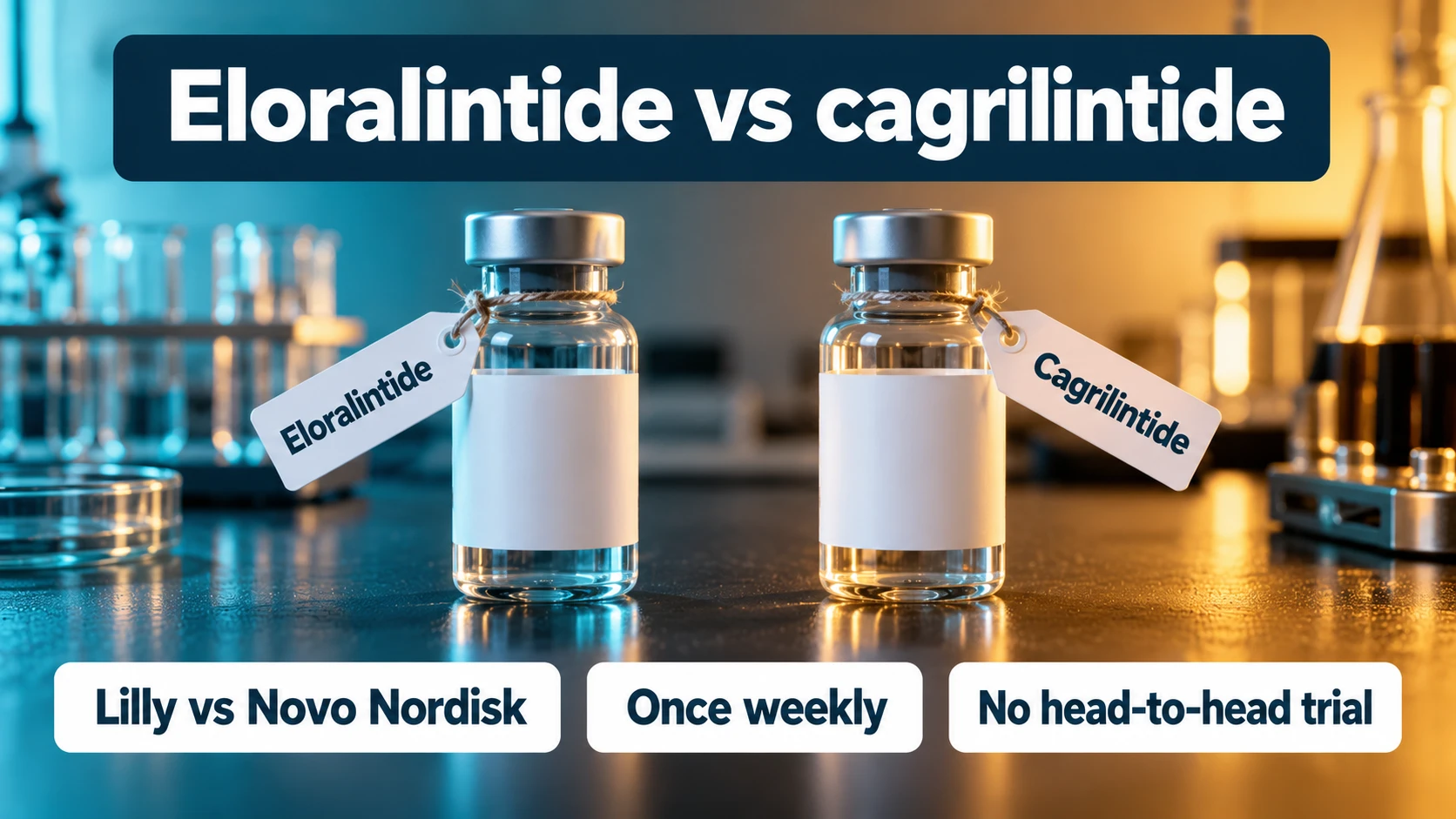
Short answer: Eloralintide (Eli Lilly) and cagrilintide (Novo Nordisk) are both long-acting, once-weekly amylin analogues carrying a fatty-acid chain, and both are being tested for obesity. Eloralintide is designed to favour the AMY1 receptor and lasts about 13 to 15 days in the body. Cagrilintide activates several amylin receptors plus the calcitonin receptor and lasts about 7 days. In separate trials, eloralintide reached about -20% weight change at 48 weeks (phase 2, on-treatment analysis) and cagrilintide about -12% at 68 weeks (phase 3 monotherapy arm). No trial has compared them head to head, so neither can be called better.
Key takeaways
- The two molecules share a design idea (lipidated amylin analogue) and differ in receptor targeting, half-life and company strategy.
- Cagrilintide’s lead product is CagriSema (cagrilintide plus semaglutide), under FDA review since December 2025. Eloralintide’s lead path is single-agent phase 3 plus EloraTZP (with tirzepatide).
- The efficacy numbers come from different trials with different durations, populations and analysis methods. A fair reading is “same ballpark, unproven which is better”.
- In rats, eloralintide caused less taste avoidance than cagrilintide, a hint of better tolerability. Human phase 2 data show wide variation in nausea by arm, and no human comparison exists.
- A 2026 network meta-analysis ranked high-dose eloralintide (-18.0% versus placebo) just above high-dose CagriSema (-17.2%), and its authors call the result preliminary and low-certainty.
Last verified October 15, 2026. Sources are listed at the end. For laboratory and research use only. Nothing here is medical or legal advice.
Contents
- Eloralintide vs cagrilintide at a glance
- How the two molecules are built
- The receptor difference: selective versus dual
- What the human trials show
- How the trials were designed
- Tolerability: what we know and what we do not
- The combination strategy: EloraTZP and CagriSema
- How the rest of the amylin field looks
- A short history of the amylin class
- Approval status of each
- Which one is better?
- How this ties to research materials
- Common questions
Eloralintide vs cagrilintide at a glance
| Eloralintide | Cagrilintide | |
|---|---|---|
| Developer | Eli Lilly | Novo Nordisk |
| Code name | LY3841136 | AM833 |
| Class | Selective amylin receptor agonist (SARA) | Dual amylin and calcitonin receptor agonist (DACRA) |
| Structure | 37-amino-acid analogue, C20 fatty diacid on lysine 26, thioacetal bridge | 37-amino-acid pramlintide-related backbone, three substitutions, C20 fatty diacid |
| Formula | C201H319N49O65S2 | C194H312N54O59S2 |
| Molecular weight | About 4,526 Da | About 4,409 Da |
| Half-life | About 13 to 15 days (310 to 366 hours) | About 7 days (159 to 195 hours) |
| Best reported result | About -20% at 48 weeks (phase 2, 9 mg arms, on-treatment) | About -12% at 68 weeks (phase 3, 2.4 mg) |
| Largest trial of the single agent | 263 adults (phase 2) | 302 adults on cagrilintide in REDEFINE 1 (phase 3 arm) |
| Combination partner in late-stage work | Tirzepatide (EloraTZP) | Semaglutide (CagriSema) |
| Regulatory status | Phase 3 (ENLIGHTEN). No filing found | CagriSema NDA filed December 2025. No standalone filing |
How the two molecules are built
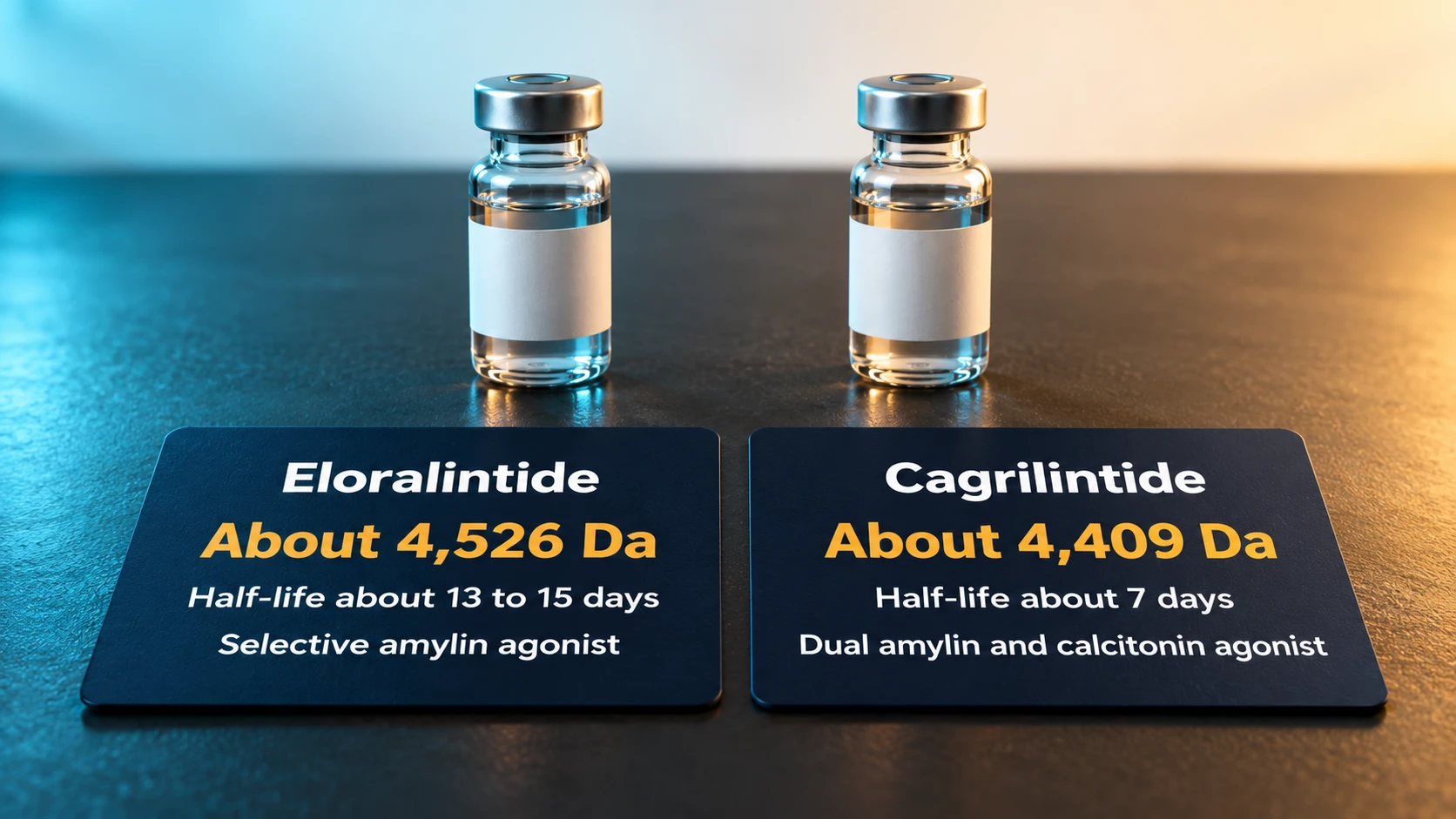
Both drugs start from human amylin and fix its two problems: it clumps, and it is cleared quickly. Both attach a 20-carbon fatty diacid so the peptide binds albumin in the blood and lasts days instead of minutes. The shared strategy is the same one that gave semaglutide its weekly schedule.
Cagrilintide is built on a 37-amino-acid backbone related to pramlintide, which was itself a modified version of human amylin. It carries three amino-acid substitutions (N14E, V17R and P37Y) and a C20 diacid attached through a gamma-glutamic acid linker, according to the original medicinal chemistry paper (Kruse and colleagues, Journal of Medicinal Chemistry, 2021). That paper reports a half-life near 180 hours.
Eloralintide is also a 37-amino-acid analogue, but with a different set of edits. Three non-coded amino acids sit at positions 11, 15 and 22, and a methylene thioacetal bridge replaces the native disulfide bond. The C20 diacid is attached through a linker to lysine 26 (Briere and colleagues, Molecular Metabolism, 2025). Its half-life is about twice cagrilintide’s: 310 to 366 hours after a single dose, against 159 to 195 hours reported for cagrilintide in the same paper.
A longer half-life changes two things in principle. The drug may hold a steadier level between weekly injections, and it may permit longer dosing intervals. The first has shown up in the pharmacokinetics (a steady-state peak-to-trough ratio of 1.28 to 1.38 for eloralintide). The second has not been tested in people.
The receptor difference: selective versus dual
An amylin receptor is the calcitonin receptor (CTR) paired with a helper protein, giving AMY1R, AMY2R or AMY3R. The CTR on its own is the calcitonin receptor.
- Cagrilintide is a DACRA. It activates AMY1R, AMY2R and AMY3R and also the CTR.
- Eloralintide is called a SARA. In human cell assays it was most potent at AMY1R (23.9 picomolar), about 12 times weaker at the CTR (291.0) and about 11 times weaker at AMY3R (253.8).
Why does that matter? Nobody has proven it does in people. The design hope is that sparing the CTR reduces effects that look like calcitonin signaling, and that favouring AMY1R keeps the appetite effect. The developers of eloralintide say so in the discovery paper. The counter-argument is that cagrilintide’s broader profile may contribute to its effect, and the clinical data are too sparse to settle it.
What the rat studies showed
The discovery paper compared the two molecules directly in rats, which is the only head-to-head data that exists.
| Test in rats | Eloralintide | Cagrilintide | Reading |
|---|---|---|---|
| Conditioned taste avoidance, ED50 | 8.9 nmol/kg | 4.2 nmol/kg | Less avoidance with eloralintide |
| Lean rats, 96-hour food intake, ED50 | 3.7 nmol/kg | 8.5 nmol/kg | Eloralintide more potent (significant) |
| Lean rats, body weight at day 4, 300 nmol/kg | -14.9% | -14.5% | Same |
| Diet-induced obese rats, day 15, 100 nmol/kg | -11.1% | -13.3% | Cagrilintide slightly larger |
| Share of weight change that was fat | 86% to 91% (low and middle dose) | 63% (100 nmol/kg) | More fat-selective with eloralintide |
| Lean mass loss | Lower (p=0.0101) | Higher | Favours eloralintide |
The pattern is similar weight effect, less taste aversion and less lean-mass loss with eloralintide. It is animal data from the developer of eloralintide, and rat taste avoidance is a rough stand-in for nausea. Treat it as a reason the molecule was advanced and not as a human result.
What the human trials show
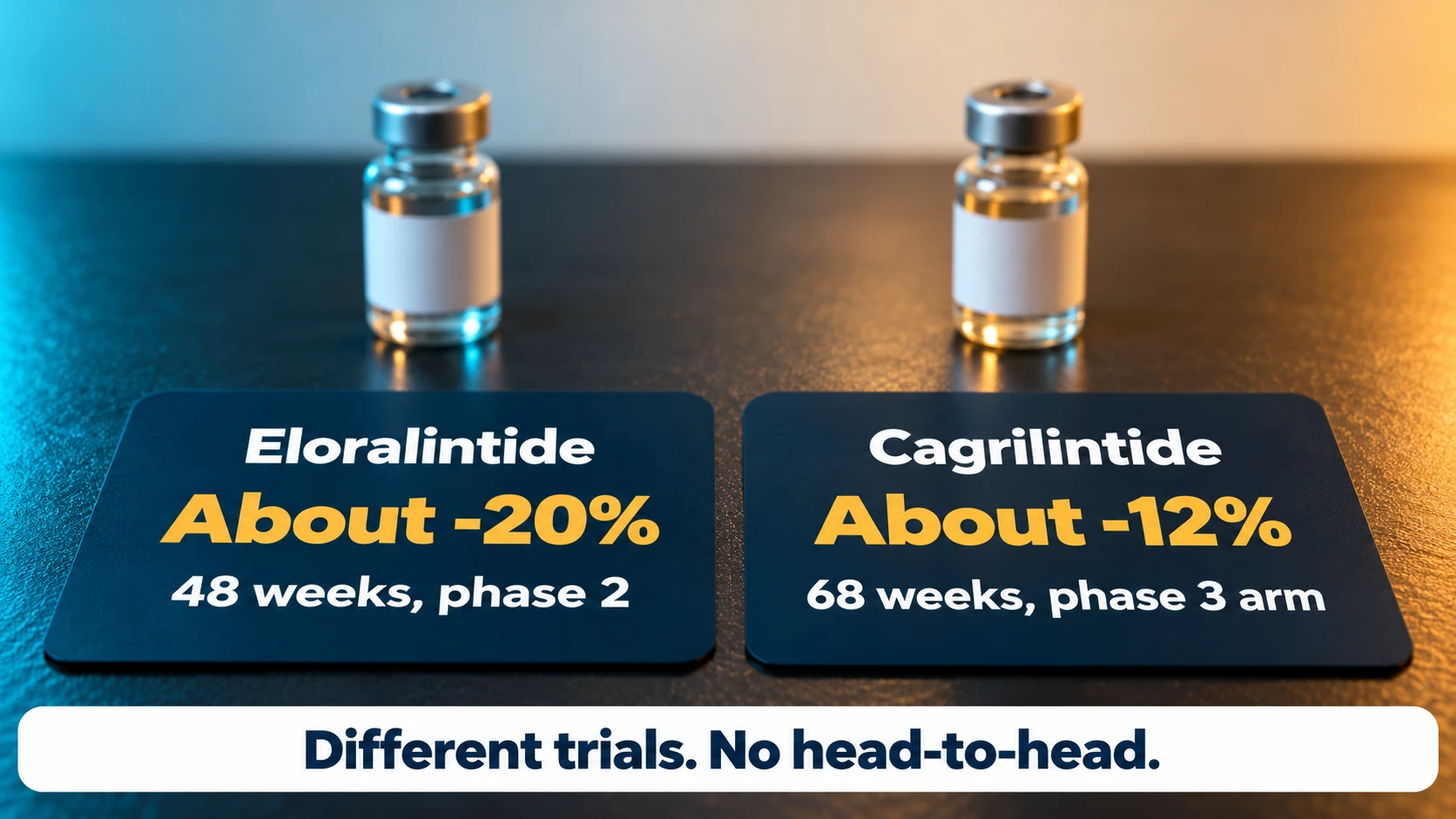
Eloralintide
The phase 2 trial in The Lancet randomized 263 adults without diabetes to placebo or six regimens for 48 weeks. Average weight change on treatment was -9% (1 mg arm), -12% (3 mg), -18% (6 mg), -20% (9 mg), -20% (6 to 9 mg escalation) and -16% (3 to 9 mg escalation), against -0.4% on placebo. Nausea ranged from 11% to 64% by arm and fatigue from 0% to 46%, against 14% and 12% on placebo. About 10% of participants stopped treatment because of an adverse event. The full breakdown is in our eloralintide guide.
Cagrilintide
Cagrilintide has two bodies of human data.
The first is the 2021 phase 2 trial in The Lancet (Lau and colleagues, 706 participants given cagrilintide 0.3 to 4.5 mg), which reported weight reductions of 6.0% to 10.8% at 26 weeks on the trial-product analysis. The 4.5 mg group lost 10.8%, against 9.0% for liraglutide 3.0 mg and 3.0% for placebo.
The second is the monotherapy arm of REDEFINE 1, the phase 3 trial of CagriSema (302 participants given cagrilintide 2.4 mg for 68 weeks). A 2026 review puts the average at about 12%, and press coverage of the trial gives about 11.8% for adherent participants. Nausea was reported by 23.8% and vomiting by 7.0% in the review’s table.
Putting the numbers side by side
| Eloralintide, phase 2 | Cagrilintide, phase 3 arm | |
|---|---|---|
| Duration | 48 weeks | 68 weeks |
| Participants on the single agent | 263 across seven arms | 302 on one dose |
| Population | US only, no diabetes, 78% women | 12 countries, no diabetes |
| Dose range | 1 to 9 mg weekly, plus escalation arms | 2.4 mg weekly |
| Weight change | -9% to -20% | About -12% |
| Nausea | 11% to 64% by arm | 23.8% |
| Vomiting | 8.2% overall | 7.0% |
Six factors keep this table from being a verdict:
- Unmatched analysis methods. Eloralintide’s headline numbers are on-treatment (efficacy estimand), which counts weight change while people stayed on the drug. The cagrilintide figure comes from a review table and press coverage, and the figure for all randomized participants is lower than the on-treatment one. Putting an on-treatment number beside an all-randomized number flatters the first.
- Different durations. Eloralintide’s results are at 48 weeks and cagrilintide’s at 68. Weight change on these drugs typically keeps falling or plateaus, so longer trials tend to show larger totals.
- Different dose ranges. Cagrilintide’s phase 3 arm used its single phase 3 dose (2.4 mg). Cagrilintide 4.5 mg in the 2021 phase 2 trial lost 10.8% at only 26 weeks (trial-product analysis), which suggests the 2.4 mg phase 3 result may not be its ceiling.
- Different trial sizes. Eloralintide’s arms held 24 to 54 participants. Small arms swing widely.
- Different sponsors and designs. Each company ran its own protocol.
- Phase. Phase 2 results tend to shrink in phase 3.
How the trials were designed
The numbers above come from trials built differently. Design details change what a weight figure means, so here are the main ones side by side.
| Design item | Eloralintide phase 2 (2025) | Cagrilintide phase 2 (2021) | REDEFINE 1, phase 3 (2025) |
|---|---|---|---|
| Participants | 263 | 706 on cagrilintide, 99 on liraglutide, 101 on placebo | 3,417 (302 on cagrilintide alone) |
| Sites | 46 US sites | 57 sites in ten countries | Multicentre, double-blind |
| Treatment length | 48 weeks | 26 weeks, plus 6 weeks of follow-up | 68 weeks |
| Who could join | Adults 18 to 75, BMI 30 or more (or 27 or more with a weight-related condition), no type 2 diabetes | Adults 18 or older without diabetes, BMI 30 or more (or 27 or more with hypertension or dyslipidaemia) | Adults without diabetes, BMI 30 or more (or 27 or more with at least one obesity-related complication) |
| Randomization | 2:1:1:1:2:1:2 across placebo and six regimens | 6:1 active versus placebo groups | 21:3:3:7 (CagriSema, semaglutide, cagrilintide, placebo) |
| Doses | 1, 3, 6, 9 mg, plus two escalation schemes | 0.3, 0.6, 1.2, 2.4, 4.5 mg | 2.4 mg |
| Headline analysis | Efficacy estimand (on treatment) | Trial-product estimand, with treatment-policy also reported | Treatment-policy estimand (all randomized) |
| Lifestyle support | Not detailed in the sources I read | Not detailed in the sources I read | Lifestyle intervention in all groups |
Notice the last row of “Headline analysis”. REDEFINE 1’s headline CagriSema number (-20.4%) counts everyone randomized, while eloralintide’s counts weight change on treatment. If both were on the same basis, eloralintide’s figure would be lower than -20%, and cagrilintide’s higher than the treatment-policy figure. Nobody can say by how much without the phase 3 data.
Tolerability: what we know and what we do not
Nausea in the eloralintide trial depended strongly on the dose and on how fast people got there. The 6 mg arm had 64% nausea and the 3 to 9 mg escalation arm 25%, even though the second reached a higher final dose. The authors reported that starting at 3 mg and escalating lowered stomach symptoms and fatigue compared with starting at 6 or 9 mg.
Cagrilintide’s published phase 3 tolerability is better described. In the 2021 phase 2 trial, permanent discontinuation was 10% across groups, mostly because of adverse events (4% of participants). In REDEFINE 1 with semaglutide combined, nausea reached 55% and vomiting 26.1%.
Two things follow. A fair comparison needs the same escalation rules and the same duration. And the animal result (less taste avoidance with eloralintide) suggests better tolerability, but the human data show eloralintide nausea was high in several arms, so the advantage is not proven.
The combination strategy: EloraTZP and CagriSema
Both companies pair their amylin drug with an incretin drug. The results show what each approach has delivered so far.
| CagriSema (Novo Nordisk) | EloraTZP (Eli Lilly) | |
|---|---|---|
| Partner drug | Semaglutide 2.4 mg | Tirzepatide up to 15 mg |
| Amylin drug | Cagrilintide 2.4 mg | Eloralintide up to 9 mg |
| Phase | Phase 3 complete; NDA filed December 2025 | Phase 2b complete; phase 3 co-formulation planned by end of 2026 |
| Obesity without diabetes | -20.4% at 68 weeks, all randomized (REDEFINE 1) | Not yet reported |
| Obesity with type 2 diabetes | -13.7% at 68 weeks (REDEFINE 2) | -23.3% at 48 weeks, on-treatment (phase 2b) |
| Versus tirzepatide | -20.2% vs -23.6% at 84 weeks, all randomized; missed non-inferiority (REDEFINE 4) | -23.3% vs -14.8% for tirzepatide 15 mg at 48 weeks in type 2 diabetes |
| Nausea / vomiting | 55% / 26.1% | Not reported by arm |
| Stopped treatment due to adverse events | 6% (REDEFINE 1) | 10.8% to 27.0% in combination arms |
Two cautions. The REDEFINE 4 comparison (809 adults, open-label, 84 weeks) is the only trial in which a combination containing an amylin analogue was run against tirzepatide, and CagriSema did not meet the non-inferiority goal. EloraTZP has no such head-to-head, and its trial was in people with type 2 diabetes, so its results sit in a different population from REDEFINE 4.
How the rest of the amylin field looks
A 2026 review in Diabetes, Obesity and Metabolism (data to April 30, 2026) lists the long-acting amylin drugs in human trials. The table below follows the review’s figures and flags where its own table and text disagree.
| Drug | Class | Result reported | Status in the review |
|---|---|---|---|
| Pramlintide | Short-acting amylin analogue | About 7% at 52 weeks | Approved for diabetes |
| Cagrilintide | DACRA | About 12% at 68 weeks | Phase 3 |
| Eloralintide | SARA | About 20% at 48 weeks | Phase 2 in the review; phase 3 since |
| Petrelintide | DACRA | 10.7% at 42 weeks versus 1.7% placebo (ZUPREME-1) | Phase 2 |
| Amycretin (zenagamtide) | GLP-1, amylin and calcitonin receptor agonist in one molecule | About 24% at 36 weeks | Phase 1b/2a |
| MET-233i | Ultra-long-acting amylin analogue | About 8% at 5 weeks | Phase 1 |
| ABBV-295 | DACRA | About 9.8% at 12 weeks | Phase 1 |
| AZD6234 | Selective amylin agonist (AMY3R) | 3.8% at day 5 | Phase 1 |
The review’s own table and text differ on a few numbers (for example, eloralintide’s discontinuation rate appears as 8% to 21% in one place and about 10% in another). Where that happens, this page cites the figure from the primary paper.
A network meta-analysis in Endocrinology, Diabetes and Metabolism (2026) pooled six trials (4,642 participants) and ranked high-dose arms against placebo: amycretin (subcutaneous) -23.95%, eloralintide -18.01%, CagriSema -17.18%, semaglutide 2.4 mg -11.45% and liraglutide 3.0 mg -6.4%. The authors say the data are sparse and low-certainty, and that the results need confirmation.
A short history of the amylin class
| Year | Event |
|---|---|
| 2005 | Pramlintide, a modified rat-sequence amylin that does not clump, is approved for people with diabetes who use mealtime insulin. It is short-acting and has limited use |
| 2021 | Cagrilintide’s phase 2 trial appears in The Lancet: up to -10.8% at 26 weeks |
| June 2025 | REDEFINE 1 and REDEFINE 2 (CagriSema) appear in the New England Journal of Medicine |
| November 2025 | Eloralintide’s phase 2 trial appears in The Lancet: up to -20% at 48 weeks |
| December 2025 | Novo Nordisk files an NDA for CagriSema, and Lilly starts ENLIGHTEN-2, the first eloralintide phase 3 study |
| February 2026 | REDEFINE 4 reports that CagriSema did not meet non-inferiority against tirzepatide 15 mg |
| 2026 | Petrelintide’s phase 2 (ZUPREME-1) reports -10.7% at 42 weeks, and amycretin’s early data reach about -24% at 36 weeks |
| September 30, 2026 | Lilly reports EloraTZP phase 2b results |
The class went from a niche diabetes adjunct to the center of the next obesity-drug wave in about five years. That is why search interest in “amylin analog” has held at about 900 to 1,000 searches a month and why the eloralintide name itself reached 27,100 searches a month by September 2026.
Approval status of each
- Eloralintide is not approved. Five phase 3 ENLIGHTEN studies are enrolling, with estimated primary completion in 2028. See the approval status guide.
- Cagrilintide is not approved as a standalone drug. Novo Nordisk filed an NDA for CagriSema in December 2025 and expects a decision around the end of 2026. Cagrilintide alone is in a separate phase 3 program (RENEW). See our cagrilintide guide.
Which one is better?
Nobody can say yet. A fair answer rests on five things that do not exist:
- A head-to-head trial of the two single agents.
- Phase 3 data for eloralintide at its candidate doses.
- Matching analysis methods and durations.
- Long-term safety for either molecule.
- Cost and access data after approval.
What can be said is narrower. Eloralintide’s phase 2 effect on weight is at least in the same range as cagrilintide’s, the animal data suggest it may be easier on the stomach, and its longer half-life leaves room for different dosing schedules. Cagrilintide has a head start: more human exposure, a combination under FDA review and a long safety record from the semaglutide partner.
How this ties to research materials
Both molecules appear in the research-peptide market. Peptryn lists cagrilintide as a research material and does not list eloralintide. Research-use-only labels do not tell a buyer what is in a vial, which is why testing claims matter. Our guide to third-party tested peptides explains the five levels of testing evidence, and our guide to evaluating an eloralintide research listing explains what a certificate would need to show for this molecule.
Common questions
What is the difference between eloralintide and cagrilintide?
Both are lipidated amylin analogues given once weekly in trials. Eloralintide (Lilly) is designed to favour the AMY1 receptor and has a half-life of about 13 to 15 days. Cagrilintide (Novo Nordisk) activates several amylin receptors and the calcitonin receptor, with a half-life of about 7 days. Their lead development paths also differ: CagriSema for cagrilintide and single-agent phase 3 plus EloraTZP for eloralintide.
Which is more effective, eloralintide or cagrilintide?
No trial compares them. Eloralintide averaged about -20% at 48 weeks in phase 2, and cagrilintide about -12% at 68 weeks in a phase 3 arm. The trials differ in length, size, population and doses, so the numbers do not settle the question. A network meta-analysis put high-dose eloralintide slightly ahead of high-dose CagriSema but called its own findings preliminary.
Is eloralintide a better version of cagrilintide?
That is the aim of its design, not a finding. Rat studies showed less taste avoidance and less lean-mass loss with eloralintide, but human data do not show clearly better tolerability, and the efficacy comparison is unsettled.
Is cagrilintide FDA approved?
Not on its own. Novo Nordisk filed a New Drug Application in December 2025 for CagriSema, a fixed-dose combination of cagrilintide and semaglutide, and no decision has been announced. Cagrilintide as a single agent is in phase 3 under the RENEW program.
Is eloralintide FDA approved?
No. It is in phase 3 as the ENLIGHTEN program, and I found no announced regulatory submission as of October 15, 2026.
How long does each drug stay in the body?
Eloralintide’s terminal half-life was 310 to 366 hours (12.9 to 15.3 days) after a single dose. Cagrilintide’s was 159 to 195 hours (6.6 to 8.1 days) in the same paper’s comparison and about 180 hours in its original publication.
What is a DACRA and what is a SARA?
DACRA stands for dual amylin and calcitonin receptor agonist, a drug that activates amylin receptors and the calcitonin receptor (cagrilintide, petrelintide). SARA stands for selective amylin receptor agonist, a drug designed to favour amylin receptors over the calcitonin receptor (eloralintide).
What is the difference between EloraTZP and CagriSema?
CagriSema pairs cagrilintide with semaglutide (a GLP-1 drug) and is under FDA review. EloraTZP pairs eloralintide with tirzepatide (a GIP and GLP-1 drug) and has finished phase 2b, with a phase 3 co-formulation planned. In type 2 diabetes, the highest EloraTZP arm lost -23.3% against -14.8% on tirzepatide alone.
Do eloralintide and cagrilintide cause the same side effects?
Both caused nausea, vomiting and fatigue in trials, which are typical for amylin and incretin drugs. The rates differ by trial design and dose, and the escalation schedule matters. Our side effects guide lists the eloralintide figures.
Related: What is eloralintide? · Amylin analogs: every drug in development · How does eloralintide work? · Eloralintide structure and half-life · EloraTZP · Eloralintide vs retatrutide · Eloralintide side effects · What is cagrilintide? · Cagrilintide vs retatrutide
Sources
All pages read October 14 to 15, 2026.
- Briere DA, et al. Eloralintide (LY3841136), a novel amylin receptor agonist: from discovery to clinical proof of concept. Molecular Metabolism 2025; PMC12640043.
- Billings LK, et al. Eloralintide phase 2 trial. The Lancet 2025; DOI 10.1016/S0140-6736(25)02155-5; NCT06230523.
- Bhattachar S, et al. Eloralintide phase 1 proof of concept. Diabetes, Obesity and Metabolism 2026; PMC12992164.
- Lau DCW, et al. Once-weekly cagrilintide for weight management in people with overweight and obesity. The Lancet 2021; PubMed 34798060.
- Garvey WT, et al. Coadministered cagrilintide and semaglutide in adults with overweight or obesity (REDEFINE 1). New England Journal of Medicine 2025; PubMed 40544433. Novo Nordisk release, June 22, 2025: PR Newswire.
- Cagrilintide-semaglutide in adults with overweight or obesity and type 2 diabetes (REDEFINE 2). New England Journal of Medicine 2025; PubMed 40544432.
- REDEFINE 4 results: Drug Topics, February 24, 2026.
- Amylin analogs: the next major class of weight loss therapy. Diabetes, Obesity and Metabolism 2026; PMC13588232.
- Novel amylin-based therapies for weight management without diabetes: a network meta-analysis. Endocrinology, Diabetes and Metabolism 2026; PMC13240113.
- Eli Lilly. EloraTZP phase 2b results, September 30, 2026: PR Newswire.
- Peptryn. What is cagrilintide? FDA status and CagriSema explained, citing Kruse et al., Journal of Medicinal Chemistry, 2021.
- ClinicalTrials.gov, ENLIGHTEN program records, retrieved October 15, 2026.
Editorial note: Peptryn sells research materials for laboratory use only. This guide is informational and is not medical advice. To report an error, use the contact page.
All products on peptryn.com are intended for laboratory research purposes only. They are not drugs, foods, dietary supplements or cosmetics, and they are not for human consumption, self-administration, or veterinary use. You must be 21 or older to buy. The information on this page has not been evaluated by the U.S. Food and Drug Administration and is not intended to diagnose, treat, cure, or prevent any disease.