Peptides for Weight Loss: What the Evidence Shows (2026)
Read this first: This page is educational. It summarizes published clinical evidence and FDA statements and is not medical advice. Peptryn is a supplier of research-use-only materials for laboratory work, and nothing here is an offer to sell any weight-management product or a suggestion to use research materials on yourself. Decisions about weight and medicines belong with a licensed clinician.
The short answer
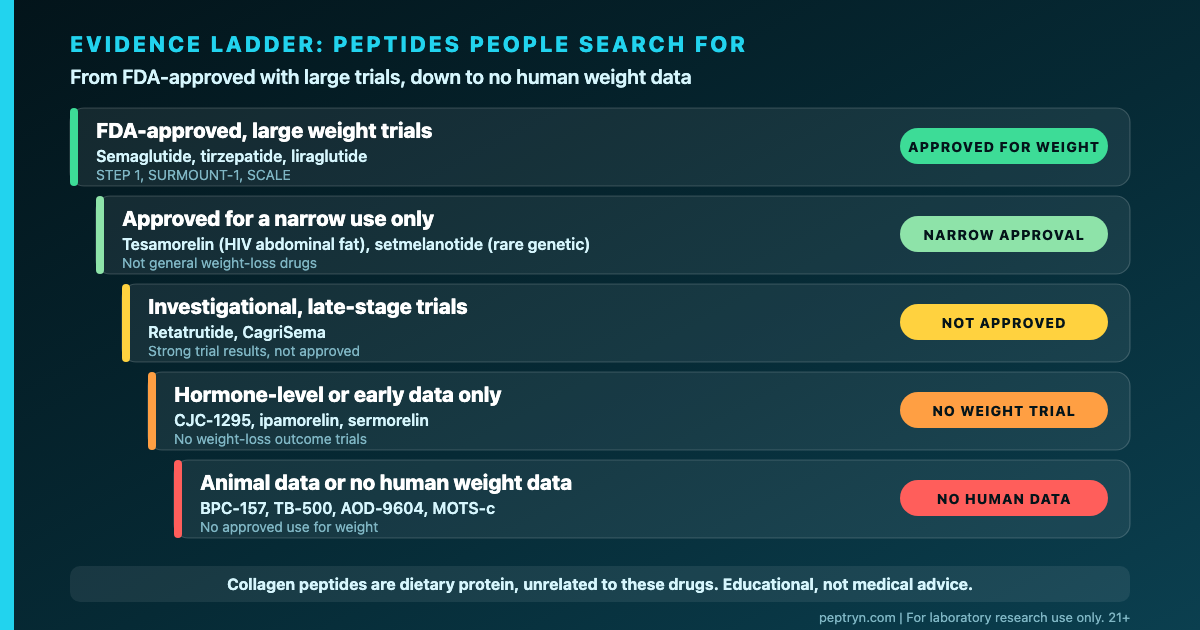
Only a small group of peptide-based medicines has both large clinical trials and FDA approval for weight management: semaglutide (Wegovy), tirzepatide (Zepbound) and liraglutide (Saxenda), plus setmelanotide (Imcivree) for rare genetic forms of obesity. In 68- to 72-week trials, people on semaglutide 2.4 mg or tirzepatide lost an average of about 15% to 21% of body weight, against 2% to 3% on placebo, alongside lifestyle support. Retatrutide and the cagrilintide-semaglutide combination (CagriSema) have strong trial results but are investigational. Most other “weight loss peptides” discussed online, such as BPC-157, AOD-9604, CJC-1295, ipamorelin and MOTS-c, have no comparable human trial for weight. The FDA has warned about unapproved and “research use only” versions of the approved drugs, so anyone considering this area should speak to a licensed clinician and use FDA-approved products from a state-licensed pharmacy.
What are weight loss peptides?
A peptide is a short chain of amino acids. The term covers very different things, which is why searches for “peptides for weight loss” and “weight loss peptides” return confusing results. Four groups sit under the label:
- Approved medicines. Semaglutide, tirzepatide and liraglutide are peptide-based drugs that imitate gut hormones involved in appetite and blood sugar. They are prescription products with FDA-reviewed labels.
- Investigational drugs. Retatrutide and CagriSema are in late-stage development and are not approved.
- Research compounds marketed online. BPC-157, TB-500, AOD-9604, CJC-1295, ipamorelin and others are sold as research chemicals. Most have no controlled human weight-loss trial.
- Dietary products. Collagen peptides are protein supplements. They are unrelated to the injectable compounds above and are not an approved weight-loss product.
Peptides for weight loss: evidence at a glance
| Compound | Status (September 2026) | Best human evidence |
|---|---|---|
| Semaglutide | FDA-approved (Wegovy: injection 2021, pill December 2025, 7.2 mg dose March 2026) | STEP 1: 1,961 adults, 68 weeks. Weight change -14.9% with semaglutide 2.4 mg and -2.4% with placebo, plus lifestyle support |
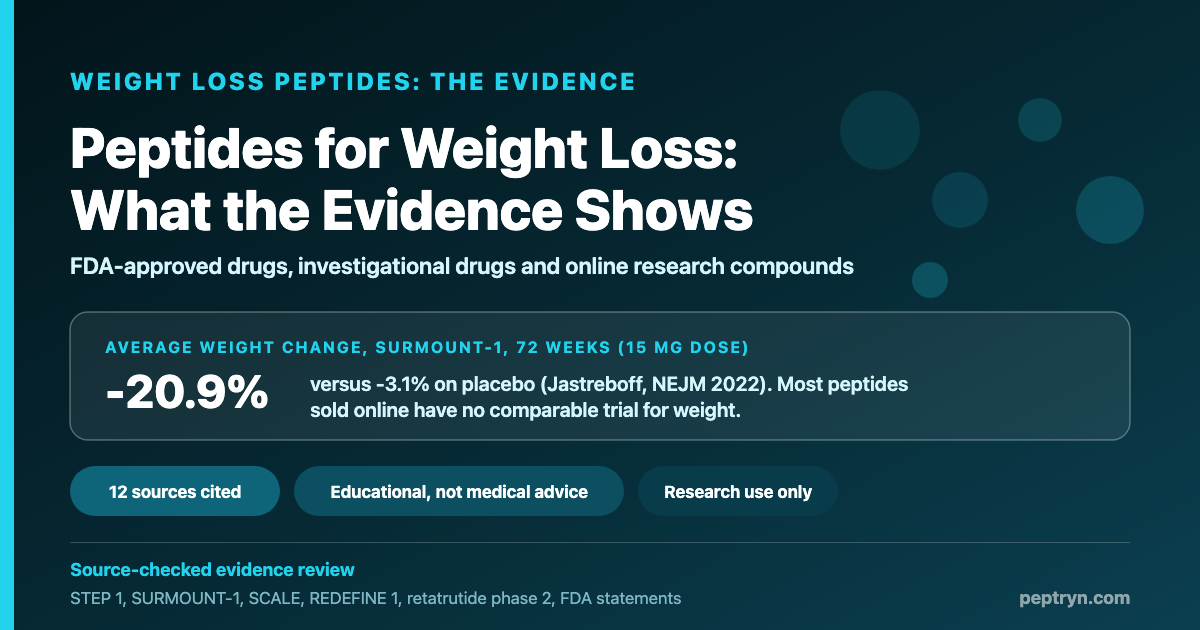
| Tirzepatide | FDA-approved (Zepbound, 2023) | SURMOUNT-1: 2,539 adults, 72 weeks. Weight change -15.0% (5 mg), -19.5% (10 mg), -20.9% (15 mg) and -3.1% with placebo |
| Liraglutide | FDA-approved (Saxenda, 2014) | SCALE: 3,731 adults, 56 weeks. Average loss 8.4 kg with liraglutide 3.0 mg and 2.8 kg with placebo |
| Setmelanotide | FDA-approved (Imcivree, 2020) for obesity from certain rare genetic conditions | Narrow approval for specific genetic causes only. Not a general weight-loss drug |
| CagriSema (cagrilintide plus semaglutide) | Investigational. Novo Nordisk filed for FDA approval in December 2025 and a decision is pending | REDEFINE 1: 3,417 adults, 68 weeks. Weight change -20.4% and -3.0% with placebo (all participants, regardless of adherence) |
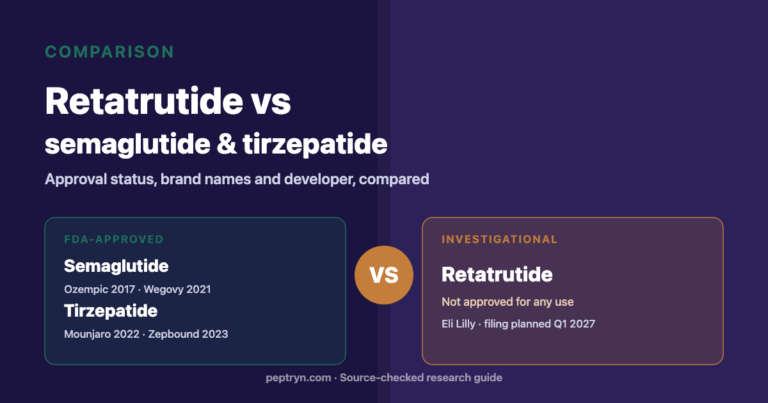
| Retatrutide | Investigational. Not FDA-approved | Phase 2: 338 adults, 48 weeks. Weight change -24.2% at 12 mg and -2.1% with placebo. Phase 3 trials are under way |
| Orforglipron (Foundayo) | FDA-approved April 2026 as a daily pill. It is a small molecule, not a peptide | Included only to clear up a common mix-up |
| Tesamorelin | FDA-approved (Egrifta) for excess abdominal fat in HIV-associated lipodystrophy only | 26-week trial: visceral fat -15.2% with tesamorelin and +5.0% with placebo. Not a general weight-loss drug |
| CJC-1295, ipamorelin, sermorelin | Not approved for weight | Growth hormone and IGF-1 changes in short studies. No weight-loss outcome trials |
| AOD-9604 | No approved product | Developed for obesity in the 2000s. No approval followed and controlled human data are limited |
| BPC-157, TB-500 | Not approved | Studied mainly in animals for tissue repair. No weight-loss trials |
| MOTS-c | Not approved | Laboratory and animal research. No published controlled human weight-loss trial |
| Collagen peptides | Dietary supplement | Protein supplement. Not a weight-loss medicine |
Do peptides work for weight loss?
For the approved GLP-1-based medicines, yes, on average, in trials that also gave participants lifestyle support. STEP 1 randomized 1,961 adults with overweight or obesity to semaglutide 2.4 mg or placebo for 68 weeks and reported a mean weight change of -14.9% versus -2.4%. SURMOUNT-1 randomized 2,539 adults to tirzepatide or placebo for 72 weeks and reported -15.0%, -19.5% and -20.9% at 5, 10 and 15 mg versus -3.1%. Both analyses counted everyone assigned to a group, whether or not they stayed on the drug.
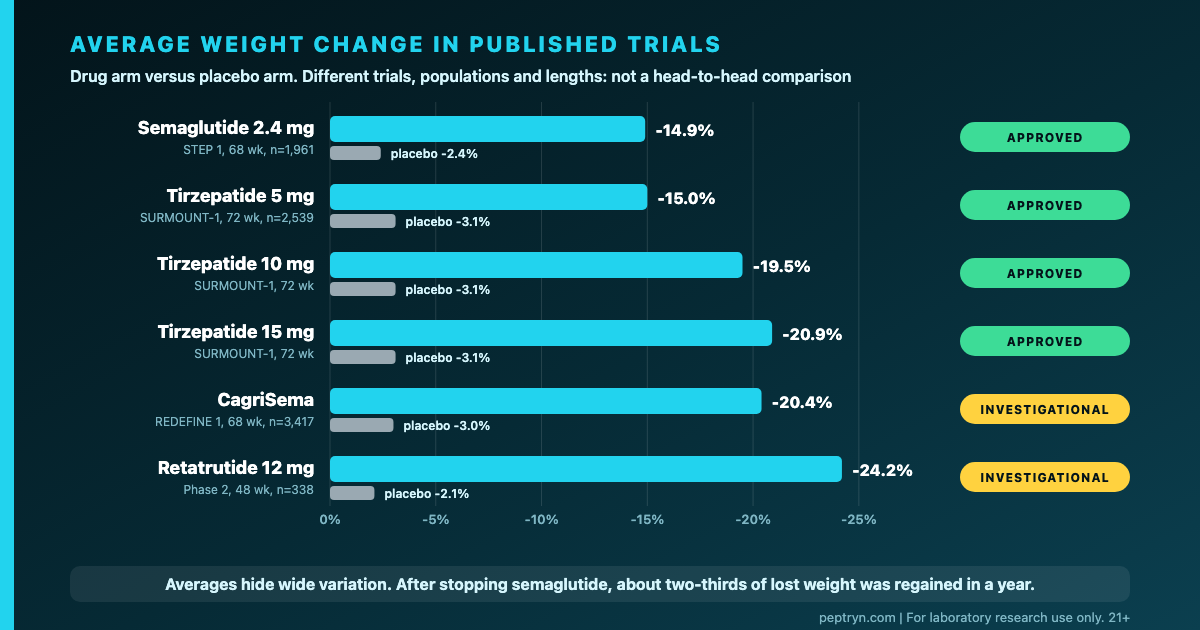
Averages hide a wide spread. Some participants lost much more and some lost little. The trials also differ in length, population and design, so the figures above are not a head-to-head comparison. A trial result does not predict what any one person will experience.
What happens when you stop?
An extension of STEP 1 followed 327 participants for a year after the drug and lifestyle support ended. Those on semaglutide had lost an average of 17.3% of body weight by week 68 and regained 11.6 percentage points by week 120, or about two-thirds of the loss. Heart and metabolic markers that had improved moved back toward baseline. That is why these medicines are described as long-term therapy for a chronic condition and not a short course.
Fat, muscle and the rest of the weight lost
Weight lost is not all fat. A DXA body-composition substudy of SURMOUNT-1 (160 participants, 72 weeks) found body weight fell 21.3% on tirzepatide versus 5.3% on placebo, fat mass fell 33.9% versus 8.2%, and lean mass fell 10.9% versus 2.6%. About three-quarters of the weight lost was fat and about a quarter was lean mass. Lean mass is not the same as muscle, but the finding is the reason clinicians pay attention to protein intake and resistance exercise during weight loss. See our guide to muscle and fat-loss peptide research for the full evidence.
Safety: what the labels say
- Thyroid tumor warning. The Wegovy label carries a boxed warning: semaglutide caused thyroid C-cell tumors in rodents, and it is unknown whether it does in humans. The drug is contraindicated in people with a personal or family history of medullary thyroid carcinoma or multiple endocrine neoplasia type 2. Zepbound carries a similar warning.
- Digestive effects. Nausea, diarrhea, vomiting and constipation are the most common side effects. In REDEFINE 1, digestive effects were reported by 79.6% of people on CagriSema versus 39.9% on placebo, and were mostly mild to moderate.
- Pregnancy and contraception. The Wegovy label advises stopping semaglutide at least 2 months before a planned pregnancy. The Zepbound label advises using a non-oral or backup contraceptive method for 4 weeks after starting and after each dose increase. See our guide to peptides for women.
- Not for everyone. These are prescription medicines chosen and monitored by a clinician against a person’s medical history and other medicines.
The FDA’s warnings about unapproved and “research use only” versions
The FDA has published specific concerns about GLP-1 drugs that are not FDA-approved:
- Compounded versions are not reviewed by the FDA for safety, effectiveness or quality before they are marketed.
- The agency warns about companies selling semaglutide, tirzepatide and related compounds labeled as research products or “not for human consumption” while marketing them to consumers with dosing instructions.
- Dosing errors have led to adverse events, some requiring hospitalization. As of May 31, 2026, the FDA had received about 990 adverse event reports linked to compounded semaglutide and more than 730 linked to compounded tirzepatide.
- Counterfeit Ozempic has circulated in the US supply chain with the wrong ingredients or doses.
- The FDA’s advice is to get a prescription from a licensed provider, use a state-licensed pharmacy, and report problems to the MedWatch program.
Research-grade material is not a cheaper version of an approved drug. It is a different product, with no approved label, no clinician oversight and no approved dosing. Read are peptides legal for the regulatory background.
Best peptides for weight loss: how to read that question
“Best peptides for weight loss” has an evidence-based answer and a marketing answer. The evidence-based answer is the FDA-approved medicines listed above, because they are the only ones with large randomized trials, an FDA review and a label describing who should and should not use them. Investigational drugs such as retatrutide and CagriSema may join that list if they are approved. The marketing answer is a list of research compounds with animal data, hormone-level data or a human trial that missed its main goal. Those lists tend to be written by people selling something.
Weight loss peptides for women and for men
The evidence is the same for both sexes, and the practical cautions differ. Women have pregnancy and contraception points on the labels, and menopause changes how weight and lean mass are gained and lost. Men have their own cautions, such as the prostate research on IGF-1 raised by growth-hormone-axis peptides. Read the full breakdowns in peptides for women and best peptides for men.
Oral peptides for weight loss
Semaglutide is available as a daily Wegovy pill, approved by the FDA in December 2025. It has to be taken under specific conditions set out on its label. Orforglipron (Foundayo), approved in April 2026, is also a pill, but it is a small molecule and not a peptide. Products sold as “oral peptides” outside those approvals have no comparable evidence.
Peptides for belly fat
Tesamorelin is the one peptide with a trial showing a drop in visceral abdominal fat, and it is approved only for people with HIV-associated lipodystrophy. Trials of GLP-1-based drugs also report reductions in waist size and fat mass. No peptide has been shown to remove fat from one area of the body.
Peptide therapy for weight loss
When clinics use the phrase “peptide therapy” for weight loss, they usually mean prescribing an FDA-approved GLP-1-based medicine. Ask what exactly is being prescribed, whether it is FDA-approved, which pharmacy dispenses it, and how it will be monitored.
Questions to bring to a clinician
- Am I a candidate for an FDA-approved weight-management medicine, given my BMI, weight-related conditions and medical history?
- Which approved option fits me, and how does it compare with non-peptide options?
- What side effects should I expect, and what should make me call you?
- How will we protect muscle, with protein intake and resistance exercise?
- What is the plan if I stop the medicine, given how much weight is typically regained?
- Which state-licensed pharmacy will dispense it, and how do I verify it?
Common questions
Do peptides work for weight loss?
The FDA-approved GLP-1-based medicines do on average: about 15% to 21% weight loss in the STEP 1 and SURMOUNT-1 trials versus 2% to 3% on placebo. Most other compounds sold as weight loss peptides lack comparable human trials.
What are the best peptides for weight loss?
The ones with large randomized trials and FDA approval: semaglutide, tirzepatide and liraglutide. They are prescription medicines. Investigational drugs like retatrutide and CagriSema are not approved.
Are weight loss peptides safe?
Approved medicines have known risks listed on their labels, including a boxed warning for thyroid C-cell tumors seen in rodents. Unapproved and research-use-only versions have no label or oversight, and the FDA has reported adverse events from compounded products.
What is the best peptide for fat loss?
No peptide is proven to target fat alone. In trials of approved drugs, about three-quarters of weight lost was fat and about a quarter was lean mass.
Which peptides are FDA-approved for weight loss?
Semaglutide (Wegovy), tirzepatide (Zepbound) and liraglutide (Saxenda), plus setmelanotide (Imcivree) for certain rare genetic conditions. Orforglipron (Foundayo) is also approved but is not a peptide.
Is retatrutide FDA-approved for weight loss?
No. As of late September 2026 retatrutide is investigational. See retatrutide FDA approval status.
Are there natural peptides for weight loss?
Collagen and other dietary protein peptides are food supplements. They are not the injectable compounds studied in weight-loss trials, and they are not an approved weight-loss product.
Are collagen peptides good for weight loss?
Collagen peptides are dietary protein. They have no approved role in weight loss, and they are unrelated to GLP-1-based medicines.
Are there oral peptides for weight loss?
Yes, one: the Wegovy pill (oral semaglutide), approved in December 2025. The other approved weight-loss pill, Foundayo (orforglipron), is not a peptide.
What is AOD-9604?
AOD-9604 is a modified fragment of growth hormone that was developed for obesity in the 2000s. It has no approved use, and controlled human data are limited.
What happens to weight when you stop taking a GLP-1 medicine?
In the STEP 1 extension, participants regained about two-thirds of their lost weight within a year of stopping semaglutide.
Are weight loss peptides different for women?
The efficacy data are similar, but women have label cautions on pregnancy planning and oral contraceptives. See peptides for women.
Can I buy weight loss peptides online?
The FDA advises getting these medicines by prescription from a licensed provider and a state-licensed pharmacy. Research-use-only materials are for laboratory work and are not for human or veterinary use.
Do weight loss peptides cause muscle loss?
Some lean mass is lost along with fat. In the SURMOUNT-1 body-composition substudy, about a quarter of the weight lost was lean mass, which is why protein intake and resistance exercise are commonly discussed with a clinician.
Related: Best peptides for muscle growth and fat loss · Peptides for women · Best peptides for men · List of peptides and what they do · Retatrutide FDA approval status · Are peptides legal?
Sources
Wilding JPH, et al. STEP 1 trial of once-weekly semaglutide 2.4 mg. New England Journal of Medicine, 2021;384:989-1002 (PMID 33567185). nejm.org
Jastreboff AM, et al. SURMOUNT-1 trial of once-weekly tirzepatide. New England Journal of Medicine, 2022;387:205-216 (PMID 35658024). nejm.org
Pi-Sunyer X, et al. SCALE Obesity and Prediabetes trial of liraglutide 3.0 mg. New England Journal of Medicine, 2015;373:11-22 (PMID 26132939). nejm.org
Garvey WT, et al. REDEFINE 1 trial of cagrilintide-semaglutide. New England Journal of Medicine, 2025 (PMID 40544433). nejm.org
Jastreboff AM, et al. Phase 2 trial of retatrutide in obesity. New England Journal of Medicine, 2023 (PMID 37366315). nejm.org
Wilding JPH, et al. Weight regain and cardiometabolic effects after withdrawal of semaglutide: the STEP 1 trial extension. Diabetes, Obesity and Metabolism, 2022 (PMID 35441470). pubmed.ncbi.nlm.nih.gov
Look M, et al. Body composition changes during weight reduction with tirzepatide in the SURMOUNT-1 study. Diabetes, Obesity and Metabolism, 2025 (PMID 39996356). pubmed.ncbi.nlm.nih.gov
Falutz J, et al. Metabolic effects of a growth hormone-releasing factor in patients with HIV. New England Journal of Medicine, 2007 (PMID 18057338). nejm.org
U.S. Food and Drug Administration. FDA’s concerns with unapproved GLP-1 drugs used for weight loss (adverse event counts as of May 31, 2026). fda.gov
U.S. Food and Drug Administration. Wegovy prescribing information, including boxed warning, contraindications and pregnancy statements. accessdata.fda.gov
Novo Nordisk. Wegovy pill FDA approval, December 22, 2025, and CagriSema FDA submission, December 2025. novonordisk.com
Eli Lilly and Company. FDA approval of Foundayo (orforglipron), April 1, 2026. investor.lilly.com
For laboratory research use only. Not for human or veterinary use, and not a drug, food, dietary supplement or cosmetic. You must be 21 or older to buy.