How to Reconstitute Retatrutide: BAC Water Amounts for 10 mg, 30 mg & 60 mg Vials
Research use only. Retatrutide supplied by Peptryn is sold strictly for in vitro and in vivo laboratory research. It is not approved by the FDA for human or veterinary use, and nothing in this guide is medical advice or an instruction for self-administration. This article covers laboratory sample preparation: solvent selection, concentration math, sterile handling, and storage.
Quick answer: how to reconstitute retatrutide
To reconstitute retatrutide, let the lyophilized vial and the bacteriostatic (BAC) water reach room temperature, disinfect both rubber stoppers, then add the BAC water slowly down the inside wall of the vial. Swirl gently until the powder dissolves into a clear solution. Never shake. Refrigerate at 2–8 °C, protected from light.
How much BAC water you add is a choice, and it sets your concentration. The formula is:
Concentration (mg/mL) = peptide mass (mg) ÷ BAC water volume (mL)
The most common setup for a 10 mg vial is 1 mL of BAC water, which gives 10 mg/mL. On a standard U-100 syringe (100 units = 1 mL), every 10 units then equals 1 mg of retatrutide. The full chart for 10 mg, 30 mg, and 60 mg vials is in the BAC water chart below.
Working with a Peptryn vial? Every batch is third-party tested, its certificate of analysis is available by lot number, and the matching bacteriostatic water is one click away:
Shop Retatrutide (10 mg / 30 mg / 60 mg) → · Add BAC Water 10 mL, $12.99 →
Table of contents
- What reconstitution is and why it matters
- What you need
- Step-by-step reconstitution
- How much BAC water for 10 mg retatrutide (and 30 mg, 60 mg)
- Syringe math: units, mL, and mg
- What “how to inject retatrutide” actually means in a research setting
- Storage and stability after mixing
- Troubleshooting
- Tirzepatide vs retatrutide: science and handling compared
- How to verify the vial you’re mixing
- FAQ
What reconstitution is and why it matters
Retatrutide is shipped as a lyophilized (freeze-dried) powder because peptides are far more stable dry than in solution. Freeze-drying removes water and leaves a fragile white “cake” at the bottom of the vial. Reconstitution means dissolving that powder in a sterile liquid (the diluent) so you have a solution of known concentration to work with.
Three things go wrong most often, and each is preventable:
- Wrong math. A concentration error ripples through every measurement that follows.
- Physical damage. Blasting diluent onto the cake or shaking the vial can foam and stress the peptide.
- Contamination. A non-sterile stopper or a reused needle compromises the whole vial.
Retatrutide is a synthetic peptide of roughly 4.7 kDa (about 4,731 Da per the product specification) that acts as a triple agonist at the GIP, GLP-1, and glucagon receptors. Peptides can be sensitive to mechanical stress, heat, and repeated freeze-thaw, so gentle handling matters. Getting retatrutide reconstitution right is mostly about math and technique, and both are covered below.
What you need
| Item | Why it matters |
|---|---|
| Lyophilized retatrutide vial (10 mg, 30 mg, or 60 mg) | Check the lot number against its certificate of analysis before you start |
| Bacteriostatic water, 10 mL (0.9% benzyl alcohol) | The preservative inhibits bacterial growth, so the vial can be accessed multiple times |
| Sterile syringes (1 mL / U-100 for measuring; larger for adding diluent) | Use a fresh sterile syringe and needle for every entry |
| 70% isopropyl alcohol swabs | Disinfect both stoppers before every puncture |
| Nitrile gloves | Keeps skin oils and contaminants off the stopper and needle |
| Permanent marker and labels | Record concentration, date mixed, and lot number |
| Sharps container | Safe disposal of needles |
Diluent note: BAC water for retatrutide is the standard choice for multi-access research vials. Sterile water without a preservative works for single-use preparations that will be consumed immediately, but it does not protect the vial from contamination between accesses. Peptryn’s bacteriostatic water guide covers the trade-offs in more depth.
Step-by-step: how to reconstitute retatrutide
This is also how to mix retatrutide with BAC water: the process is the same whichever vial size you have.
- Bring everything to room temperature. Take the vial out of cold storage and let it sit for 15–30 minutes. Cold glass collects condensation, and cold powder dissolves unevenly.
- Check the vial. The lyophilized cake should be intact and white to off-white. Confirm the lot number matches your COA.
- Do the math first. Decide your target concentration and calculate the BAC water volume using the chart below. Write it down before you touch anything.
- Disinfect the stoppers. Remove the plastic caps, wipe both the retatrutide vial and BAC water vial stoppers with an alcohol swab, and let them air-dry for 10–15 seconds.
- Draw the BAC water. Using a sterile syringe, draw slightly more than your target volume, then expel air bubbles and adjust to the exact volume.
- Add the diluent slowly down the wall. Insert the needle through the stopper, angle the tip against the inner glass wall, and let the liquid run down the side over 20–30 seconds. Do not jet it directly onto the powder cake.
- Withdraw the needle and let it settle. Leave the vial upright for a minute or two. Much of the powder dissolves on its own.
- Swirl gently. Roll the vial slowly between your palms or swirl it in small circles. Never shake. Shaking creates foam and can damage the peptide.
- Inspect the solution. It should be clear and colorless with no visible particles. If it stays cloudy or has floating material, see troubleshooting.
- Label and refrigerate. Write the concentration, date, and lot number on the vial. Store at 2–8 °C, away from light.
That’s the whole process. It takes under five minutes once your materials are laid out.
How much BAC water for 10 mg retatrutide
There is no single “correct” volume. What matters is that you choose a concentration deliberately and record it. Use the chart below for Peptryn’s three vial sizes.
Formula: BAC water volume (mL) = vial mass (mg) ÷ target concentration (mg/mL)
10 mg vial
| BAC water added | Concentration | mg per syringe unit (U-100) | Units for 1 mg |
|---|---|---|---|
| 1 mL | 10 mg/mL | 0.10 mg | 10 units |
| 2 mL | 5 mg/mL | 0.05 mg | 20 units |
| 2.5 mL | 4 mg/mL | 0.04 mg | 25 units |
| 3 mL | 3.33 mg/mL | 0.033 mg | 30 units |
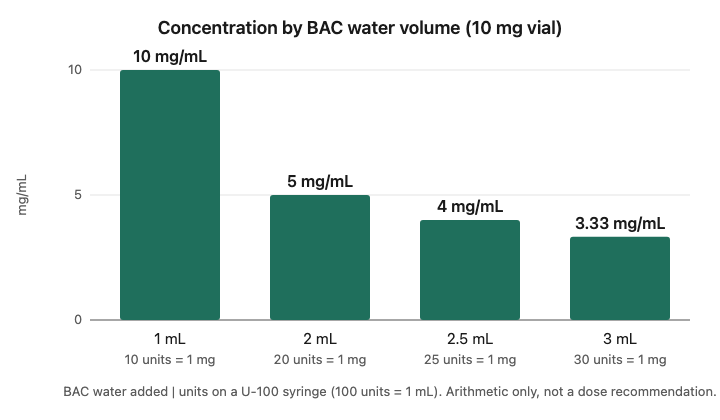
Most-searched answer: for a 10 mg vial, 1 mL of BAC water gives 10 mg/mL, which is the easiest concentration to work with because the syringe math is one-to-one (10 units = 1 mg). A larger volume gives a more dilute solution, which makes it easier to measure small quantities accurately with a syringe.
30 mg vial
| BAC water added | Concentration | mg per syringe unit (U-100) | Units for 1 mg |
|---|---|---|---|
| 1.5 mL | 20 mg/mL | 0.20 mg | 5 units |
| 2 mL | 15 mg/mL | 0.15 mg | 6.7 units |
| 3 mL | 10 mg/mL | 0.10 mg | 10 units |
| 6 mL | 5 mg/mL | 0.05 mg | 20 units |
60 mg vial
| BAC water added | Concentration | mg per syringe unit (U-100) | Units for 1 mg |
|---|---|---|---|
| 3 mL | 20 mg/mL | 0.20 mg | 5 units |
| 4 mL | 15 mg/mL | 0.15 mg | 6.7 units |
| 6 mL | 10 mg/mL | 0.10 mg | 10 units |
Check your vial capacity. Confirm that the total volume you add fits comfortably in the vial with headspace to spare. If you’re using an odd size such as 5 mg, 15 mg, or 20 mg, the same formula applies: a 20 mg vial with 2 mL of BAC water is 10 mg/mL, and a 5 mg vial with 1 mL is 5 mg/mL.
A note on precision: dissolved powder adds a tiny amount of volume, so the true final volume is slightly higher than the diluent you added. For routine research work this is negligible, but record the intended concentration and keep it consistent across experiments.
Syringe math: units, mL, and mg (how to draw retatrutide accurately)
Most confusion around retatrutide handling comes from mixing up three units. On a standard U-100 insulin syringe:
- 100 units = 1 mL
- 1 unit = 0.01 mL
- mg per unit = concentration (mg/mL) ÷ 100
To find how many syringe units correspond to a target mass:
Units to draw = target mass (mg) × 100 ÷ concentration (mg/mL)
Worked examples (arithmetic only, not dose recommendations):
- Concentration 10 mg/mL, target 1 mg → 1 × 100 ÷ 10 = 10 units (0.1 mL)
- Concentration 5 mg/mL, target 0.5 mg → 0.5 × 100 ÷ 5 = 10 units (0.1 mL)
- Concentration 20 mg/mL, target 1 mg → 1 × 100 ÷ 20 = 5 units (0.05 mL)
Notice that a more concentrated solution means a smaller draw volume. Small volumes are harder to measure precisely, so choose a concentration where your typical draw sits comfortably in the readable middle of the syringe barrel.
Peptryn’s peptide calculator can run these numbers for you. Always double-check the result by working the formula by hand once.
What “how to inject retatrutide” actually means
This is one of the most-searched phrases in this topic, so it deserves a straight answer.
In published clinical trials, retatrutide has been given as a once-weekly subcutaneous injection under clinical supervision, with the dose stepped up gradually. The trial results are public: in the phase 2 obesity trial published in the New England Journal of Medicine, participants on the highest dose lost an average of 24.2% of body weight at 48 weeks (NEJM, 2023), and Lilly’s phase 3 TRIUMPH-1 trial reported an average 28.3% loss at 12 mg after 80 weeks in its efficacy-estimand analysis (25.0% in the treatment-regimen analysis) (Eli Lilly). Those results come from a supervised, regulated investigational program, not from vials bought from a research supplier.
Retatrutide is not FDA-approved. It remains an investigational drug. Lilly has said it expects to submit its approval application in the first quarter of 2027 (CNBC, July 2026), so check Lilly’s investor page for the latest status.
Peptryn’s vials are for laboratory research. They are not for human injection or self-administration, and this guide doesn’t provide injection technique, dose guidance, or a titration schedule for people. If you’re interested in retatrutide as a treatment, the appropriate routes are to talk with a licensed clinician and to look at registered clinical trials (search “retatrutide” at ClinicalTrials.gov).
What this guide can help with is the laboratory side: accurately preparing, measuring, and transferring known amounts of the peptide, which is what the syringe math above is for.
Storage and stability after reconstitution
| Stage | Recommended handling |
|---|---|
| Lyophilized (unopened) | Store at −20 °C, protected from light. Avoid repeated freeze-thaw cycles (per Peptryn product specification) |
| BAC water, unopened | Room temperature (20–25 °C) |
| BAC water, after first puncture | Refrigerate at 2–8 °C and use within 28 days. Do not freeze |
| Reconstituted retatrutide | Refrigerate at 2–8 °C, protected from light. Prepare fresh as your protocol requires |
On the 28-day figure: it comes from standard multi-dose vial practice and applies to the opened BAC water. There is no published stability study for reconstituted retatrutide from research vials, so treat 28 days as a conservative ceiling and shorter windows as better practice for anything sensitive. If your protocol allows, reconstitute only what you’ll use soon, or split into small aliquots so you don’t repeatedly puncture and warm one vial.
Do:
- Keep the solution refrigerated and out of light
- Use a fresh sterile needle and swab the stopper every time
- Label every vial with concentration and date mixed
Don’t:
- Freeze the reconstituted solution unless your protocol validates it
- Leave the vial at room temperature for extended periods
- Shake, vortex, or reuse needles
More on this in Peptryn’s storage and handling guide.
Troubleshooting: cloudy, foamy, or undissolved retatrutide
| Problem | Likely cause | What to do |
|---|---|---|
| Powder won’t dissolve | Cold vial, too little diluent, or not enough time | Warm to room temperature, wait 5–10 minutes, swirl gently. Do not heat or shake |
| Foam on top | Diluent added too fast or vial shaken | Let it stand upright until foam settles. Add diluent more slowly next time |
| Cloudy solution | Contamination, degraded sample, or incomplete dissolving | Wait a few minutes. If it stays cloudy, do not use it. Contact support with your lot number |
| Visible particles or strands | Undissolved peptide or contamination | Swirl gently and re-inspect. If particles persist, discard |
| Yellow tint | Degradation or contaminated diluent | Do not use. Contact support |
When in doubt, throw it out. A vial that looks wrong is not worth the risk to your data.
Tirzepatide vs retatrutide: science and handling compared
Since you may be working with both, here is how the two compounds compare.
| Tirzepatide | Retatrutide | |
|---|---|---|
| Mechanism | Dual GIP + GLP-1 receptor agonist | Triple GIP + GLP-1 + glucagon receptor agonist |
| Regulatory status | Approved (marketed as Mounjaro and Zepbound) | Investigational, not approved |
| Approximate molecular weight | ~4.8 kDa | ~4.7 kDa |
| Approximate half-life | ~5 days | ~6 days |
| Pivotal-trial weight loss, efficacy estimand | 22.5% at 72 weeks (SURMOUNT-1, 15 mg) | 28.3% at 80 weeks (TRIUMPH-1, 12 mg) |
| Pivotal-trial weight loss, treatment-regimen estimand | 20.9% at 72 weeks (SURMOUNT-1, 15 mg) | 25.0% at 80 weeks (TRIUMPH-1, 12 mg) |
| Reported side effects | Predominantly gastrointestinal | GI effects (nausea 28.6–42.4% vs 14.8% placebo at 4–12 mg); dysesthesia (skin sensation changes) in 5.1–12.5% vs 0.9% placebo |
| Research-vial handling | Lyophilized powder, reconstitute as above | Lyophilized powder, reconstitute as above |
Two honest caveats about this table.
- These are not head-to-head numbers. The trials enrolled different populations over different durations (72 vs 80 weeks). The two rows also use different statistical analyses: the efficacy estimand assumes everyone stayed on treatment, while the treatment-regimen estimand counts everyone regardless of adherence. Compare like with like, and don’t conclude that one drug “beats” the other from these figures. Lilly is running a direct comparison trial of retatrutide against tirzepatide in adults with obesity (roughly 89 weeks), and until it reports, the question “which is better?” has no evidence-based answer (Lilly trial listing).
- The handling is essentially the same. Both are peptides of similar size, and the reconstitution steps, sterile technique, and storage rules in this guide apply to both. The approved tirzepatide products come as prefilled pens or vials that patients don’t reconstitute, but that is a pharmacy product and isn’t the same thing as a research-grade lyophilized vial.
Peptryn stocks both for laboratory comparison work: Retatrutide (from $130) and Tirzepatide (from $169.99). Researchers running side-by-side studies can order both in one shipment, and on the retatrutide listing, volume discounts of 3%, 5%, and 10% apply automatically from 3, 5, and 10 vials.
How to verify the vial you’re mixing
The best reconstitution technique in the world can’t rescue a poor-quality peptide. Before you mix anything, confirm what’s actually in the vial:
- Match the lot number to a COA. Peptryn publishes certificates of analysis by lot in its COA library (see the retatrutide 10 mg COA), tested by an independent US lab (MZ Biolabs) for purity, identity, and endotoxin.
- Look for HPLC and mass-spec data. The retatrutide listing states ≥99% purity by HPLC and mass spectrometry, with identity and molecular weight verified on the certificate.
- Read it properly. Not sure what you’re looking at? Peptryn’s guide on how to read a certificate of analysis walks through each line.
- Ask for missing reports. If a lot’s certificate isn’t published yet, email support with your order number and they’ll send the current report on file.
See the published lab results before you order. Shipping is from the USA with same-day dispatch, and orders over $150 ship free.
Ready to start?
Shop Retatrutide with a batch COA → · Add BAC Water → · Browse all GLP research peptides →
Frequently asked questions
How do I reconstitute a 10 mg vial of retatrutide?
Add bacteriostatic water slowly down the inside wall of the vial, swirl gently until clear, and refrigerate. For a 10 mg vial, 1 mL of BAC water gives 10 mg/mL and 2 mL gives 5 mg/mL. Pick the volume that gives a concentration you can measure precisely, and record it on the label.
How much BAC water do I mix with 10 mg of retatrutide?
There’s no fixed rule. It depends on the concentration you want. Divide the vial mass by your target concentration: 10 mg ÷ 10 mg/mL = 1 mL, or 10 mg ÷ 5 mg/mL = 2 mL. The chart above also covers 30 mg and 60 mg vials.
How do I reconstitute 20 mg of retatrutide?
The same formula applies. A 20 mg vial with 2 mL of BAC water is 10 mg/mL, and with 4 mL it’s 5 mg/mL. Peptryn currently supplies 10 mg, 30 mg, and 60 mg retatrutide vials, so check the product page for what’s in stock.
Can I use sterile water instead of bacteriostatic water?
For a single-use preparation that will be used immediately, yes. For any vial you’ll access more than once, bacteriostatic water is preferred because the benzyl alcohol inhibits bacterial growth between punctures.
How many units on a syringe equal 1 mg of retatrutide?
It depends on your concentration. Divide 100 by the concentration in mg/mL. At 10 mg/mL, 1 mg is 10 units. At 5 mg/mL, 1 mg is 20 units. At 20 mg/mL, 1 mg is 5 units.
How long does reconstituted retatrutide last?
Refrigerated at 2–8 °C, the commonly used ceiling is 28 days, matching the limit for opened bacteriostatic water. No published stability study covers reconstituted research-vial retatrutide specifically, so shorter is safer for sensitive work.
Should I shake the vial to mix it faster?
No. Shaking causes foaming and can damage the peptide. Swirl gently or roll the vial between your palms, and give it a few minutes.
Is retatrutide FDA-approved?
No. Retatrutide is an investigational drug from Eli Lilly and is not approved by the FDA. Peptryn sells it for laboratory research only, not for human use.
How do I inject retatrutide?
Peptryn’s products are not for human injection or self-administration, so this guide doesn’t provide injection instructions. In published clinical trials, retatrutide was given once weekly as a supervised subcutaneous injection. Anyone considering treatment should consult a licensed clinician.
Tirzepatide vs retatrutide: which is better?
There is no head-to-head result yet. Cross-trial numbers favor retatrutide for average weight loss on both the efficacy and treatment-regimen analyses, but the trials differ in design and length, and tirzepatide has far more real-world safety data because it has been approved since 2022. Lilly’s direct comparison trial is ongoing.
Final take
Reconstituting retatrutide comes down to four habits: calculate the concentration before you start, add diluent slowly down the wall, swirl instead of shake, and label and refrigerate immediately. Get those right and you’ll avoid nearly every problem researchers run into.
Get your research-grade retatrutide with a lot-specific COA →
Related guides: Reconstitution basics for laboratory peptides · Bacteriostatic water for peptide reconstitution · Is retatrutide the same as “GLP-3”? · Where to buy retatrutide: what to verify before you order · Are peptides legal? · What is a COA? · Peptide purity · Peptide testing · Buy retatrutide for research
Editorial note: Peptryn sells the research peptides discussed in this guide for laboratory use only. This guide is informational and is not medical advice. Sources are listed below. To report an error, email [email protected].
Sources
- Jastreboff AM, et al. Triple–Hormone-Receptor Agonist Retatrutide for Obesity — A Phase 2 Trial. N Engl J Med, 2023. nejm.org
- Eli Lilly and Company. Lilly’s triple agonist, retatrutide, delivered powerful weight loss in pivotal Phase 3 obesity trial (TRIUMPH-1). prnewswire.com
- Jastreboff AM, et al. Tirzepatide Once Weekly for the Treatment of Obesity (SURMOUNT-1). N Engl J Med, 2022. nejm.org
- Eli Lilly and Company. Lilly’s tirzepatide delivered up to 22.5% weight loss in adults with obesity or overweight in SURMOUNT-1. investor.lilly.com
- CNBC. Eli Lilly will file for approval of retatrutide obesity drug in 2027 (July 23, 2026). cnbc.com
- Eli Lilly and Company. A Study of Retatrutide (LY3437943) Compared to Tirzepatide (LY3298176) in Adults Who Have Obesity. trials.lilly.com
All products on peptryn.com are intended for laboratory research purposes only. Not for human consumption, self-administration, or veterinary use. The information on this page has not been evaluated by the U.S. Food and Drug Administration and is not intended to diagnose, treat, cure, or prevent any disease. Nothing here should be construed as medical advice.