Retatrutide’s Half-Life: What the Trial Data Shows
The short answer
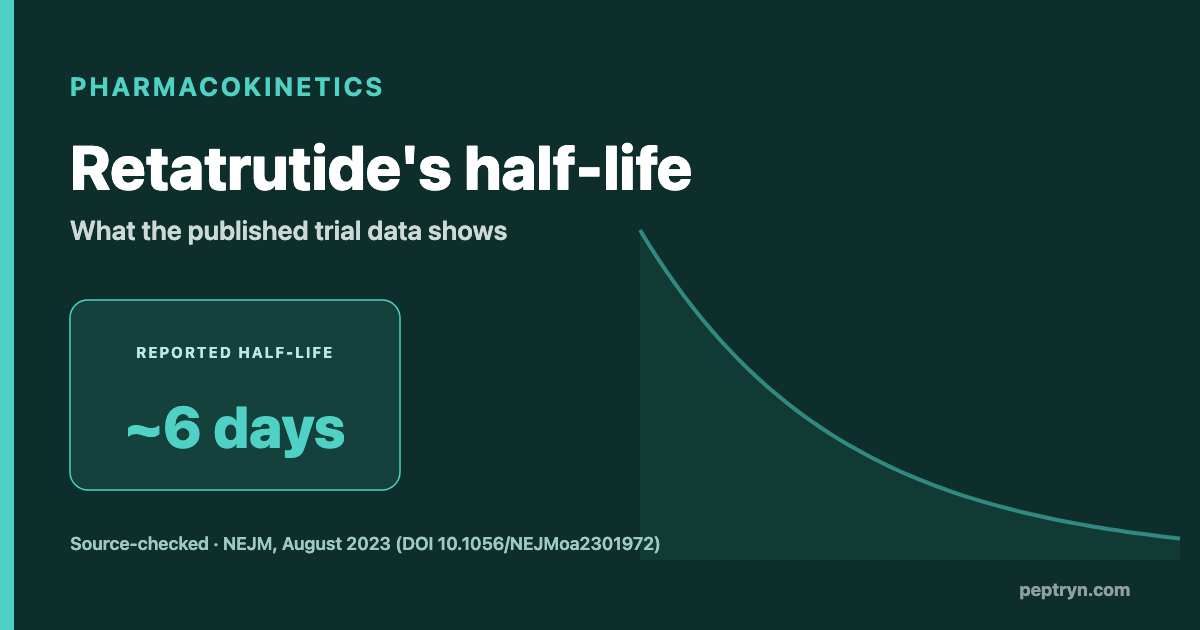
Published trial data puts retatrutide’s half-life at approximately 6 days. That figure comes from the Phase 2 trial results Eli Lilly published in the New England Journal of Medicine in 2023, the same study that first reported retatrutide’s pharmacokinetics in detail.
What half-life means
Half-life is a pharmacology measurement, not a usage instruction. It describes how long it takes for the concentration of a compound in blood plasma to fall by half after it enters the body. A short half-life means a compound clears the body quickly. A long one means it stays measurable for days or weeks. Peptryn does not give dosing or administration guidance for anything it sells; half-life is simply a chemical property researchers report and compare when studying a compound, the same way they report molecular weight or a formula.
What the trial data showed
The 2023 NEJM paper describes retatrutide’s pharmacokinetics as dose-proportional, meaning blood concentrations rose in line with the amount administered, with an elimination half-life of about 6 days. Researchers running that Phase 2 trial designed the study protocol around once-weekly injections for participants, a scheduling decision the trial authors describe as consistent with a compound that clears slowly. That detail describes how the clinical trial was structured, not guidance for handling a research vial.
How that compares to other peptides Peptryn supplies
Half-life varies enormously across peptide classes, and comparing figures from different studies and species is only useful in broad strokes. Published animal data for TB-500 (thymosin beta-4 acetate) puts its elimination half-life at under 30 minutes in rats and beagle dogs, dramatically shorter than retatrutide’s. Sermorelin, a much smaller GHRH fragment, is reported in the pharmacology literature to clear in minutes rather than days. Retatrutide’s multi-day half-life sits at the longer end of what’s been published for peptides in this general size range, similar in order of magnitude to some antibody-conjugated compounds. See our TB-500 product page and sermorelin product page for their own specifications.
Why this figure isn’t the whole picture
A single half-life number from one trial is a starting point for reading the literature, not a complete pharmacokinetic profile. Half-life can shift with dose, formulation, and the population studied, and Lilly’s more recent Phase 3 trials have not yet published the same level of pharmacokinetic detail as the original 2023 paper. Anyone citing this figure for research purposes should read the original trial data directly rather than relying on a summary, including this one.
Common questions
Where does the 6-day figure come from?
From Eli Lilly’s Phase 2 trial results, published in the New England Journal of Medicine in August 2023 (NEJM DOI 10.1056/NEJMoa2301972). It is the earliest published pharmacokinetic data for the compound.
Does Peptryn’s retatrutide behave the same way?
Peptryn cannot speak to pharmacokinetics in a living system. We supply retatrutide as a lyophilized laboratory research material and test each lot for identity and purity; what a compound does after administration is a separate question addressed by the published clinical literature, not by a vial’s COA.
Is a longer half-life better or worse?
Neither, on its own. It is a property that researchers weigh alongside many others when designing a study or comparing compounds. Peptryn does not make comparative claims about which half-life is preferable.
Related: Retatrutide’s FDA approval status · Retatrutide vs semaglutide and tirzepatide · Buying retatrutide for research · Retatrutide product page
For laboratory research use only. Not for human or veterinary use, and not a drug, food, dietary supplement or cosmetic. You must be 21 or older to buy.