Best Peptides for Women: What the Research Shows by Goal
The short answer
There is no single best peptide for women, and for most of the goals women search for, including menopause symptoms, weight, skin, hair and libido, the human evidence for research peptides is thin or absent. The peptides women ask about most fall into a few groups: growth-hormone-axis peptides (sermorelin, CJC-1295, ipamorelin), copper peptides for skin and hair (GHK-Cu, AHK-Cu), tissue-repair peptides (BPC-157), kisspeptin-10 for reproductive-hormone research, and the GLP-1 class for weight. Only two have strong human trial data for a women’s goal, and both are approved prescription drugs: the GLP-1 peptides for body weight and bremelanotide (PT-141, sold as Vyleesi) for low sexual desire in premenopausal women. This guide sorts the peptides women search for by goal and by strength of evidence, covers the women-specific safety points that most pages skip (pregnancy planning, contraception, menstrual-cycle timing), and explains how to vet a research-peptide supplier if you are sourcing materials for laboratory work.
Best peptides for women by goal: evidence at a glance
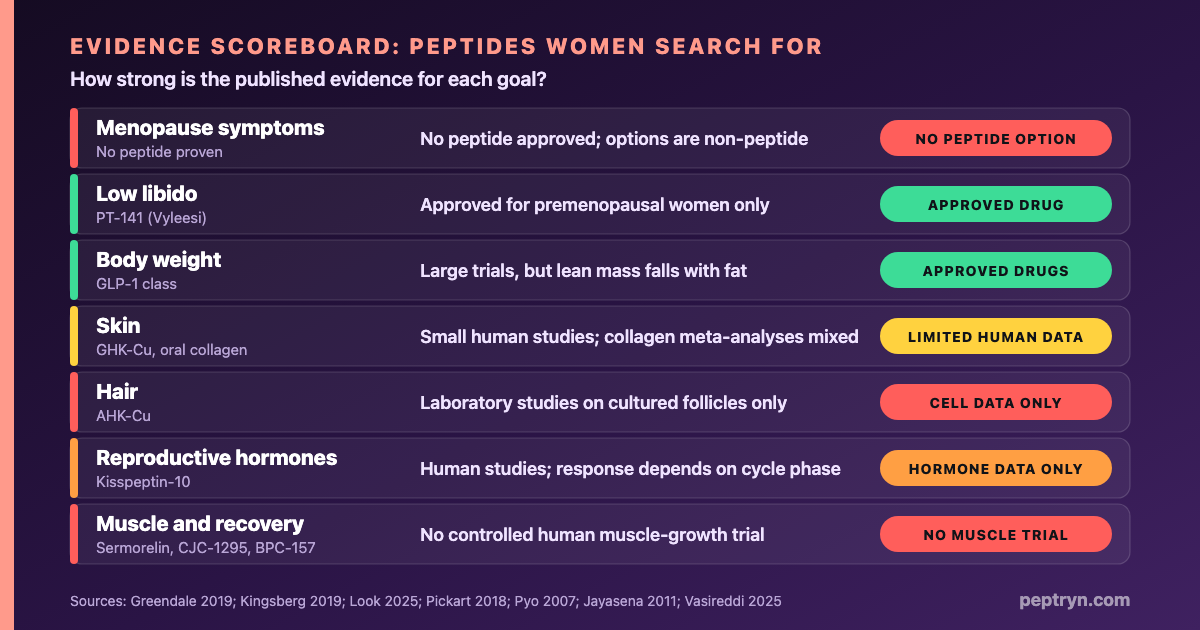
Searches for the best peptides for women and what the best peptides for women are cluster around seven goals. This table shows what the published research says for each and whether Peptryn carries the compound as a laboratory research material.
| Goal | Compounds discussed | What the evidence shows | At Peptryn |
|---|---|---|---|
| Menopause symptoms | None proven | No peptide approved. Approved options are hormone therapy and two non-peptide drugs | Not applicable |
| Low libido | PT-141 | Approved as Vyleesi for premenopausal women, based on two Phase 3 trials | Not sold |
| Body weight | GLP-1 class | Large trials, approved drugs. Lean mass falls with fat. Pregnancy and contraception cautions | Not featured here |
| Skin | GHK-Cu, oral collagen | Small human studies and cell work. Collagen meta-analyses are mixed | GHK-Cu |
| Hair | AHK-Cu | Cultured hair follicles only | AHK-Cu |
| Reproductive hormones | Kisspeptin-10 | Supervised human studies. Response depends on cycle phase | Kisspeptin-10 |
| Muscle and recovery | Sermorelin, CJC-1295, BPC-157 | Hormone levels or animal data. No human muscle-growth trial | All three |
What do peptides do for women?
Peptides are short chains of amino acids, and many act as signaling molecules that prompt the body to release or respond to a hormone. Some are natural to women’s physiology, such as the hypothalamic signals that drive the menstrual cycle, and some are synthetic research compounds designed to mimic or amplify a signal. What a specific peptide does depends entirely on its sequence, which is why findings for one compound do not carry over to another, and why claims that peptides “balance hormones” as a group are not supported by the evidence.
Peptides for menopause
Peptides for menopause is one of the fastest-growing searches in this topic, and the honest answer is that no peptide is approved for menopause symptoms and none has been shown in a controlled trial to relieve them. What is approved is useful to know. Menopausal hormone therapy is the long-established option. Two non-hormonal, non-peptide drugs targeting the brain’s temperature-control pathway have since been approved for moderate to severe hot flashes and night sweats: fezolinetant (Veozah, approved May 2023) and elinzanetant (Lynkuet, approved October 2025).
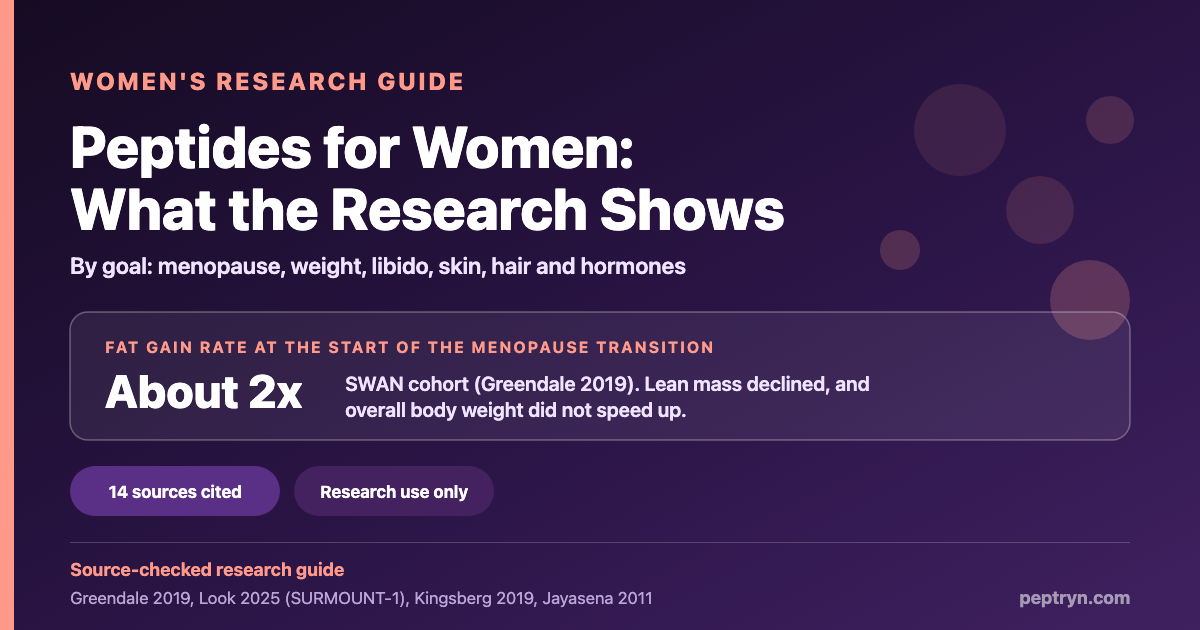
For peptides for menopausal women, the same conclusion holds. The menopause transition also changes body composition in a documented way. In the SWAN cohort (Greendale et al., JCI Insight, 2019; PMID 30843880), the rate of fat gain roughly doubled at the start of the menopause transition and lean mass declined, continuing until about two years after the final menstrual period, while overall body weight did not accelerate. That pattern is part of why women search for peptides for muscle and weight after 40, and it is also why the interventions with the best evidence for it, resistance training and adequate protein, matter more than any research peptide.
Best peptides for women over 40 and over 50
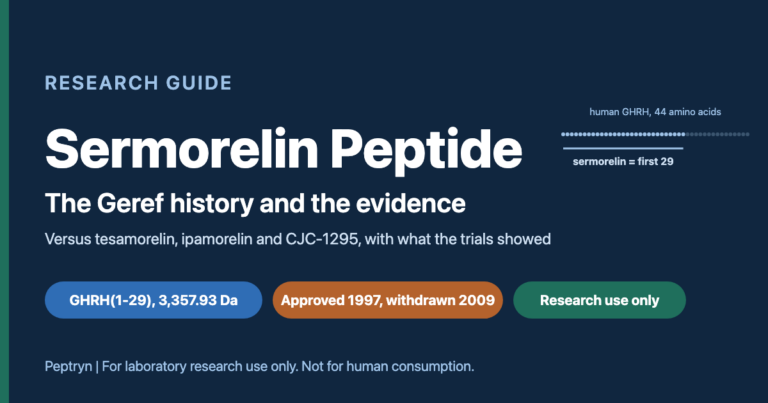
Searches for the best peptides for women over 40 and peptides for women over 50 usually point to growth-hormone-axis compounds such as sermorelin, CJC-1295 and ipamorelin, on the theory that growth hormone secretion declines with age. That is true, and the evidence for what to do about it in women is weaker than for men. The human studies of growth-hormone-releasing hormone fragments in older adults measured growth hormone and IGF-1 levels, not muscle, strength or wellbeing, and the 2007 systematic review of growth hormone in healthy older adults (Liu et al., Annals of Internal Medicine; 220 people receiving growth hormone) found lean mass up about 2.1 kg and fat mass down about 2.1 kg, with more fluid retention, joint pain, carpal tunnel syndrome and insulin resistance. None of the studies cited here was designed to test a muscle or wellbeing benefit specifically in women.
Weight loss peptides for women: what the trials show
Peptides for weight loss is the largest search in the whole peptide category, and the answer to it is dominated by one class: GLP-1 pathway peptides. Searches for the best peptides for weight loss, peptides for women weight loss, weight loss peptides for women and peptides for weight loss women all lead to the same drugs, so this section covers what the trials actually show for women, and it does not recommend or link to any product.
Approved, investigational and research-grade are different things
The FDA-approved peptide drugs for weight are semaglutide (Wegovy, approved 2021), tirzepatide (Zepbound, 2023) and liraglutide (Saxenda, 2014), plus setmelanotide (Imcivree, 2020) for obesity from certain rare genetic conditions. Retatrutide, cagrilintide (in the CagriSema combination) and survodutide are investigational, and none is approved. Research-grade versions of these compounds sold by laboratory suppliers are not the approved drugs, and the FDA has issued warning letters to sellers who marketed them for human use. That distinction is the most important fact on this page for anyone weighing the topic.
Do women respond differently?
In the SURMOUNT-1 tirzepatide trial, analyses by sex reported that 75% of the weight lost by women and 73% of the weight lost by men was fat mass, so the composition of weight lost was similar (Look et al., Diabetes, Obesity and Metabolism, 2025; PMID 39996356). A post hoc analysis (Ard et al., Diabetes, Obesity and Metabolism, 2025; PMID 40677091) reported that women took about 4.2 weeks longer to reach a weight plateau and that more late responders were men, which the analysis suggested could relate to men having lower drug exposure than women of the same weight. Across the whole trial, about a quarter of the weight lost was lean mass, so the lean-mass caution applies to women, and it matters more for women after menopause, when lean mass is already declining.
Pregnancy and contraception
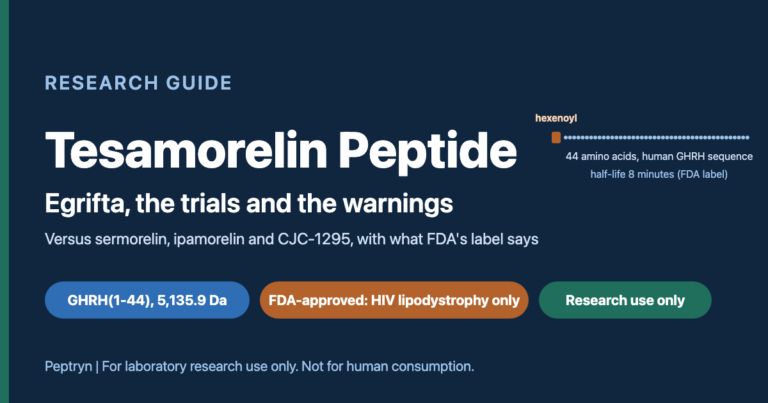
Two label statements are specific to women and often missing from weight-loss content. The Wegovy label advises discontinuing semaglutide at least 2 months before a planned pregnancy because of its long half-life and the potential for fetal harm, and human pregnancy data are limited. The Zepbound label advises that women using oral hormonal contraceptives switch to a non-oral method or add a barrier method for 4 weeks after starting tirzepatide and for 4 weeks after each dose increase, because delayed stomach emptying may reduce the contraceptive’s effectiveness. Tesamorelin is likewise contraindicated in pregnancy.
Natural peptides and fat-burning peptides for women
Searches for natural peptides for weight loss women and fat burning peptides for women lead to two dead ends. We found no controlled trial showing that a natural or over-the-counter peptide supplement, including collagen, causes weight loss. Among research compounds marketed as fat-burning, AOD-9604 failed its Phase IIb human obesity trial and development for that use stopped in 2007, and 5-Amino-1MQ is a small molecule, not a peptide, with mouse data only. The best weight loss peptides for women, in the sense of what has been proven, are therefore the approved drugs described above, prescribed by a licensed clinician.
Peptides for women’s libido and sexual health
Peptides for libido in women is a genuine exception to the thin-evidence rule, but it is an approved drug, not a research peptide. Bremelanotide (PT-141) was approved by the FDA in June 2019 as Vyleesi for acquired, generalized hypoactive sexual desire disorder in premenopausal women, based on two identical Phase 3 trials that showed statistically significant improvements in desire scores versus placebo (Kingsberg et al., Obstetrics and Gynecology, 2019; PMID 31599840). Nausea and transient blood pressure increases were among the most common adverse findings. Peptryn does not sell bremelanotide.
Peptides for skin and hair in women
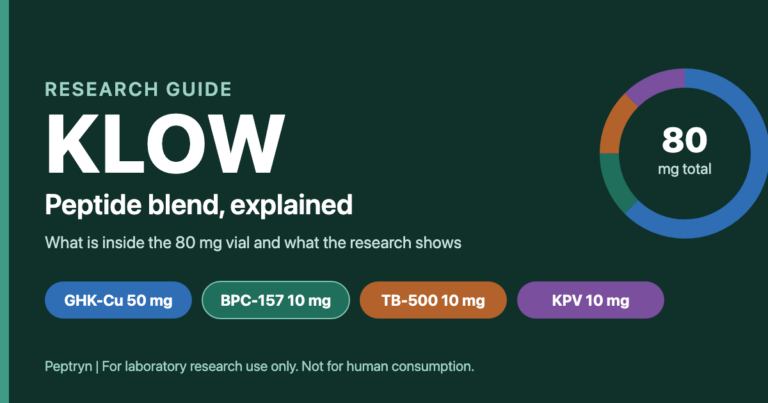
Hair growth peptides for women and skin-focused searches point mostly to copper peptides. GHK-Cu has the most research of the group: cell and animal work linking it to collagen synthesis and tissue-repair signaling (Pickart and Margolina, International Journal of Molecular Sciences, 2018), and a small number of controlled human skin studies of GHK-Cu formulations with limited independent replication. For hair, the published work on AHK-Cu is a 2007 laboratory study on cultured human hair follicles (Pyo et al.; PMID 17703734), not a human trial, and the FDA-approved over-the-counter option for female pattern hair loss is topical minoxidil, not a peptide.
Oral collagen peptides are a separate, food-category product. A 2021 meta-analysis (de Miranda et al., International Journal of Dermatology) reported improved skin hydration, elasticity and wrinkles versus placebo, while a 2025 meta-analysis was reported to conclude there is no proven benefit, so the honest summary is that results are mixed.
Kisspeptin-10 and women’s reproductive hormones
Kisspeptin-10 is the peptide with the most sex-specific human data, and it shows why “for women” cannot be assumed from studies in men. In a supervised study (Jayasena et al., Journal of Clinical Endocrinology and Metabolism, 2011; PMID 21976724), intravenous kisspeptin-10 raised LH and FSH in men and in women during the preovulatory phase of the cycle, but produced no change in gonadotropins in women during the follicular phase even at the highest doses tested. The response depended on cycle phase, the studies were short and supervised, and they measured hormone levels rather than symptoms, so they do not establish any self-use approach.
Peptides for muscle and recovery in women
Searches for peptides for muscle growth women and BPC-157 peptides for women lead to the same evidence as for men: no controlled human trial of these peptides shows muscle or strength gains, and the BPC-157 evidence is mostly animal data (35 preclinical studies and 1 clinical study among 36 in a 2025 systematic review; PMID 40756949). See our guides to peptides for muscle growth and the BPC-157 research guide.
Women-specific safety checks
Five points come up for women in particular, and a good guide names them plainly.
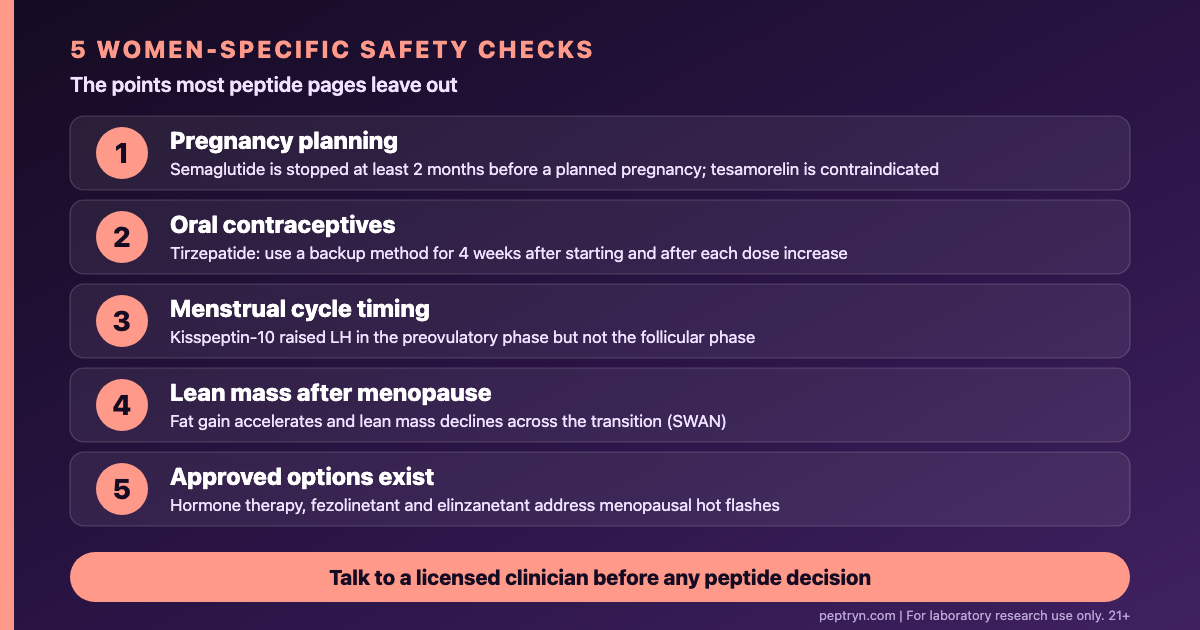
- Pregnancy planning. Semaglutide is stopped at least 2 months before a planned pregnancy, and tesamorelin is contraindicated in pregnancy.
- Oral contraceptives. Tirzepatide can reduce oral contraceptive effectiveness, so the label advises a backup method for 4 weeks after starting and after each increase.
- Cycle timing. Kisspeptin-10 raised gonadotropins in the preovulatory phase but not the follicular phase, so results in one phase do not predict another.
- Lean mass after menopause. Fat gain accelerates and lean mass declines across the transition, which makes muscle loss from any weight-reducing drug a bigger issue.
- Approved options exist. Hormone therapy and two approved non-peptide drugs address menopausal hot flashes, so a peptide is not the only or the proven route.
What has the best evidence for women
For body composition, the interventions with the strongest evidence are resistance training and adequate protein: a meta-analysis of 49 trials (Morton et al., British Journal of Sports Medicine, 2018; PMID 28698222) found that protein supplementation added about 0.30 kg of fat-free mass and 2.49 kg of strength on top of resistance training. Persistent low energy, mood changes, sleep disruption and changing cycles have many causes, from thyroid and iron status to perimenopause, and a licensed clinician can evaluate them. That evaluation, not a research peptide, is the step that determines what is relevant.
How to choose a research-peptide supplier
If you are sourcing peptides for laboratory research, the compound matters less than whether you can verify what is in the vial. Five checks separate a supplier worth using from one that is not:
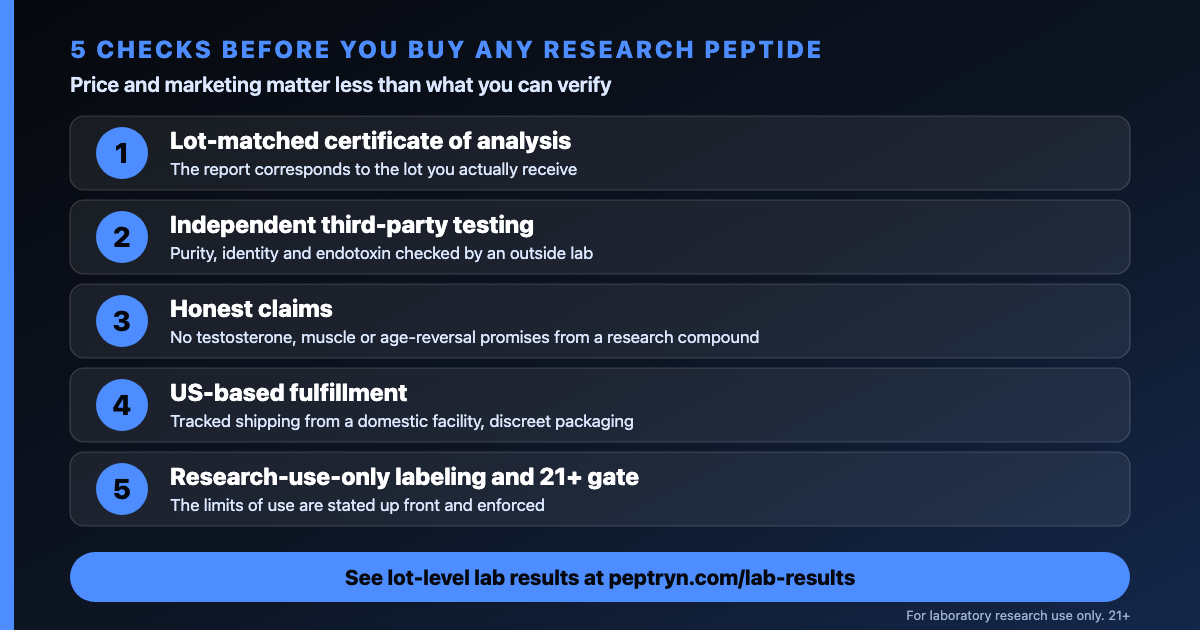
- A lot-matched certificate of analysis. The report should correspond to the lot you receive (see what is a COA).
- Independent testing. Purity, identity and endotoxin testing by an outside lab (see peptide purity).
- Honest claims. A supplier promising hormone balance, weight, skin or libido results from a research compound is asserting something the science does not support.
- US-based fulfillment. Tracked shipping from a domestic facility and discreet packaging.
- Clear research-use-only labeling and an age gate. Legitimate suppliers state the limits of use and require buyers to be 21 or older. See our peptide legality guide.
Peptryn was built around those checks: independent third-party testing of every batch, Certificates of Analysis published by lot in the COA Library, and US-based fulfillment. Read more on our about page.
Sourcing research peptides for laboratory work?
Check the lot-level certificates of analysis first, then browse the compounds below. Orders over $150 ship free, with same-day dispatch from the USA. Research use only. You must be 21 or older.
Research materials commonly studied in women’s-health research
These are the compounds from this guide that Peptryn carries as laboratory research materials. Each is sold for in-vitro research only, and nothing here is a claim that it produces any result in people.
Kisspeptin-10
Studied in supervised human research on reproductive hormone release.
Why there is no established dose, timing or schedule
Many searches in this topic ask how to take peptides or what the best dose is for women. No controlled human trial has established a dose, timing, route or schedule of the research peptides discussed here for any of these goals in women. The doses in the studies cited above were supervised research protocols, often intravenous, and they do not transfer to self-administration. Any chart in circulation is extrapolated from animal work, vendor material or anecdote. For that reason this guide does not give doses, timing, routes or schedules.
Common questions
What are the best peptides for women?
The research does not support a single best peptide. Only two peptide drugs have strong human trial data for a women’s goal, and both are prescription drugs: GLP-1 peptides for body weight and bremelanotide for low sexual desire in premenopausal women. Research peptides such as GHK-Cu, AHK-Cu, kisspeptin-10 and BPC-157 have cell, animal or short supervised human data only.
What are the benefits of peptides for women?
Proven benefits are limited to approved drugs for specific indications. For research peptides, reported benefits are hypotheses drawn from animal and cell studies, and none has been confirmed in a controlled human trial for women.
What are the best peptides for women over 40?
Sermorelin, CJC-1295 and ipamorelin are discussed most, but the human studies measured hormone levels, not strength or wellbeing, and none was designed for women. After 40, menopause-related body composition changes are better addressed with resistance training and protein.
What are the best peptides for women over 50?
No peptide has been shown to improve muscle, energy or menopause symptoms in women over 50 in a controlled trial. Approved menopause options are hormone therapy, fezolinetant and elinzanetant.
Are there peptides for menopause?
No peptide is approved for menopause symptoms. Fezolinetant (2023) and elinzanetant (2025) are approved non-hormonal drugs for hot flashes and night sweats, and they are not peptides.
What are the best weight loss peptides for women?
The only peptides with strong trial data for weight are approved drugs: semaglutide, tirzepatide and liraglutide. Their trials show substantial weight reduction with about a quarter to two-fifths of the loss as lean mass, and women have pregnancy and contraception cautions on the labels.
Do peptides for weight loss work differently in women?
In SURMOUNT-1, the share of weight lost as fat was similar in women (75%) and men (73%), women took about 4.2 weeks longer to plateau, and men had lower drug exposure at the same body weight.
Can you take weight loss peptides while trying to get pregnant?
The Wegovy label advises stopping semaglutide at least 2 months before a planned pregnancy. Tesamorelin is contraindicated in pregnancy. Anyone planning pregnancy should discuss any peptide drug with a clinician first.
Do weight loss peptides affect birth control?
Tirzepatide may reduce the effectiveness of oral hormonal contraceptives, and the label advises a non-oral or barrier method for 4 weeks after starting and after each dose increase.
Are there natural peptides or fat burning peptides for women?
We found no controlled trial showing that a natural or over-the-counter peptide supplement causes weight loss. AOD-9604, sold as a fat-burning peptide, failed its human obesity trial in 2007, and 5-Amino-1MQ is a small molecule with mouse data only.
What are the most popular peptides for women?
The most-searched are GHK-Cu, BPC-157, the growth-hormone-axis peptides (CJC-1295, ipamorelin, sermorelin) and the GLP-1 drugs. Popularity reflects marketing and search interest, not evidence. See our popular peptides ranking for FDA status of each.
Can peptides balance hormones in women?
No peptide has been shown to balance hormones in women as a group of effects. Kisspeptin-10 raised gonadotropins in supervised studies only during certain cycle phases, and menopause symptoms have approved non-peptide options. Claims about peptides for hormone balance in women are not supported by controlled trials.
What are the best injectable peptides for women?
The injectable peptides with real human trial data for women are approved prescription drugs: the GLP-1 class for body weight and bremelanotide for low sexual desire in premenopausal women. Research-use-only peptides are sold to laboratories and are not for human use.
Are there peptides for women’s libido?
Bremelanotide (Vyleesi) is FDA-approved for low sexual desire in premenopausal women, and it can cause nausea and raise blood pressure. Peptryn does not sell it.
Are there peptides for hair growth in women?
The research on AHK-Cu and hair is limited to cultured hair follicles. The FDA-approved option for female pattern hair loss is topical minoxidil, not a peptide.
Are peptides safe for women?
Long-term human safety has not been established for the research peptides discussed. Women-specific concerns include pregnancy, contraception interactions and lean-mass loss after menopause.
Where can women buy research peptides, and what should they check?
Research-use-only suppliers sell lyophilized materials to laboratories for in-vitro research, not for human use. Check for a lot-matched certificate of analysis, independent testing, honest claims, US-based fulfillment and an age gate. See how Peptryn’s COA Library works.
Related: Best peptides for men · Peptides for muscle growth · Best peptides for muscle growth and fat loss · List of peptides and what they do · What is a COA? · Peptides for weight loss: what the evidence shows
Sources
Greendale GA, et al. Changes in body composition and weight during the menopause transition. JCI Insight, 2019 (PMID 30843880). pubmed.ncbi.nlm.nih.gov
Look M, et al. Body composition changes during weight reduction with tirzepatide in the SURMOUNT-1 study. Diabetes, Obesity and Metabolism, 2025 (PMID 39996356). pubmed.ncbi.nlm.nih.gov
Ard J, et al. Weight reduction over time in tirzepatide-treated participants by early weight loss response: post hoc analysis in SURMOUNT-1. Diabetes, Obesity and Metabolism, 2025 (PMID 40677091). pubmed.ncbi.nlm.nih.gov
U.S. Food and Drug Administration. Zepbound (tirzepatide) prescribing information and Wegovy (semaglutide) prescribing information. accessdata.fda.gov
Kingsberg SA, et al. Bremelanotide for the treatment of hypoactive sexual desire disorder: two randomized phase 3 trials. Obstetrics and Gynecology, 2019 (PMID 31599840). pubmed.ncbi.nlm.nih.gov
Jayasena CN, et al. Effects of kisspeptin-10 on reproductive hormone release show sexual dimorphism in humans. Journal of Clinical Endocrinology and Metabolism, 2011 (PMID 21976724). pubmed.ncbi.nlm.nih.gov
Liu H, et al. Systematic review: the safety and efficacy of growth hormone in the healthy elderly. Annals of Internal Medicine, 2007;146(2):104-115. doi.org/10.7326/0003-4819-146-2-200701160-00005
Pickart L, Margolina A. Regenerative and protective actions of the GHK-Cu peptide in the light of the new gene data. International Journal of Molecular Sciences, 2018 (PMC6073405). pmc.ncbi.nlm.nih.gov
Pyo HK, et al. The effect of tripeptide-copper complex on human hair growth in vitro. Archives of Pharmacal Research, 2007 (PMID 17703734). pubmed.ncbi.nlm.nih.gov
de Miranda RB, Weimer P, Rossi RC. Effects of hydrolyzed collagen supplementation on skin aging: a systematic review and meta-analysis. International Journal of Dermatology, 2021. onlinelibrary.wiley.com
Vasireddi N, et al. Emerging use of BPC-157 in orthopaedic sports medicine: a systematic review. HSS Journal, 2025 (PMID 40756949). pubmed.ncbi.nlm.nih.gov
Morton RW, et al. A systematic review, meta-analysis and meta-regression of the effect of protein supplementation on resistance training-induced gains in muscle mass and strength in healthy adults. British Journal of Sports Medicine, 2018 (PMID 28698222). pubmed.ncbi.nlm.nih.gov
U.S. Food and Drug Administration. Approvals of Veozah (fezolinetant, May 12, 2023) and Lynkuet (elinzanetant, October 24, 2025) for menopausal vasomotor symptoms. fda.gov
Heffernan M, et al. The effects of human GH and its lipolytic fragment (AOD9604) on lipid metabolism. Endocrinology, 2001 (PMID 11713213). pubmed.ncbi.nlm.nih.gov
For laboratory research use only. Not for human or veterinary use, and not a drug, food, dietary supplement or cosmetic. You must be 21 or older to buy.