CJC-1295 Peptide: With DAC vs Without DAC, Mod GRF 1-29, and What the Research Shows
Research use only. Peptides supplied by Peptryn are sold strictly for in vitro and preclinical laboratory research. They are not approved by the FDA for human or veterinary use, and nothing here is medical advice, a dosing recommendation, or an instruction for self-administration. This guide summarizes published research on CJC-1295 and explains how to read a certificate of analysis.
Quick answer: what is CJC-1295?
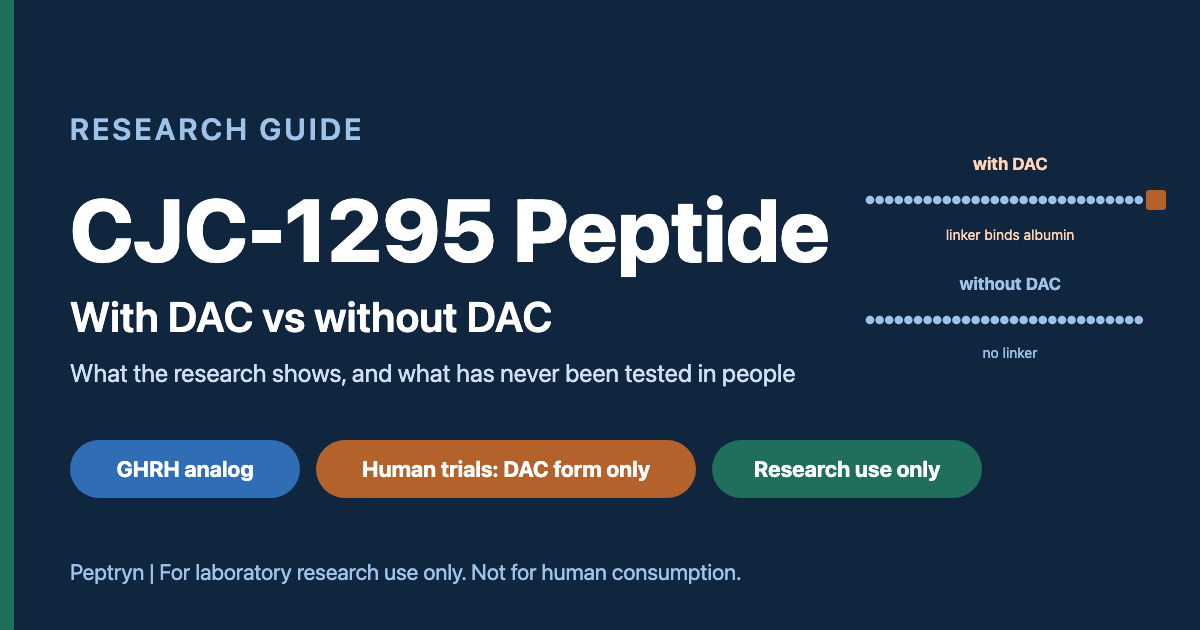
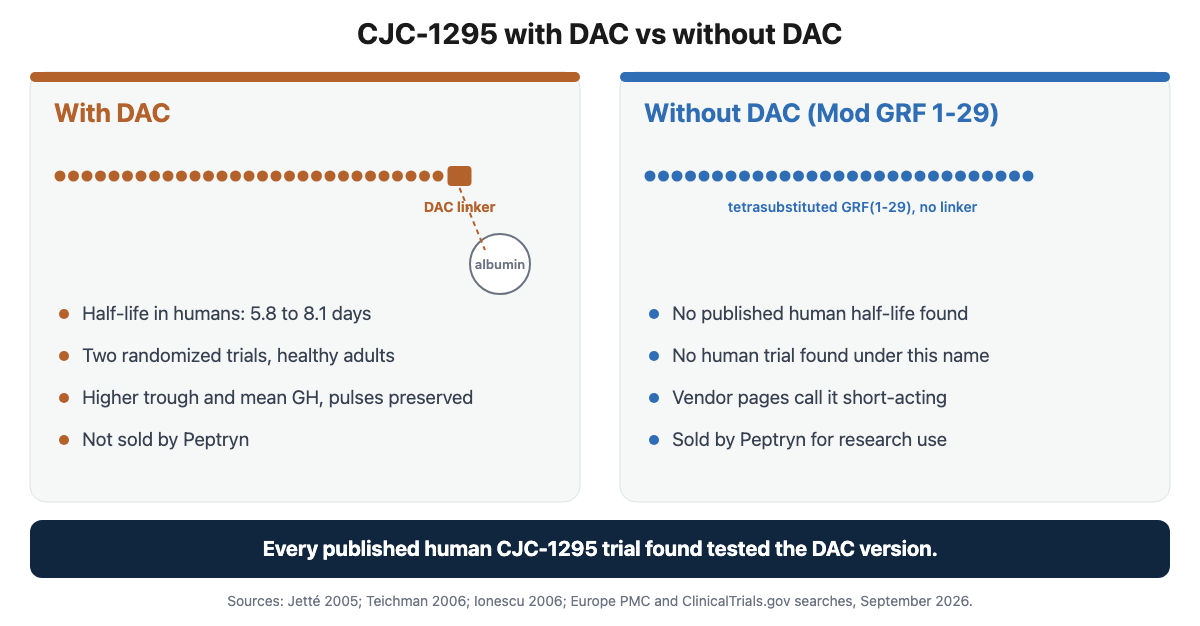
CJC-1295 is a synthetic analog of growth hormone-releasing hormone (GHRH), the hypothalamic signal that tells the pituitary to release growth hormone (GH). The name covers two different products. CJC-1295 with DAC (drug affinity complex) carries a chemical linker that attaches it to albumin in the blood. CJC-1295 without DAC, also called Modified GRF (1-29) or Mod GRF 1-29, does not carry that linker.
The distinction matters because of what has been studied. The human trials of CJC-1295 published in the medical literature tested the DAC version. In healthy adults a single injection raised mean GH 2- to 10-fold for 6 days or more, with an estimated half-life of 5.8 to 8.1 days. We found no published human trial of the without-DAC form under that name, and no published human half-life for it. Peptryn sells the without-DAC form for laboratory research.
With DAC and without DAC at a glance
| CJC-1295 with DAC | CJC-1295 without DAC (Mod GRF 1-29) | |
|---|---|---|
| Structure | Tetrasubstituted GRF(1-29) plus a lysine-based linker that binds albumin | Tetrasubstituted GRF(1-29), no linker |
| Published human data | Yes: two randomized, placebo-controlled trials in healthy adults, plus follow-up analyses | None found under this name |
| Published half-life | 5.8 to 8.1 days in humans | No published human figure found |
| GH pattern reported | Higher trough and mean GH, pulses preserved | Not reported in human studies found |
| Peptryn listing | Not sold | 10 mg vial, lyophilized, research use only |
Table of contents
- What CJC-1295 is
- CJC-1295 with or without DAC: what actually differs
- What the human studies tested
- CJC peptide benefits: what the studies measured
- CJC-1295 dosage: why there is no established one
- CJC-1295 side effects and safety
- CJC-1295 vs sermorelin vs tesamorelin
- Regulatory and sport status
- How to evaluate a CJC-1295 vial
- Frequently asked questions
- Final take
What CJC-1295 is
Sermorelin is the first 29 amino acids of human GHRH. A 1999 review describes it as the shortest synthetic peptide with the full biological activity of GHRH. CJC-1295 builds on that sequence. Jetté and colleagues (2005) describe it as a tetrasubstituted form of hGRF(1-29), meaning four amino acids were substituted, with an added maleimidopropionamide derivative of lysine at the C-terminus. That added group reacts with a free thiol on Cys34 of serum albumin, so after injection the peptide binds albumin and stays in circulation. In rats it was still detectable in plasma beyond 72 hours and produced about four times the GH exposure of unmodified hGRF(1-29) over 2 hours.
That linker is the DAC. Take it away and you have the tetrasubstituted GRF(1-29) alone, which vendors sell as “CJC-1295 without DAC” or “Mod GRF 1-29”. Peptryn’s certificate of analysis for its lot names the compound “CJC-1295 without DAC, also known as Modified GRF (1-29)”.
CJC-1295 with or without DAC: what actually differs
The half-life is the headline difference, and it comes from the linker. The albumin-bound DAC version gave a human half-life of 5.8 to 8.1 days in one trial and about 8 days in another analysis. Vendor pages, including Peptryn’s own listing, describe the no-DAC form as short-acting, but we found no human pharmacokinetic study that puts a number on it.
The second difference is the pattern of GH exposure. Ionescu and Frohman (2006) sampled healthy men overnight one week after a DAC injection. GH pulses kept their normal frequency and size, while the baseline between pulses rose about 7.5-fold. The authors linked that raised baseline to the higher IGF-I. No comparable overnight sampling has been published for the no-DAC form.
The third difference is the evidence itself. Everything in the table above that reads “yes” for the DAC version reads “none found” for the other. A page that describes how the no-DAC form behaves in people is describing the DAC data, a different product’s data, or animal work.
What the human studies tested
Teichman and colleagues (2006) ran two randomized, placebo-controlled, double-blind, ascending-dose trials in healthy adults aged 21 to 61, lasting 28 and 49 days. After one injection, mean GH rose 2- to 10-fold for 6 days or more and mean IGF-I rose 1.5- to 3-fold for 9 to 11 days. With repeated doses, IGF-I stayed above baseline for up to 28 days. No serious adverse reactions were reported, and the authors called it relatively well tolerated at the doses they judged best.
Sackmann-Sala and colleagues (2009) analyzed serum from 11 healthy young men before and one week after a CJC-1295 injection and found protein changes that track GH and IGF-I activity, useful as candidate biomarkers. Alba and colleagues (2006) reported that once-daily CJC-1295 normalized growth in GHRH-knockout mice.
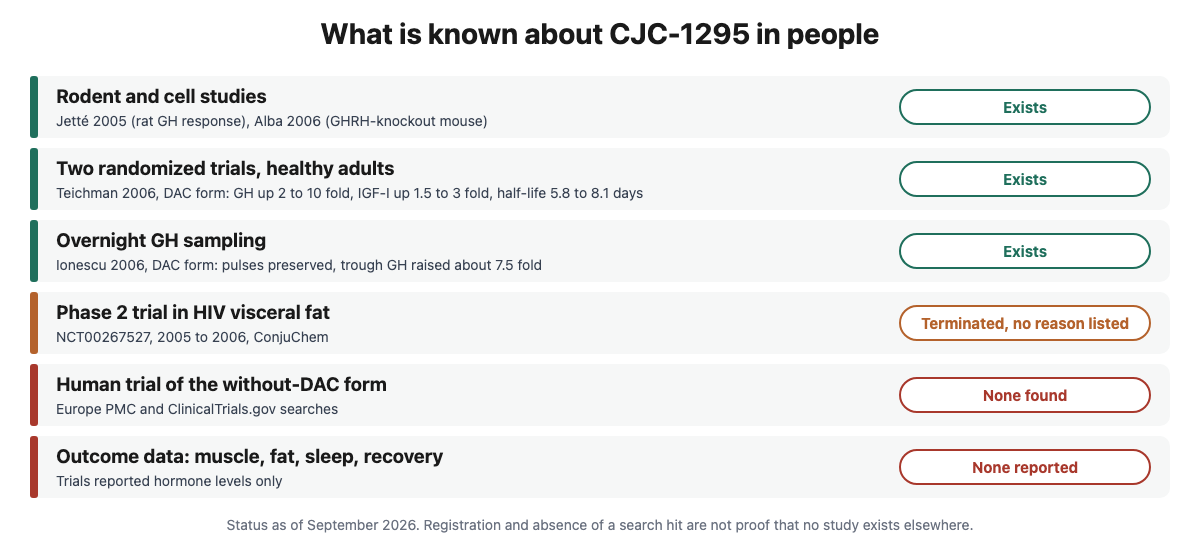
One phase 2 trial tested a clinical outcome. ConjuChem registered a 12-week randomized study of CJC-1295 in HIV patients with visceral fat (NCT00267527), running from December 2005 to September 2006. The registry lists it as terminated and gives no reason.
A 2026 narrative review in Frontiers in Endocrinology sorts these peptides into evidence tiers and lists CJC-1295 with DAC and CJC-1295 without DAC as separate entries. Its stated concern is the gap between the peer-reviewed data and the protocols circulating online.
CJC peptide benefits: what the studies measured
The trials measured hormone levels: GH, IGF-I, and the pharmacokinetics of the peptide. They did not report muscle mass, fat loss, sleep quality or recovery, which are the benefits online pages attach to CJC-1295. A rise in IGF-I is a marker, and it has not been shown to produce any of those effects in this peptide’s studies. The one trial built to test a clinical endpoint was terminated.
The honest summary of “CJC peptide benefits” is therefore narrow. In healthy adults the DAC form raised GH and IGF-I in a dose-dependent way. For the without-DAC form, the human benefit literature is empty.
CJC-1295 dosage: why there is no established one
Dosage is the second-largest search cluster around this peptide, and no dose has been established for the without-DAC form. The published human doses were weight-based and given to healthy adults in a research setting, using the DAC version, so they do not describe a vial of the other product. Online dosing charts mix the two versions, borrow numbers from animal work or from sermorelin, and disagree with each other. Peptryn does not publish a dose for any product, and this guide does not either.
CJC-1295 side effects and safety
Teichman’s trials reported no serious adverse reactions. FDA’s view is more cautious. On its page for bulk drug substances that may present significant safety risks (content current as of 04/22/2026), FDA lists CJC-1295 in Category 2 and says compounded drugs containing it may pose a risk of immunogenicity for certain routes of administration and may involve complexities with peptide-related impurities and characterization of the active ingredient. FDA also states that it has identified serious adverse events associated with CJC-1295, including increased heart rate and a systemic vasodilatory reaction, and that available clinical data are limited.
The 2026 Frontiers review lists adverse effects reported across this drug class in clinical practice, including prolactin and cortisol elevations, appetite changes, dysglycemia, fluid retention, muscle and joint symptoms and injection-site reactions. It also flags the uncertainty around product composition, dose and stacking in unregulated supply. These are class-level reports and not findings specific to one peptide.
CJC-1295 vs sermorelin vs tesamorelin
All three are GHRH analogs. Sermorelin is GHRH(1-29) itself. A 1999 review covers its use in diagnosing and treating children with idiopathic growth hormone deficiency. Tesamorelin, a longer GHRH analog, was tested in 412 HIV patients with abdominal fat accumulation and cut visceral fat 15.2% versus a 5.0% rise on placebo over 26 weeks (Falutz 2007), and FDA approved it as Egrifta on November 10, 2010. CJC-1295 has no approval. Of the three, tesamorelin has the strongest human evidence for a clinical outcome, and it is a regulated drug product, which a research vial is not.
Regulatory and sport status
FDA lists CJC-1295 in Category 2 of the bulk substances nominated for compounding, the group it says may present significant safety risks. The World Anti-Doping Agency prohibits it at all times. The prohibited list names CJC-1295 as an example of a GHRH analogue under S2. Peptryn sells it for laboratory research only. For how the “research use only” framing fits with US law, see our guide on whether peptides are legal.
How to evaluate a CJC-1295 vial
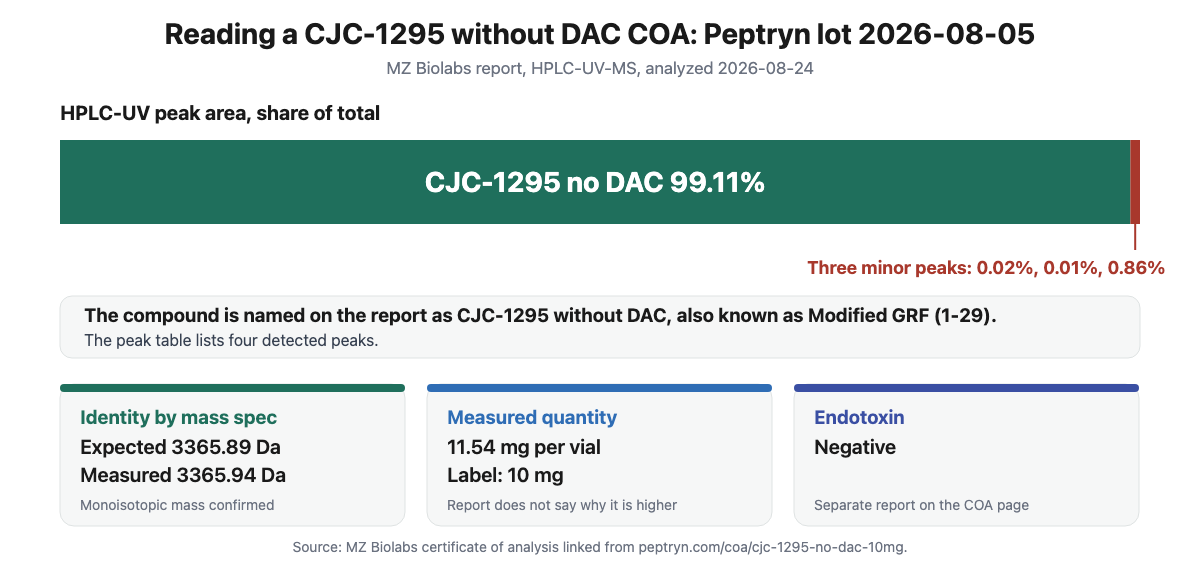
The first check is the name. A COA for “CJC-1295” should say whether it is the DAC version, and the mass tells you: the DAC version carries an extra linker and is heavier than the tetrasubstituted GRF(1-29) alone. Peptryn’s CJC-1295 no DAC COA page links to the MZ Biolabs report, and it makes a useful worked example.
| COA field | What the report shows |
|---|---|
| Compound name | CJC-1295 without DAC, also known as Modified GRF (1-29) |
| Lot and analysis date | 2026-08-05, analyzed 2026-08-24, HPLC-UV-MS |
| Main peak | 99.11% of peak area, with three minor peaks at 0.02%, 0.01% and 0.86% |
| Identity by mass spec | Expected monoisotopic mass 3365.89 Da, measured 3365.94 Da |
| Measured quantity | 11.54 mg per vial (label: 10 mg) |
| Endotoxin | Negative, per the separate report on the COA page |
The report does not explain why the measured quantity exceeds the label, so ask the supplier before you calculate concentrations from the label amount. See our guide to how to read a certificate of analysis for the full checklist.
Frequently asked questions
Is CJC-1295 a peptide?
Yes. It is a synthetic peptide analog of GHRH built on the first 29 amino acids, with four substitutions. The DAC version adds a linker that binds albumin.
What is the difference between CJC-1295 with and without DAC?
The DAC version carries a linker that binds albumin and extends its half-life to days in humans. The without-DAC version lacks it. All published human trials we found tested the DAC form.
Is Mod GRF 1-29 the same as CJC-1295 without DAC?
Peptryn’s COA uses both names for one compound. Published work describes CJC-1295 as tetrasubstituted GRF(1-29) plus the linker, so removing the linker leaves the modified GRF(1-29).
What is the half-life of CJC-1295?
The published human half-life, 5.8 to 8.1 days, is for the DAC form. We found no published human half-life for the without-DAC form.
Does CJC-1295 work?
In healthy adults, the DAC form raised GH and IGF-I in a dose-dependent way. No published trial shows it changes body composition, sleep or recovery, and the one clinical-outcome trial was terminated.
What are the side effects of CJC-1295?
The published trials reported no serious adverse reactions. FDA says it has identified serious adverse events, including increased heart rate and a systemic vasodilatory reaction, and notes that clinical data are limited. This is a summary of sources, not medical advice.
Is CJC-1295 legal?
FDA lists it in Category 2 for compounding, and WADA prohibits it in sport. See our legal guide for how research-use-only sales are treated.
Final take
CJC-1295 is two products under one name. The one with published human trials is the DAC form: hormone levels up in healthy adults, no serious adverse reactions in two small trials, and one clinical-outcome trial terminated. The without-DAC form has no published human study under its name. For a laboratory, the useful details are which form the vial contains, the mass the COA confirms, and the measured quantity. On Peptryn’s lot 2026-08-05 the main peak is 99.11%, the mass matches, and the measured quantity is 11.54 mg per 10 mg vial.
See CJC-1295 without DAC with its batch COA · Browse GH secretagogue research peptides
Related guides: Sermorelin peptide guide · Ipamorelin peptide guide · CJC-1295 and ipamorelin · How to read a certificate of analysis · Are peptides legal? · Tesamorelin peptide guide · What is a COA? · Peptide purity · Peptide testing · Popular peptides
Editorial note: Peptryn sells the research peptides discussed in this guide for laboratory use only. This guide is informational and is not medical advice. Sources are listed below. To report an error, email [email protected].
Sources
- Jetté L, Léger R, Thibaudeau K, et al. Human growth hormone-releasing factor (hGRF)1-29-albumin bioconjugates activate the GRF receptor on the anterior pituitary in rats: identification of CJC-1295 as a long-lasting GRF analog. Endocrinology, 2005. pubmed.ncbi.nlm.nih.gov
- Teichman SL, Neale A, Lawrence B, et al. Prolonged stimulation of growth hormone and insulin-like growth factor I secretion by CJC-1295, a long-acting analog of GH-releasing hormone, in healthy adults. J Clin Endocrinol Metab, 2006. pubmed.ncbi.nlm.nih.gov
- Ionescu M, Frohman LA. Pulsatile secretion of growth hormone persists during continuous stimulation by CJC-1295, a long-acting GH-releasing hormone analog. J Clin Endocrinol Metab, 2006. pubmed.ncbi.nlm.nih.gov
- Sackmann-Sala L, Ding J, Frohman LA, Kopchick JJ. Activation of the GH/IGF-1 axis by CJC-1295, a long-acting GHRH analog, results in serum protein profile changes in normal adult subjects. Growth Horm IGF Res, 2009. pmc.ncbi.nlm.nih.gov
- Alba M, Fintini D, Sagazio A, et al. Once-daily administration of CJC-1295, a long-acting growth hormone-releasing hormone (GHRH) analog, normalizes growth in the GHRH knockout mouse. Am J Physiol Endocrinol Metab, 2006. pubmed.ncbi.nlm.nih.gov
- Dominikowski A, Rękoś Z, Olejarz M, et al. The emerging landscape of performance-enhancing peptides modulating GH-IGF1 axis: bridging the gap between clinical evidence and patient self-administration. Front Endocrinol, 2026. pmc.ncbi.nlm.nih.gov
- Prakash A, Goa KL. Sermorelin: a review of its use in the diagnosis and treatment of children with idiopathic growth hormone deficiency. BioDrugs, 1999. pubmed.ncbi.nlm.nih.gov
- Falutz J, Allas S, Blot K, et al. Metabolic effects of a growth hormone-releasing factor in patients with HIV. N Engl J Med, 2007. pubmed.ncbi.nlm.nih.gov
- U.S. Food and Drug Administration. Certain Bulk Drug Substances for Use in Compounding that May Present Significant Safety Risks (content current as of 04/22/2026). fda.gov
- U.S. FDA, Drugs@FDA: Egrifta (tesamorelin acetate), application 022505, original approval November 10, 2010. accessdata.fda.gov
- World Anti-Doping Agency. The Prohibited List, section S2. wada-ama.org
- ClinicalTrials.gov: NCT00267527 (CJC 1295 in HIV visceral obesity, terminated).
- PubChem, National Library of Medicine: CID 91976842, as cited on the MZ Biolabs report.
- MZ Biolabs certificate of analysis, CJC-1295 without DAC 10 mg, lot 2026-08-05, via peptryn.com/coa/cjc-1295-no-dac-10mg.
All products on peptryn.com are intended for laboratory research purposes only. Not for human consumption, self-administration, or veterinary use. The information on this page has not been evaluated by the U.S. Food and Drug Administration and is not intended to diagnose, treat, cure, or prevent any disease.