Eloralintide Structure, Formula, Molecular Weight and Half-Life Explained (2026)
Research use only. This guide is education, not medical advice. Eloralintide is an investigational drug that no regulator has approved. Nothing here is a dosing recommendation or an instruction for self-administration, and Peptryn gives none.
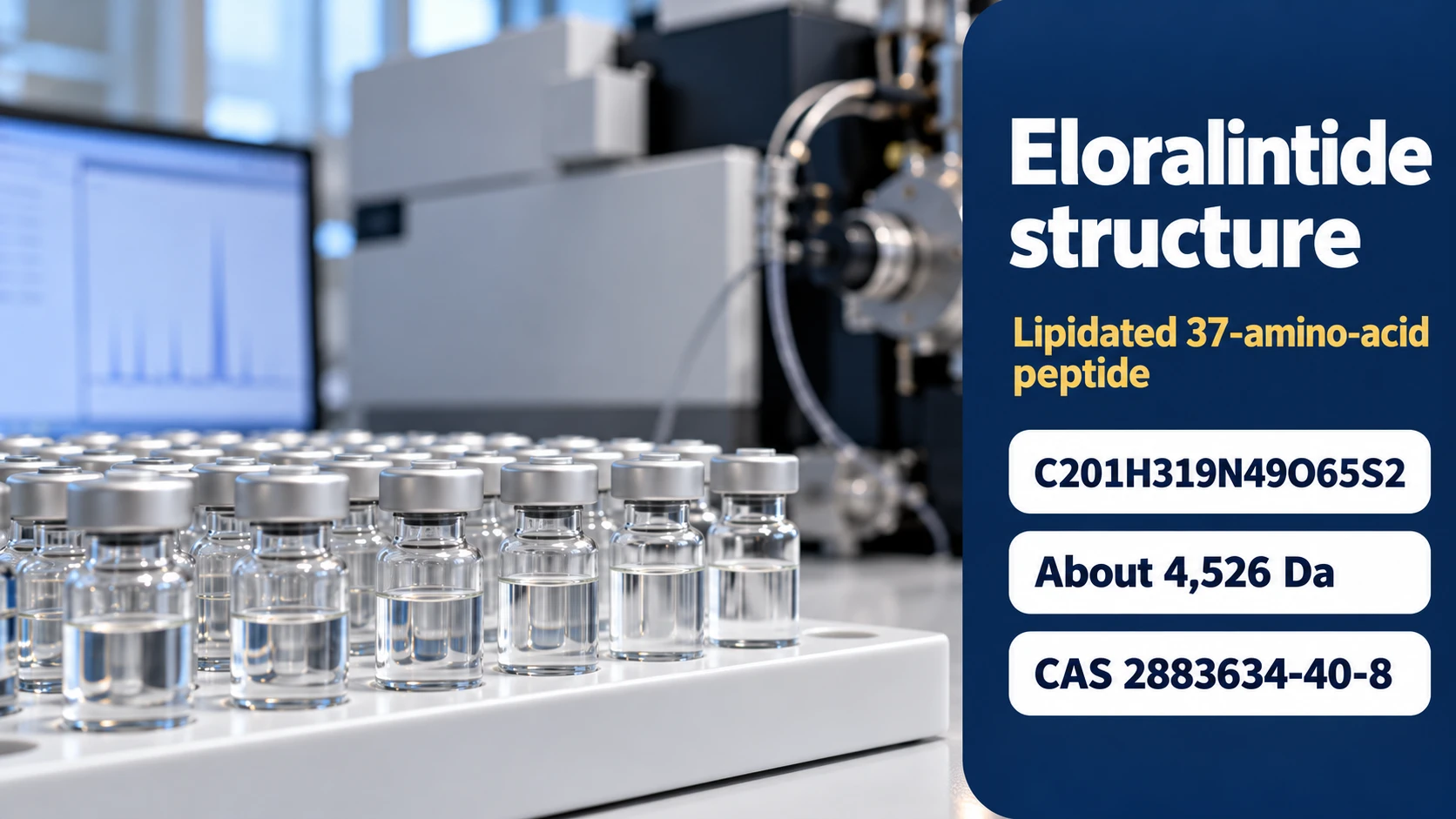
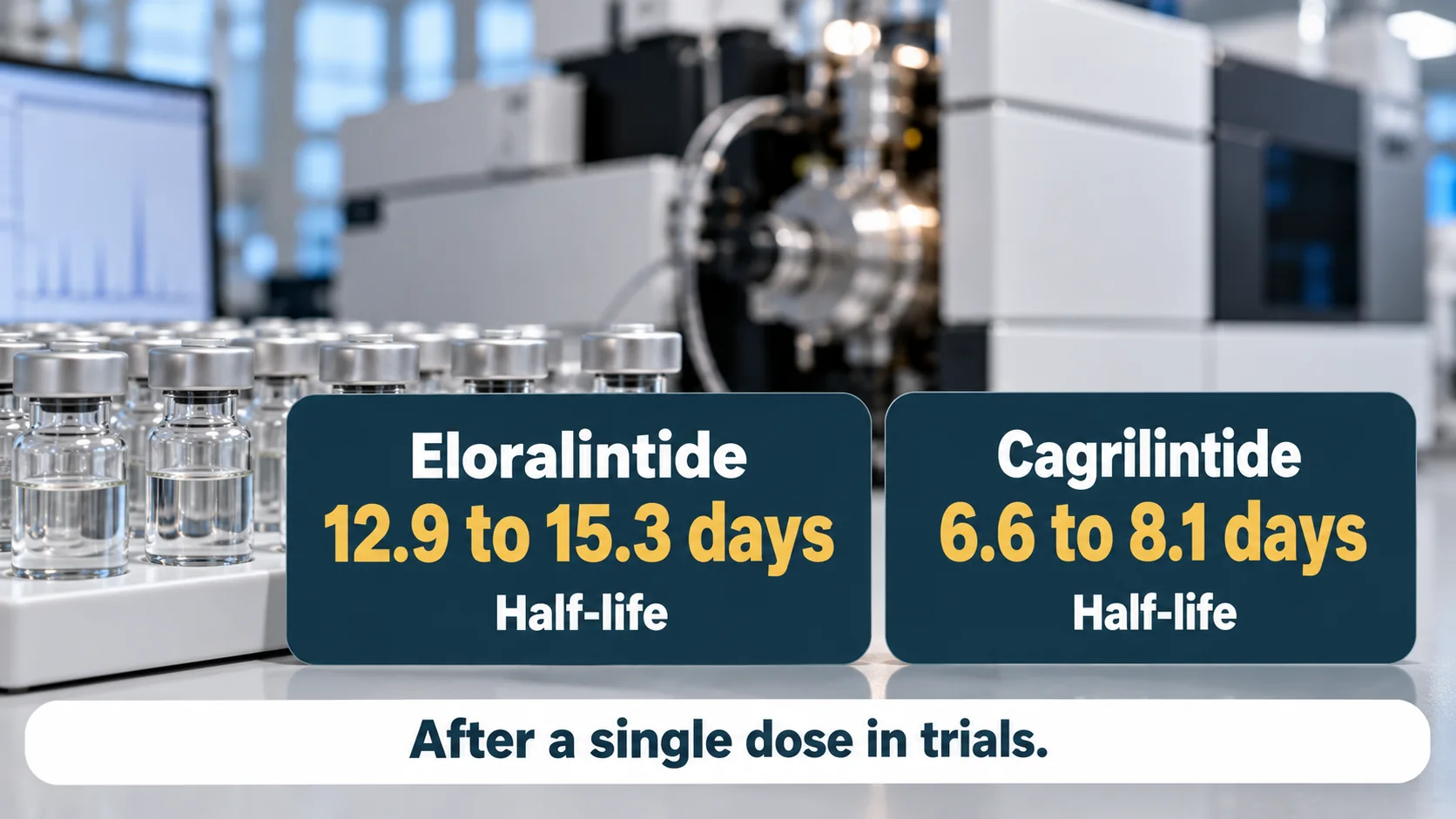
Short answer: Eloralintide (LY3841136) is a synthetic 37-amino-acid analogue of human amylin with the formula C201H319N49O65S2 and an average molecular weight of about 4,526 Da (CAS 2883634-40-8). It has three non-coded amino acids, a methylene thioacetal bridge instead of the native disulfide, a C-terminal amide and a C20 fatty diacid on lysine 26 that binds albumin. After a single dose in healthy adults its terminal half-life averaged 310 to 366 hours (12.9 to 15.3 days), and in a 12-week study it was about 14 days. Cagrilintide, by comparison, has a half-life of about 7 days.
Key takeaways
- Formula C201H319N49O65S2. The average mass I calculate from it is 4,526.16 Da and the monoisotopic mass is 4,523.26 Da, which matches PubChem and Wikipedia.
- Four design features set it apart from natural amylin: three non-coded residues, a thioacetal bridge, a lysine-26 fatty diacid and a C-terminal amide.
- Half-life: 12.9 to 15.3 days after one dose. Roughly five half-lives clear most of a drug, so washout would take about 9 to 11 weeks, a general pharmacokinetic rule and not a measured eloralintide value.
- Peak-to-trough variation at steady state is small (1.28 to 1.38), which fits once-weekly dosing in trials.
- Mass spectrometry can confirm the weight of a sample. It cannot, on its own, prove the exact structure, and no public reference standard exists for eloralintide.
Last verified October 15, 2026. Sources are listed at the end. For laboratory and research use only. Nothing here is medical or legal advice.
Contents
- The identity card
- Four design features, in plain language
- Molecular weight and what it means
- How it compares with natural amylin, pramlintide and cagrilintide
- Structure claims on vendor pages that the papers do not make
- Half-life and pharmacokinetics
- Stability and handling: what is known
- Why the structure matters for buyers
- Common questions
The identity card
| Item | Value | Source |
|---|---|---|
| Name | Eloralintide (USAN) | PubChem |
| Development code | LY3841136 (also AMY-1176 in some catalogs) | PubChem |
| Developer | Eli Lilly and Company | ClinicalTrials.gov |
| Class | Selective, long-acting amylin receptor agonist | The Lancet 2025 |
| Molecular formula | C201H319N49O65S2 | PubChem CID 175663130 |
| Average molecular weight | 4,526.16 Da | Wikipedia; matches my calculation |
| Monoisotopic mass | 4,523.26 Da (calculated from the formula) | This guide |
| CAS number | 2883634-40-8 | PubChem |
| UNII | 73G3354J8W | PubChem |
| Backbone | 37 amino acids, C-terminal amide, L-amino acids only | Molecular Metabolism 2025 |
| Non-coded residues | Three, at positions 11, 15 and 22 | Molecular Metabolism 2025 |
| Bridge | Methylene thioacetal in place of the native disulfide | Molecular Metabolism 2025 |
| Lipid | C20 fatty diacid on the lysine-26 side chain, through a linker | Molecular Metabolism 2025 |
| Receptor profile | AMY1R 23.9 pM, AMY3R 253.8 pM, CTR 291.0 pM (human cells) | Molecular Metabolism 2025 |
Four design features, in plain language
1. A 37-amino-acid backbone with three non-coded residues
Natural human amylin has 37 amino acids and clumps into fibrils. Eloralintide keeps the 37-residue length but carries three amino acids at positions 11, 15 and 22 that are not among the 20 standard amino acids. Reviews classify it as a non-aggregating amylin analogue. The papers I read do not spell out the specific job of each non-coded residue.
2. A methylene thioacetal bridge
Natural amylin has a disulfide bond between two cysteines that holds part of the chain in a loop. Disulfides are valuable in peptides but chemically fragile during manufacturing and in the body. Eloralintide replaces the disulfide with a methylene thioacetal, which swaps the sulfur-sulfur link for a sulfur-carbon-sulfur link. A 2025 review in Frontiers in Chemistry describes this as a surrogate that offers a favorable balance of structural fidelity, synthetic accessibility and chemical stability. The discovery paper says it improves chemical stability.
3. A C20 fatty diacid on lysine 26
A 20-carbon fatty diacid is attached through a linker to the side chain of lysine 26. Albumin, the most abundant protein in blood, binds the fatty acid reversibly. Bound drug is protected from clearance and released slowly, which acts as a depot. The strategy is shared with other long-acting peptides: semaglutide and cagrilintide both carry fatty-acid chains, with different lengths and linkers. For eloralintide it extends the half-life from minutes (natural amylin) to roughly two weeks.
4. An amidated C-terminus and L-amino acids
The end of the chain is capped with an amide group, as in many natural peptide hormones, and all amino acids are in the natural L form. Both are standard for peptide drugs.
Molecular weight and what it means
Using standard atomic masses, the formula gives these values.
| Quantity | Value |
|---|---|
| Average molecular weight | 4,526.16 g/mol |
| Monoisotopic mass | 4,523.26 Da |
| 1 mg of pure eloralintide | About 0.22 micromoles |
| 10 mg of pure eloralintide | About 2.2 micromoles |
| Cagrilintide, for comparison (C194H312N54O59S2) | 4,409.07 g/mol average; 10 mg is about 2.3 micromoles |
Two points follow. First, a milligram weighs the peptide plus whatever else is in the powder. Freeze-dried peptide also holds water and the counter-ion left over from purification, so the “net peptide content” of a vial is lower than its labeled mass. Second, milligrams do not translate across molecules, because a mole of eloralintide weighs about 4.5 grams while a mole of a small-molecule drug weighs a fraction of that.
What a mass spectrometry result should look like
Electrospray mass spectrometry measures peptides as charged ions, so a 4,500 Da molecule appears as a series of peaks at several charges, and software converts them to one mass. The table below shows where those peaks should fall for the formula above. These are calculated values, not measurements.
| Charge state | Expected m/z (average mass) | Expected m/z (monoisotopic) |
|---|---|---|
| 3+ | 1,509.73 | 1,508.76 |
| 4+ | 1,132.55 | 1,131.82 |
| 5+ | 906.24 | 905.66 |
| 6+ | 755.37 | 754.88 |
| 7+ | 647.60 | 647.19 |
| 8+ | 566.78 | 566.42 |
A report that shows a deconvoluted mass close to 4,526 Da (average) or 4,523 Da (monoisotopic) is consistent with the formula. A report that only says “identity confirmed” shows nothing you can check. See what a certificate for this molecule should show.
The limits of mass as identity
Matching the weight is necessary and not sufficient. Several different molecules can have the same mass, for example if the fatty acid sat on a different lysine, or if residues were swapped. Telling them apart needs fragmentation (tandem mass spectrometry) or peptide mapping, or comparison with an authenticated standard. No pharmacopoeia monograph for eloralintide turned up in my search, so a third-party lab usually has no standard to compare against unless the seller provides one.
How it compares with natural amylin, pramlintide and cagrilintide
| Human amylin | Pramlintide | Cagrilintide | Eloralintide | |
|---|---|---|---|---|
| Length | 37 amino acids | 37 amino acids | 37 amino acids | 37 amino acids |
| Main change from human amylin | None | Rat-type sequence that does not clump | Three substitutions (N14E, V17R, P37Y) | Three non-coded residues (positions 11, 15, 22) |
| Disulfide bridge | Native disulfide | Native disulfide | Native disulfide | Replaced by methylene thioacetal |
| Fatty acid | None | None | C20 diacid through a gamma-glutamic acid linker | C20 diacid through a linker on lysine 26 |
| Half-life | Short | Short, so it needs several injections a day | About 6.6 to 8.1 days | About 12.9 to 15.3 days |
| Receptor profile | AMY1R, AMY2R, AMY3R and calcitonin receptor | Same family | Dual amylin and calcitonin receptor agonist | Favours AMY1R |
| Status | Natural hormone | Approved for diabetes | Phase 3 (and in CagriSema, under FDA review) | Phase 3 |
The pattern is a step-by-step engineering of one hormone: fix the clumping (pramlintide), then add a lipid for weekly dosing (cagrilintide), then change the receptor balance and stabilize the bridge (eloralintide).
Structure claims on vendor pages that the papers do not make
Search results for eloralintide include vendor and catalog pages that describe the molecule in more detail than the papers I could read. Some say the lysine side chain carries a specific linker of two gamma-glutamic acids before the fatty diacid. Others quote half-life figures or storage conditions. I did not use those details, because they are not in the peer-reviewed papers I read and I could not verify them. The published sources confirm a C20 fatty diacid on lysine 26 through a linker, but not the linker’s exact makeup. If a certificate or specification sheet lists a different linker, a different lipid length or a different attachment site, that is a reason to ask which molecule it describes.
Half-life and pharmacokinetics
The two phase 1 papers give most of the human numbers.
| Measure | Result | Study |
|---|---|---|
| Terminal half-life, single dose (0.4 to 12 mg) | 310 to 366 hours (12.9 to 15.3 days), geometric mean | Single-dose study, healthy adults |
| Time to peak concentration | Median 72.0 to 132.2 hours | Single-dose study |
| Exposure versus dose | Area under the curve dose-proportional from 0.4 to 12 mg; peak concentration rose less than proportionally | Single-dose study |
| Half-life, weekly dosing for 12 weeks | About 2 weeks (about 14 days) | Multiple-dose study |
| Peak-to-trough ratio at steady state | 1.28 to 1.38 | Multiple-dose study |
| Dose proportionality at week 12 | Ratio 1.05 for exposure and 1.04 for peak concentration (1.2 to 12 mg) | Multiple-dose study |
| Cagrilintide half-life (comparison) | 159 to 195 hours (6.6 to 8.1 days); peak at 24 to 72 hours | Cited in the discovery paper |
In rats and cynomolgus monkeys, eloralintide showed higher exposure, a longer half-life and flatter concentration-time curves than cagrilintide. The paper’s numeric animal half-lives are in a supplement I could not read.
What the numbers mean
- A slow rise. The peak arrives roughly three to five days after a dose. The drug does not hit the blood all at once.
- A flat profile. A peak-to-trough ratio of 1.28 to 1.38 means concentrations at steady state vary by about a third across the week, which is smooth compared with a short-acting peptide.
- Dose-proportional exposure. Doubling the dose roughly doubled exposure across the range tested, which makes the pharmacology predictable.
- A long tail. The half-life of about two weeks is why the drug stays in the body for weeks after the last dose.
How long does eloralintide stay in the body?
A standard pharmacokinetic rule says that after about five half-lives, roughly 97% of a drug has left. With half-lives of 12.9 to 15.3 days, five half-lives is 64 to 77 days, or about 9 to 11 weeks. That is a calculation from the published half-life and a general rule, not a measured washout study. The same logic runs the other way: with weekly dosing and a two-week half-life, drug builds up over several weeks before reaching steady state, and the 12-week study measured it at week 12.
Could the half-life allow longer dosing intervals?
The longer half-life compared with cagrilintide raises the question, and some commentary online speculates about monthly dosing. No trial has tested a schedule longer than weekly for eloralintide, and the phase 3 program uses once-weekly dosing. Other companies are developing monthly amylin analogues (for example, Metsera’s MET-233i, now part of Pfizer), which is a separate program.
Stability and handling: what is known
The published papers describe chemical stability as a design goal (the thioacetal bridge) and describe the molecule as non-aggregating. They do not give shelf-life, temperature or in-solution stability data for any form, and I found no peer-reviewed stability study of a research-grade vial. Sellers typically state storage conditions for lyophilized peptide on their certificates or specification sheets. Treat any stability claim without a source as unverified. Peptryn does not give handling or use instructions for eloralintide.
Why the structure matters for buyers
Because eloralintide has non-coded residues, a non-natural bridge and a fatty diacid, it cannot be made on a basic peptide synthesizer with the 20 standard amino acids. A vial sold as eloralintide needs evidence that those features are present, and a purity percentage alone does not show it. Our guide to evaluating an eloralintide research listing lists the tests to ask for, and our peptide purity guide explains what a purity figure counts.
Common questions
What is the structure of eloralintide?
A 37-amino-acid synthetic analogue of amylin with three non-coded amino acids at positions 11, 15 and 22, a methylene thioacetal bridge replacing the native disulfide, a C-terminal amide and a C20 fatty diacid on lysine 26 attached through a linker.
What is the molecular formula of eloralintide?
C201H319N49O65S2.
What is the molecular weight of eloralintide?
The average molecular weight is about 4,526 Da (4,526.16 g/mol). The monoisotopic mass calculated from the formula is 4,523.26 Da.
What is the CAS number for eloralintide?
2883634-40-8.
What is the half-life of eloralintide?
In healthy adults, the terminal half-life after a single dose averaged 310 to 366 hours (12.9 to 15.3 days). In a 12-week weekly-dosing study it was about 14 days.
How long does eloralintide stay in your system?
By the standard rule of five half-lives, about 9 to 11 weeks for most of the drug to clear. That is a calculation, not a measured result.
What is the half-life of eloralintide compared with cagrilintide?
Eloralintide’s is about twice as long: 12.9 to 15.3 days against 6.6 to 8.1 days for cagrilintide.
Is eloralintide a peptide?
Yes. It is a synthetic peptide of 37 amino acids with a lipid attached, so it is a lipidated peptide.
What does the fatty acid on eloralintide do?
It binds albumin in the blood reversibly, which slows clearance and lengthens the half-life to about two weeks. The same strategy is used by semaglutide and cagrilintide.
Is eloralintide stable at room temperature?
I found no published stability data for any form. The molecule was designed for chemical stability, but a design goal is not a shelf-life. Check the lab and seller documentation for any specific vial.
Where does the name “LY3841136” come from?
It is Eli Lilly’s internal development code for the molecule. Eloralintide is its US adopted name.
Related: What is eloralintide? · How does eloralintide work? · Eloralintide vs cagrilintide · Amylin analogs · Peptide purity · How to read a certificate of analysis · All eloralintide guides
Sources
All pages read October 14 to 15, 2026. Mass and ion values were calculated by the author from the formula using standard atomic masses.
- PubChem. Eloralintide, compound CID 175663130 (formula, synonyms, CAS, UNII).
- Briere DA, et al. Eloralintide (LY3841136), a novel amylin receptor agonist: from discovery to clinical proof of concept. Molecular Metabolism 2025; PMC12640043 (structure, receptor data, single-dose pharmacokinetics, animal data).
- Bhattachar S, et al. Eloralintide phase 1 proof of concept. Diabetes, Obesity and Metabolism 2026; PMC12992164 (multiple-dose pharmacokinetics).
- Strategic applications of methylene thioacetal bonds as disulfide surrogates in peptide drug discovery. Frontiers in Chemistry 2025; PubMed 40657552.
- Wikipedia. Eloralintide (average molecular weight 4,526.16).
- Peptryn. What is cagrilintide? (cagrilintide formula and molecular weight, citing Kruse et al., Journal of Medicinal Chemistry, 2021).
- Amylin analogs: the next major class of weight loss therapy. Diabetes, Obesity and Metabolism 2026; PMC13588232.
Editorial note: Peptryn sells research materials for laboratory use only. This guide is informational and is not medical advice. To report an error, use the contact page.
All products on peptryn.com are intended for laboratory research purposes only. They are not drugs, foods, dietary supplements or cosmetics, and they are not for human consumption, self-administration, or veterinary use. You must be 21 or older to buy. The information on this page has not been evaluated by the U.S. Food and Drug Administration and is not intended to diagnose, treat, cure, or prevent any disease.