Pinealon: What the Research Shows and Where the Evidence Comes From (2026)
Note: This guide is educational and is not medical advice. Peptryn supplies research-use-only peptides to laboratories, and nothing here suggests using research materials on yourself. Speak to a licensed clinician about any cognitive or neurological question.
The short answer
Pinealon is a synthetic tripeptide, three amino acids long: glutamic acid, aspartic acid and arginine, written as Glu-Asp-Arg or EDR. It belongs to a family of short peptides developed over several decades by the Russian researcher Vladimir Khavinson and colleagues at the Saint Petersburg Institute of Bioregulation and Gerontology. The idea behind the family, which also includes Epitalon and Semax, is that a very short peptide sequence can nudge gene activity in a tissue-specific way, in Pinealon’s case in brain and pineal tissue.
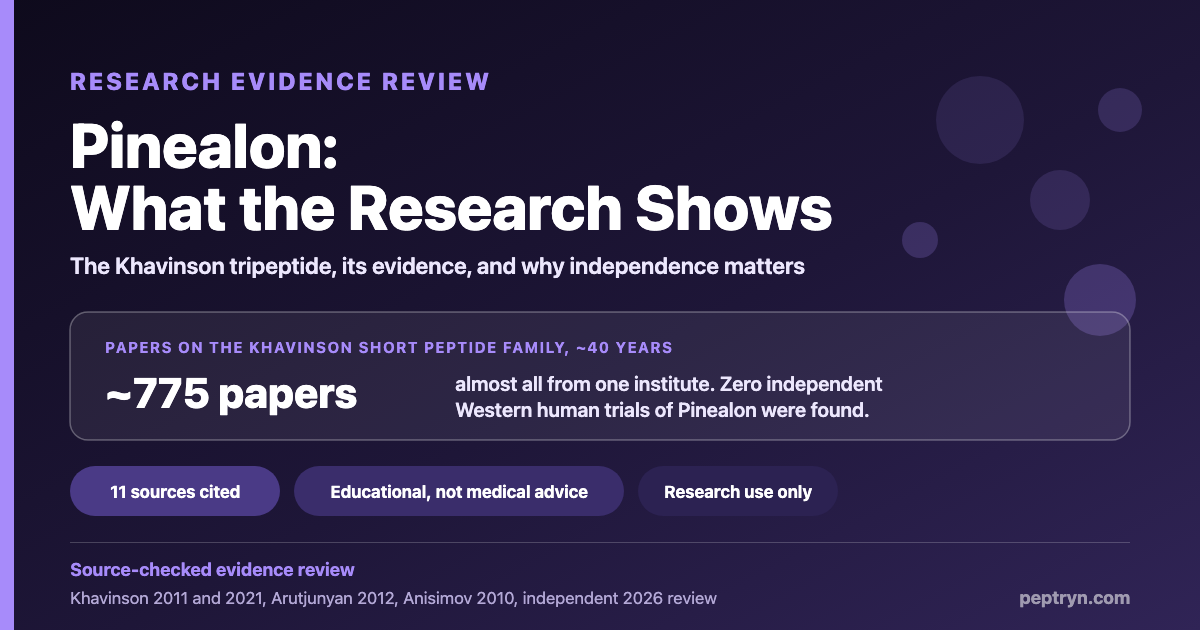
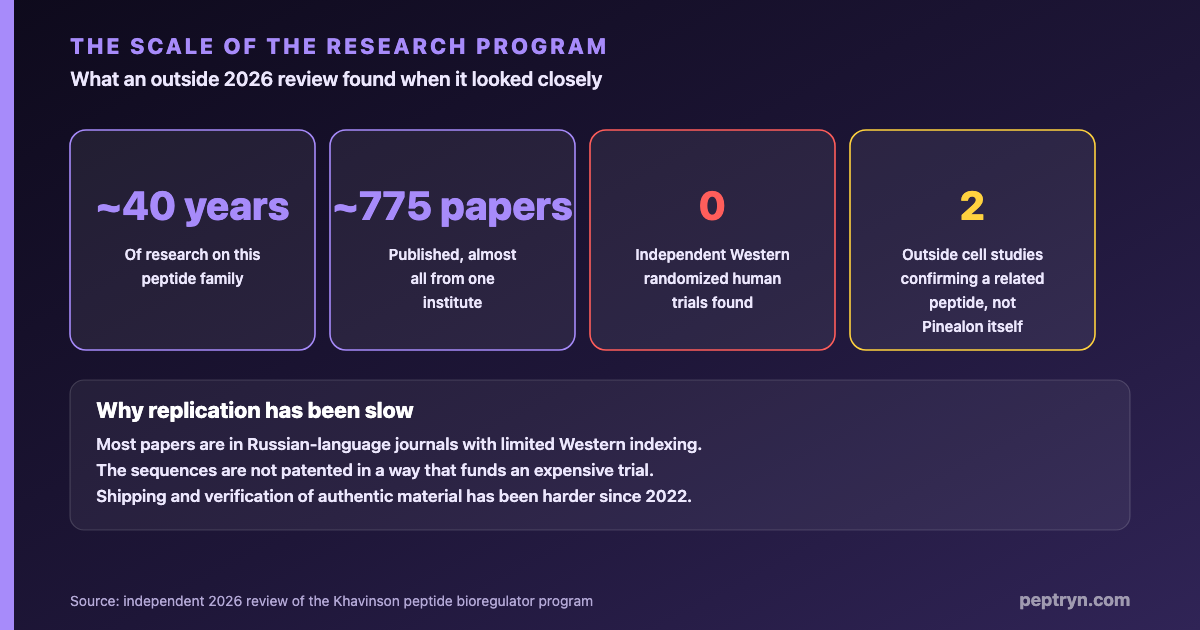
The laboratory record is genuinely substantial: cell studies, rat and mouse studies, and reviews spanning more than a decade, mostly on oxidative stress, cell survival and neuroprotection. What is unusual, and worth knowing before reading further, is where that record comes from. The overwhelming majority of the roughly 775 papers on this peptide family, across Pinealon and its relatives, were produced by one institute and its close collaborators. Independent Western laboratories have not run controlled human trials of Pinealon, and the animal and human studies that exist used designs that would not meet current Western standards for randomization and blinding. That does not make the biology false. It means the claims should be read as an internally consistent research program, not as established medical fact.
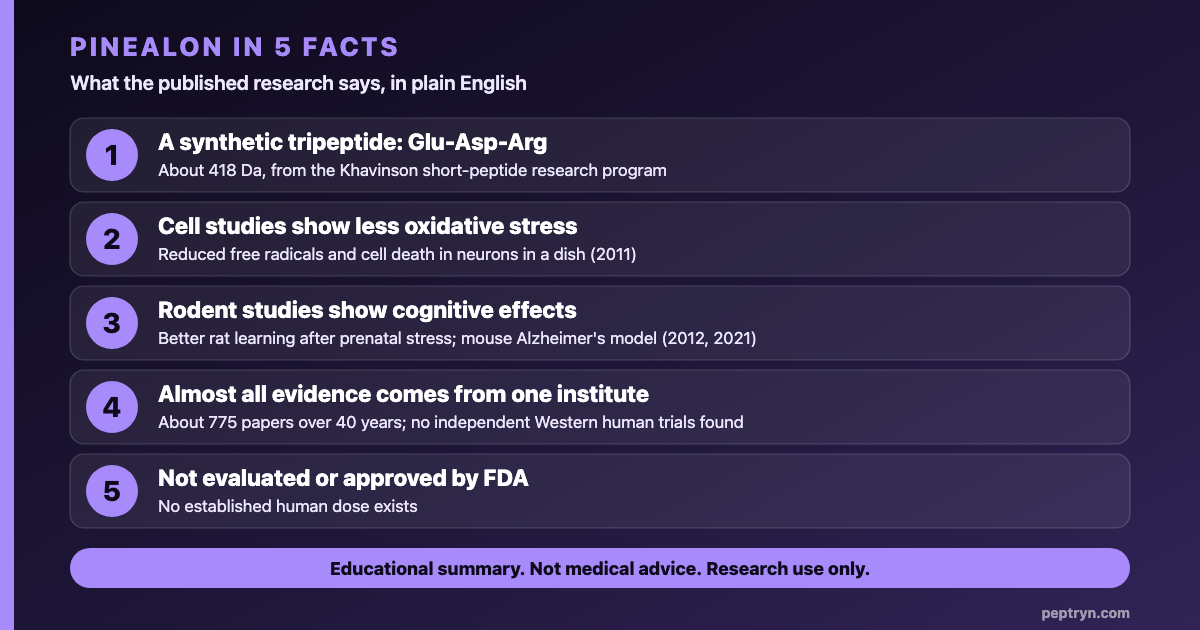
| Question | What is known | Evidence |
|---|---|---|
| What is it? | A synthetic tripeptide, Glu-Asp-Arg, about 418 daltons, one of the Khavinson short peptides | Chemistry |
| Where does the research come from? | Almost entirely one institute in Saint Petersburg and its collaborators | Publication record |
| What has been shown in cells? | Reduced oxidative stress markers and less cell death in cultured neurons and other cell lines | Cell studies |
| What has been shown in animals? | Better spatial learning in rat offspring after a prenatal stress model; protected dendritic connections in an Alzheimer’s mouse model | Rodent studies |
| What has been shown in people? | Reviews describe clinical use in elderly cohorts, without randomization or blinding described | Weak human evidence |
| Is it approved? | Not an FDA-approved drug; not evaluated by FDA for any use | Regulatory |
What Pinealon is, chemically
Pinealon is the tripeptide glutamic acid, aspartic acid, arginine (Glu-Asp-Arg, EDR for short), molecular formula C15H26N6O8, about 418.40 daltons. It is one of a group of short synthetic peptides, usually two to four amino acids long, that Khavinson’s group designed to mimic natural peptide fragments extracted from specific organs. The pineal gland and the retina were both linked historically to a related tetrapeptide, Epitalon (Ala-Glu-Asp-Gly), while EDR was developed specifically around brain and pineal tissue signaling.
The underlying idea, described across Khavinson’s papers, is that these short sequences interact with DNA and influence which genes a cell turns on, in a way that is specific to the tissue the original peptide came from. That is a testable hypothesis, and some of the molecular modeling work below tries to test it directly. It is also a strong claim, and the strength of the claim is part of why independent confirmation matters.
Where the research comes from, and why that matters
Before looking at what the studies found, it helps to know who ran them. Vladimir Khavinson founded and led the Saint Petersburg Institute of Bioregulation and Gerontology, and over roughly four decades his group published on the order of 775 papers on short peptide bioregulators, Pinealon among them. A 2013 review by Khavinson’s own group states plainly that it summarizes work from that institute’s clinical applications of these peptides.
Three things follow from that concentration of authorship. First, replication: almost none of the work has been repeated by a laboratory with no connection to the original group, so the usual scientific check of independent confirmation has mostly not happened. Second, study design: an outside review of the human studies found that patients were not randomly assigned, the dosing was not blinded, and comparison groups were not matched for how often they saw a doctor, which alone can produce an apparent benefit. Third, commercial interest: the same institute that generated the evidence also developed and markets these peptides, which is a conflict of interest that a reader should weigh, not a reason to dismiss the work outright.
None of this means the biology is wrong. Cell and rodent experiments are the normal early stage of any drug or supplement story, and this program has done a great deal of that early-stage work. It means Pinealon sits earlier on the evidence ladder than the label “geroprotector,” used across this literature, suggests.
What outside reviewers found when they looked closely
A 2026 independent review of the Khavinson peptide bioregulator program, published outside the institute’s own network, tried to weigh the record on its merits. It counted roughly 775 papers produced over about forty years, essentially all from the same institutional network, and found zero Western-run randomized controlled trials in that entire body of work. Two 2025 cell-culture studies from outside laboratories confirmed a laboratory-level finding for a related peptide, Epitalon, on telomere length in human cells, but neither addressed clinical dosing or benefit in a living person, and neither was about Pinealon specifically.
The same review points to practical reasons independent confirmation has been slow: most of the primary literature was published in Russian-language journals with limited Western indexing, the peptide sequences are not patented in a way that gives a pharmaceutical company a commercial reason to fund an expensive trial, and shipping and verification of authentic Russian-sourced material has become harder since 2022. None of those reasons make the underlying biology wrong. They do explain why, after four decades, “no independent Western human trial” is still the honest answer for Pinealon.
What cell studies show
The most-cited Pinealon-specific study, from Khavinson’s group in 2011, tested the peptide directly on three kinds of cells: cerebellar granule neurons, neutrophils and PC12 cells, a standard neuron-like cell line. Pinealon reduced the buildup of reactive oxygen species caused by oxidative stress, in a dose-dependent way, and reduced necrotic cell death measured by a standard dye test. The effect leveled off at low concentrations for the antioxidant and survival effects, while an effect on the cell cycle continued at higher concentrations, which the authors read as evidence that Pinealon does more than mop up free radicals and also interacts with the genome directly.
A related 2014 study looked at gene activity rather than survival. Pinealon and a second short peptide, Lys-Glu-Asp, increased the activity of a gene needed to make serotonin in aging brain cortex cells kept in culture. The researchers used computer modeling to show the peptides could plausibly bind a specific DNA sequence near that gene, a proposed explanation, not one demonstrated in living tissue.
What animal studies show
Two rodent studies push the cell findings toward a whole organism. In a 2012 study, pregnant rats were fed a methionine-loaded diet to induce hyperhomocysteinemia, a stress model linked to cognitive problems in offspring. Rats that also received Pinealon during pregnancy had offspring with better spatial orientation and learning in behavioral tests, and the offspring’s cerebellar neurons had fewer markers of oxidative stress and necrotic death when examined afterward.
A 2021 study used a genetically modified mouse strain that develops Alzheimer’s-like brain changes. Daily injections of a related short peptide from two to four months of age reduced the loss of dendritic spines, the small connection points on neurons that are lost early in Alzheimer’s disease models, and Pinealon showed a similar protective pattern in the cell portion of the same study. The authors also used molecular docking, a computational method, to identify genes involved in Alzheimer’s biology that the peptide sequence could plausibly bind.
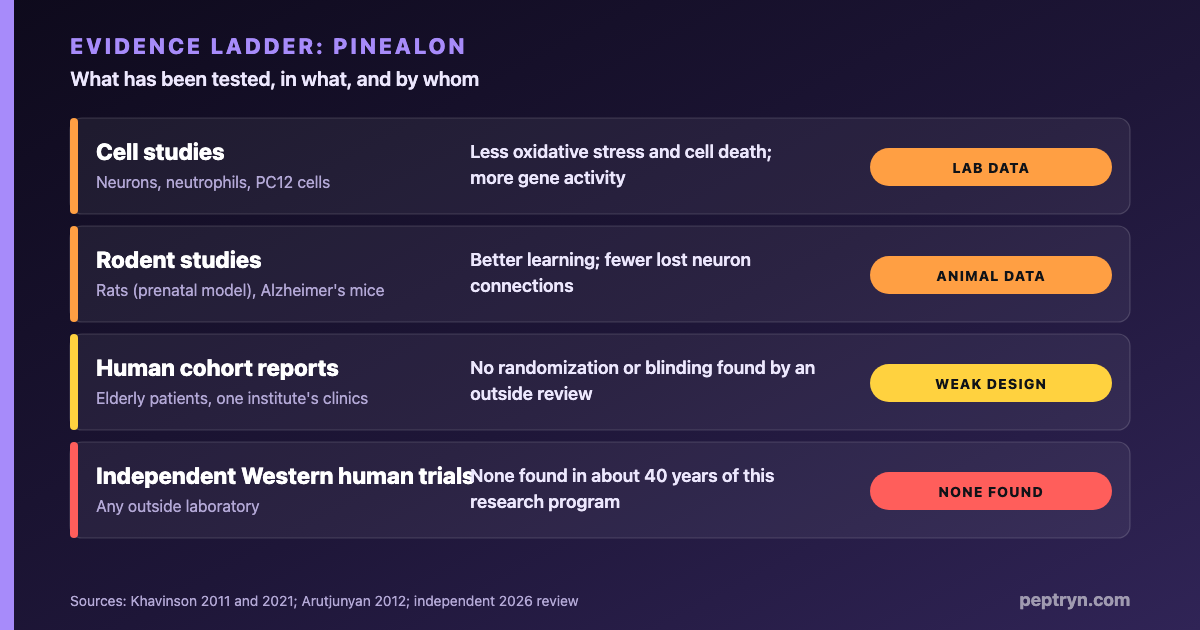
Read together, these are laboratory and animal findings using a specific research group’s own models and, in several cases, computational predictions rather than a direct measurement of what actually happens in living tissue. That is a normal early stage for a compound, and it is not the same as demonstrated benefit in a living brain, let alone a human one.
What human evidence exists
A 2013 Russian-language review from Khavinson’s group compares two classes of peptide products used in elderly and older patients: complex polypeptide extracts and short peptides including Semax, Kortagen and Pinealon, describing clinical use and proposed cell-level pathways. A broader 2013 review from the same institute is explicitly framed as reporting the institute’s own clinical study results across the peptide bioregulator family. Neither is a randomized, placebo-controlled trial of Pinealon by itself, and an outside review of this literature found that the human cohorts were not randomly selected, were not blinded, and were not matched for how often patients saw a clinician, any of which can produce an apparent effect by itself.
We found no independent, Western-run controlled trial of Pinealon in the sources reviewed for this guide. That is different from finding no human data at all. It means the human data that exists comes from one research tradition, using designs that make it hard to separate a real effect from other explanations.
The Khavinson short peptide family
Pinealon is usually discussed alongside its relatives, and people researching one often end up comparing several.
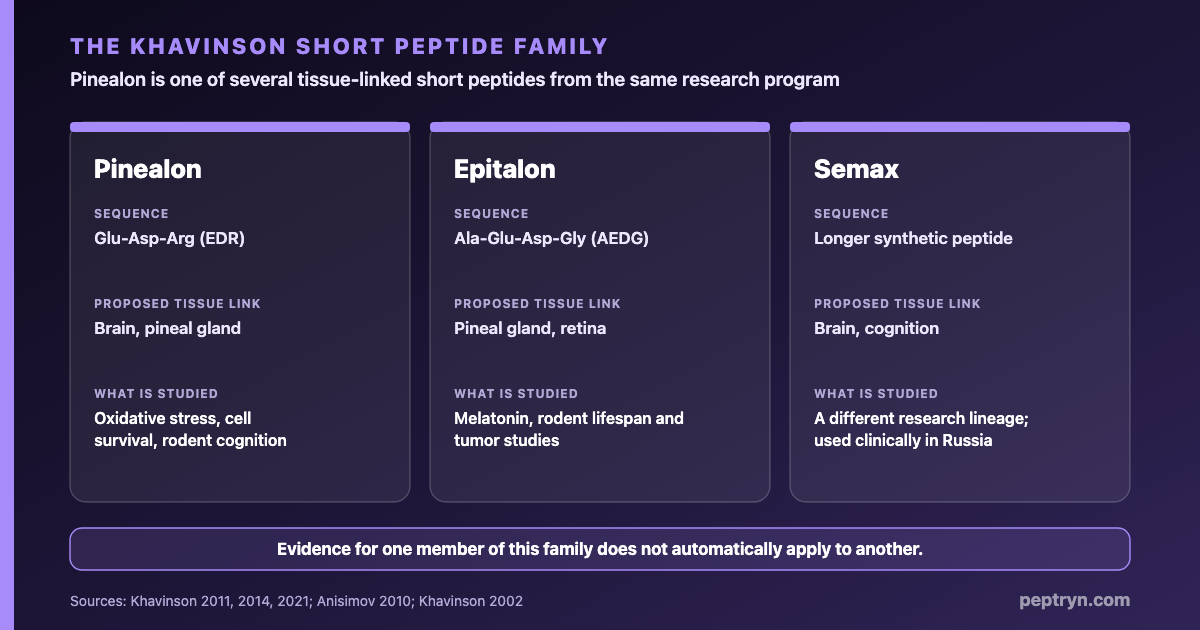
| Peptide | Sequence | Proposed tissue link | What is studied |
|---|---|---|---|
| Pinealon | Glu-Asp-Arg (EDR) | Brain, pineal gland | Oxidative stress, cell survival, gene activity in brain cells, rodent cognition |
| Epitalon | Ala-Glu-Asp-Gly (AEDG) | Pineal gland, retina | Melatonin production, lifespan and tumor studies in rodents, some human aging biomarker studies |
| Semax | Longer synthetic peptide (ACTH fragment derived) | Brain, cognition | A different research lineage, used clinically in Russia; not part of the same short-peptide family design |
The comparison matters because Epitalon has a somewhat larger published record, including some rodent lifespan studies going back to the 1990s, and Semax comes from an entirely different discovery path. Grouping the whole family as interchangeable evidence for any one peptide is a mistake that some marketing pages make.
What sellers claim versus what is shown
Pinealon is marketed online for sleep, focus, “crossing the blood-brain barrier,” and general cognitive support, and searches for a “best time to take” it are common. Here is how those claims line up against the research reviewed for this guide.
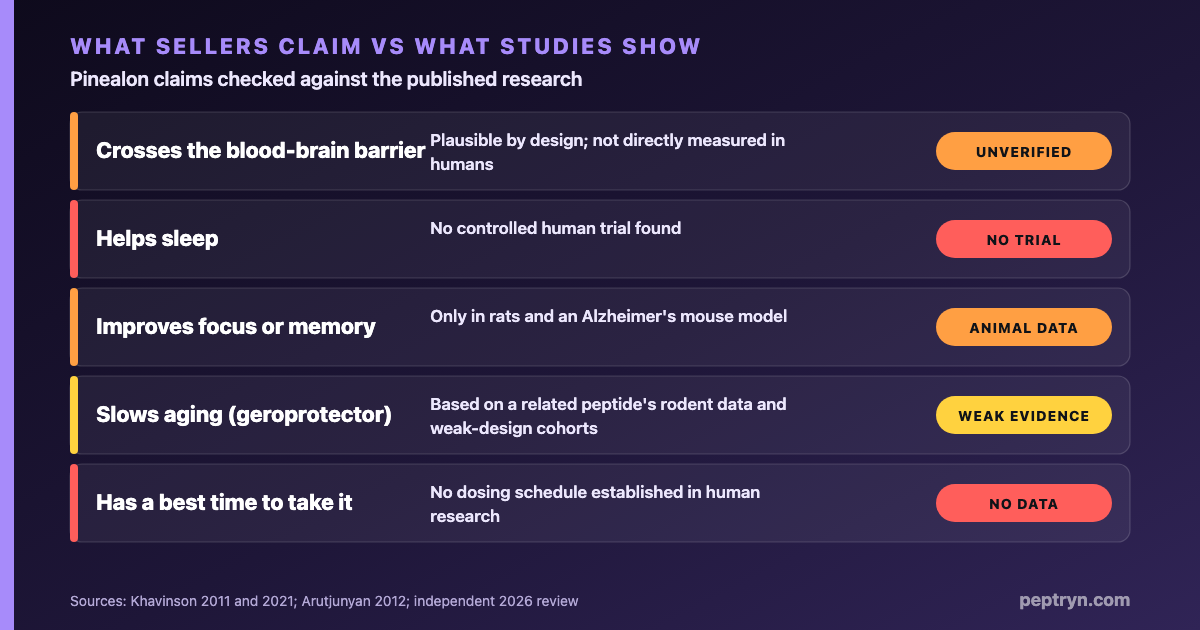
- “Crosses the blood-brain barrier.” Short peptides in this size range are designed with brain penetration in mind, and some of the cell and rodent work is consistent with central activity. We found no study directly measuring Pinealon levels in human cerebrospinal fluid or brain tissue.
- Helps sleep. We found no controlled human trial of Pinealon for sleep. The claim appears to be an extrapolation from its “neuroprotective” framing rather than a tested outcome.
- Improves focus or memory. The closest supporting data are the rat spatial-learning results after a prenatal stress model, and the Alzheimer’s mouse dendritic-spine findings, neither of which was done in an ordinary person with no diagnosed condition.
- Is a geroprotector (slows aging). This term appears throughout the Khavinson literature for the peptide family as a whole, based mainly on rodent lifespan work for a different family member, Epitalon, and on the reviewed human cohort studies whose design an outside review found lacking randomization and blinding.
- Has a best time to take it. No dosing schedule, let alone a time of day, has been established in controlled human research.
Regulatory and legal status
Pinealon is not an FDA-approved drug, and it has not gone through FDA review for safety or effectiveness for any use. It is a different case from peptides like BPC-157, TB-500 and KPV, which FDA has explicitly discussed on its restricted compounding list; Pinealon and the other Khavinson-family peptides sit outside that US regulatory conversation entirely, largely because they come out of a separate Russian research and manufacturing tradition rather than the US research-peptide market. That does not mean Pinealon is approved or has been found safe. It means no US regulator has evaluated it either way, so the burden of judging quality and safety falls entirely on the buyer. See are peptides legal? for how “research use only” labeling works in general.
Safety questions
- No independent human safety data. The clinical reports come from the peptide’s own developers, using designs that a 2025 outside review flagged for lacking randomization and blinding.
- No dose has been established for any use outside a research protocol. Doses in the animal studies above were set for those specific experiments, in rodents, and are not a guide for a person.
- Not evaluated by FDA. Pinealon is not an FDA-approved drug and has not gone through FDA safety review. Our peptide safety guide covers what that means for research peptides generally, including contamination and product-quality risks in unregulated vials.
- Sourcing has become harder to verify. A 2026 retrospective on this research program notes that geopolitical restrictions since 2022 have complicated shipping and verification of authentic Russian-sourced peptide material, which is one more reason a lot-matched certificate of analysis matters for any Khavinson-family peptide.
Buying Pinealon: what to check
- Sequence and molecular weight. Pinealon is Glu-Asp-Arg, about 418 daltons. A certificate should confirm identity by mass spectrometry.
- Is there a lot-matched certificate of analysis? Look for purity, quantity and endotoxin results tied to the specific lot, from a lab you can verify. Our COA guide explains what each test covers. Peptryn’s Pinealon listing does not yet have a published certificate, and the product page says so directly; ask any seller, including us, for the current lot report before ordering.
- What is the label’s stated use? “For research use only” means the seller is not offering it for human use.
- Which studies are actually being cited? A citation to “Khavinson peptides” in general does not tell you whether a claim was tested for Pinealon specifically, for Epitalon, or for neither.
- Is a dosing schedule being presented as established? No such schedule exists in the published research, so any specific protocol you see online is the seller’s own invention.
Frequently asked questions
What is Pinealon?
Pinealon is a synthetic tripeptide, glutamic acid, aspartic acid and arginine (Glu-Asp-Arg), developed as part of a Russian research program on short, tissue-specific peptides.
Does Pinealon work?
Cell and rodent studies from its developers report antioxidant, cell-survival and cognitive effects. No independent Western human trial was found in the sources reviewed, so “works in people” is not established.
Is Pinealon the same as Epitalon?
No. Both come from the same research tradition and both are linked to the pineal gland, but they are different peptides, Glu-Asp-Arg for Pinealon and Ala-Glu-Asp-Gly for Epitalon, with different (though overlapping) published research.
Is Pinealon safe?
No independent human safety data were found. Reported clinical use comes from the peptide’s own developers, using study designs an outside review found lacked randomization and blinding.
Is Pinealon FDA approved?
No. It is not an FDA-approved drug and has not been evaluated by FDA for any use.
What is the Pinealon dosage?
There is no established human dose. Rodent study doses were set for those specific experiments and are not guidance for people.
Related: KPV · Kisspeptin-10 · Are peptides safe? · Are peptides legal? · What are peptides? · What is a COA?
Sources
Khavinson V, Ribakova Y, Kulebiakin K, et al. Pinealon increases cell viability by suppression of free radical levels and activating proliferative processes. Rejuvenation Research, 2011 (PMID 21978084). pubmed.ncbi.nlm.nih.gov
Arutjunyan A, Kozina L, Stvolinskiy S, et al. Pinealon protects the rat offspring from prenatal hyperhomocysteinemia. International Journal of Clinical and Experimental Medicine, 2012 (PMID 22567179). pubmed.ncbi.nlm.nih.gov
Khavinson VKh, Lin’kova NS, Tarnovskaya SI, et al. Short peptides stimulate serotonin expression in cells of brain cortex. Bulletin of Experimental Biology and Medicine, 2014 (PMID 24909721). pubmed.ncbi.nlm.nih.gov
Khavinson V, Ilina A, Kraskovskaya N, et al. Neuroprotective effects of tripeptides, epigenetic regulators, in a mouse model of Alzheimer’s disease. Pharmaceuticals, 2021 (PMID 34071923). pubmed.ncbi.nlm.nih.gov
Umnov RS, Lin’kova NS, Khavinson VKh. Neuroprotective effects of peptide bioregulators in people of various ages. Advances in Gerontology, 2013 (PMID 24738258). pubmed.ncbi.nlm.nih.gov
Khavinson VKh, Kuznik BI, Ryzhak GA. Peptide bioregulators: the new class of geroprotectors. Message 2. Clinical studies results. Advances in Gerontology, 2013 (PMID 24003726). pubmed.ncbi.nlm.nih.gov
Anisimov VN, Khavinson VKh. Peptide bioregulation of aging: results and prospects. Biogerontology, 2010 (PMID 19830585). pubmed.ncbi.nlm.nih.gov
Khavinson VKh. Peptides and ageing. Neuroendocrinology Letters, 2002 (PMID 12374906). pubmed.ncbi.nlm.nih.gov
Khavinson V, Popovich I, Mikhailova O. Towards realization of longer life. Acta Bio-Medica, 2020 (PMID 32921699). pubmed.ncbi.nlm.nih.gov
The Peptide List. Forty years, seven hundred papers, zero Western trials: an independent look at Khavinson’s peptide bioregulator research. thepeptidelist.substack.com
U.S. Food and Drug Administration. Certain bulk drug substances for use in compounding that may present significant safety risks. fda.gov
For laboratory research use only. Not for human or veterinary use, and not a drug, food, dietary supplement or cosmetic. You must be 21 or older to buy.