Peptide Sciences Shut Down in March 2026: What We Know and How to Vet a Supplier
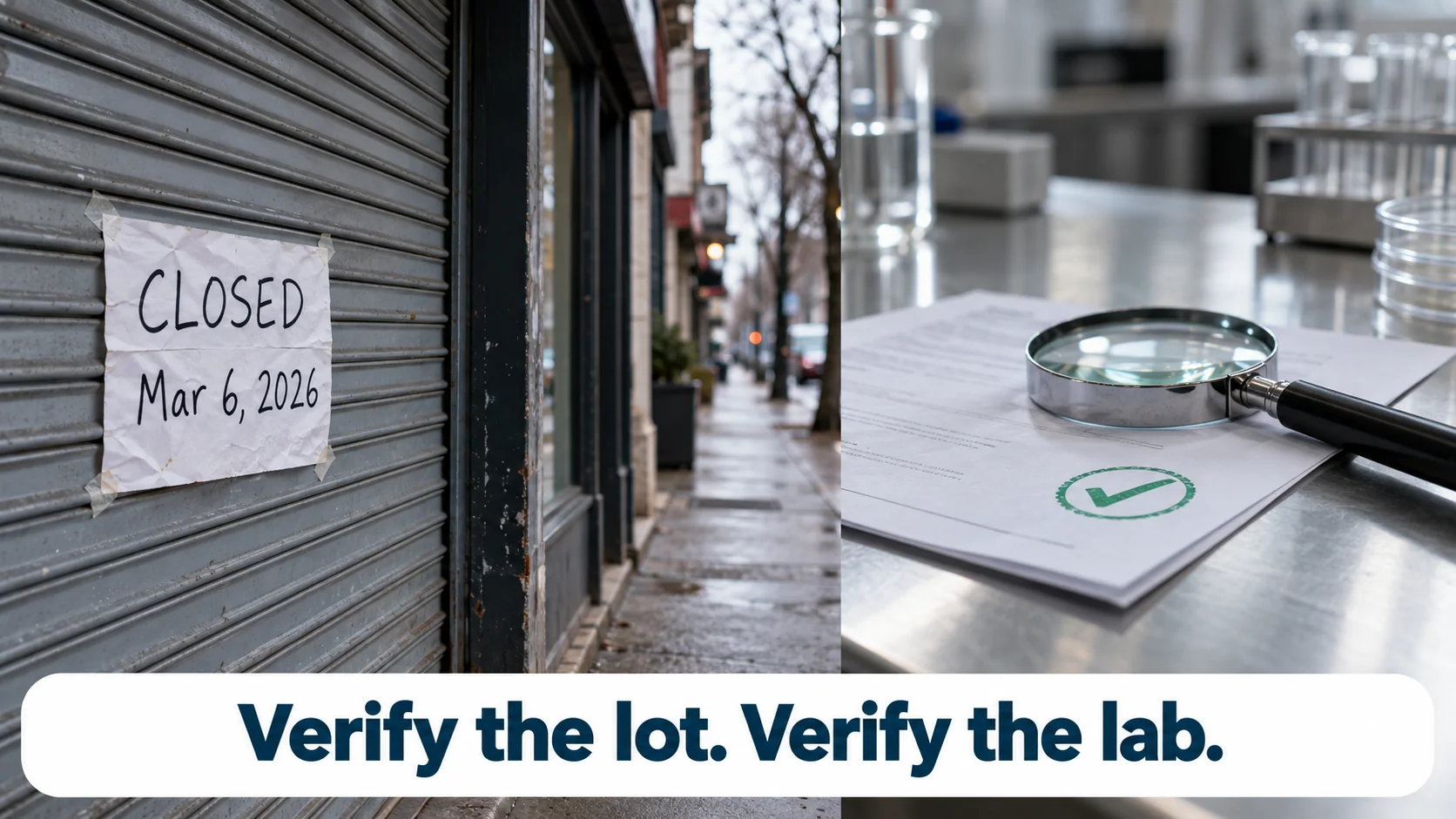
Quick answer: Peptide Sciences shut down on March 6, 2026, according to archive captures and Finnrick, a testing and rating company. The company’s notice calls the closure voluntary and gives no reason. As of October 7, 2026, peptidesciences.com shows only that notice, which says sites claiming to be Peptide Sciences or a successor are fraudulent. If you bought research materials from Peptide Sciences and are now comparing suppliers, the most reliable method is to check each lot’s laboratory report yourself instead of trusting a ranking, a coupon blog or a storefront that copies the old name.
Peptryn is an independent supplier of laboratory research materials. It is not affiliated with, endorsed by or a successor to Peptide Sciences.
Key takeaways
- Archive captures and Finnrick put the closure at March 6, 2026. The first archived copy of the closure notice is dated March 8.
- The company stated no reason. In the records we searched, we found no FDA warning letter naming it, no case in which it is a party and no news report tying it to an enforcement action. One federal complaint, Eli Lilly’s August 12, 2026 suit against Lone Star Peptide Co., says in passing that Peptide Sciences “shut down due to FDA enforcement pressures”. It cites that rival seller’s own marketing page rather than any FDA record, and the company’s notice calls the closure voluntary.
- Two domains styled as Peptide Sciences were registered on April 16 and 17, 2026. The company’s notice says sites claiming to be Peptide Sciences, a successor or a seller of its products are unauthorized and fraudulent.
- A purity percentage is not enough. Ask for the lot, the lab, a report you can open on the lab’s own site, and identity, quantity and endotoxin results.
- We do not rank suppliers. A later section shows how Peptryn answers the same checks, including where it falls short.
Last verified October 7, 2026. Sources are listed at the end. For laboratory and research use only. Nothing here is medical or legal advice.
What happened to Peptide Sciences
Peptide Sciences sold research peptides online for years. Its closure sent buyers looking for replacements, and most of what ranks for “peptide sciences shut down” comes from vendors and affiliates that sell or rank alternatives, and from auto-generated pages. This page comes from a supplier too, so we rely on archived copies of the company’s own pages, FDA’s database, court records and domain registry data, and we say where a claim could not be checked.
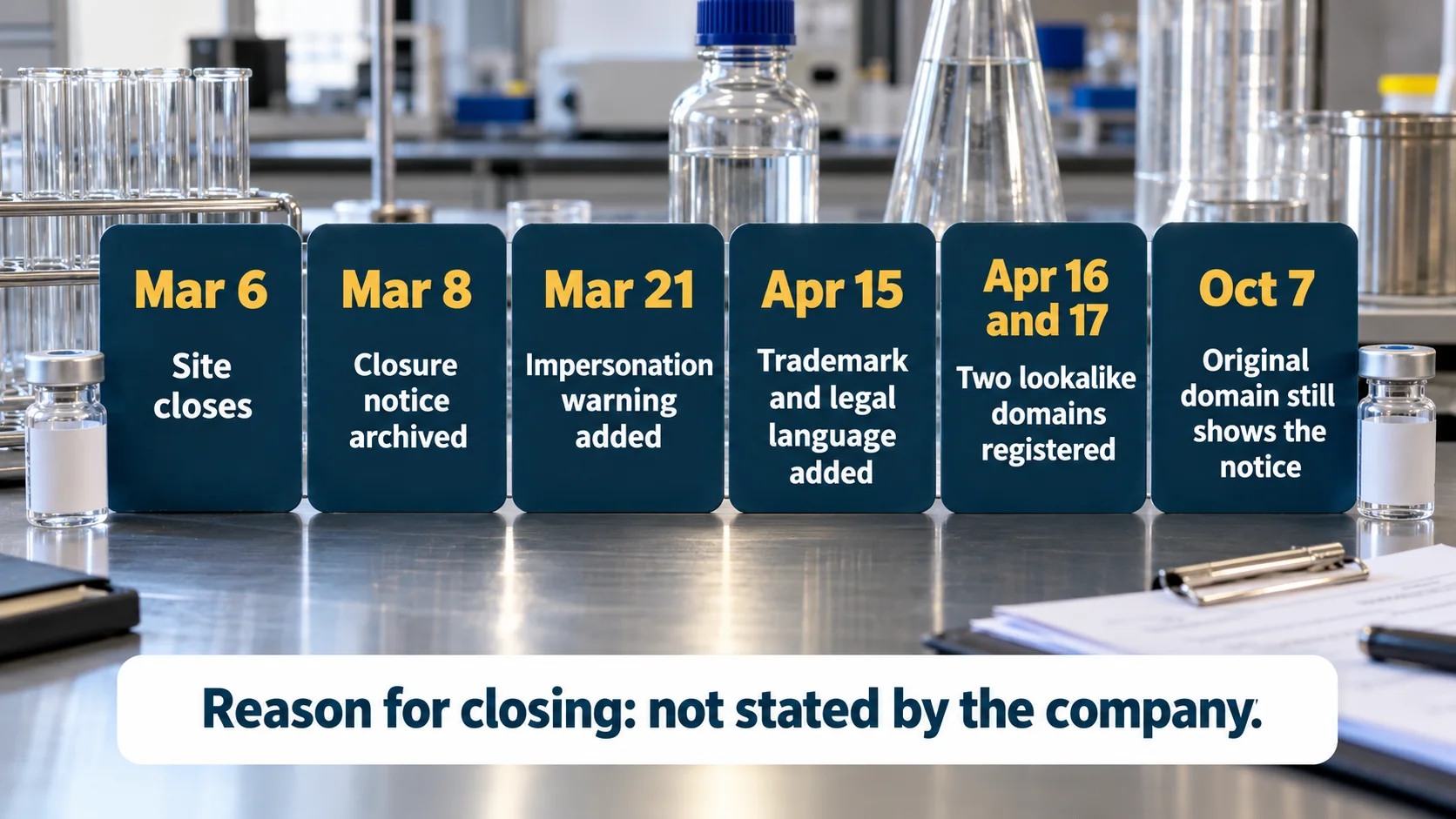
| Date (2026) | What the record shows |
|---|---|
| March 5 | Last archived capture of a normal store page before the closure |
| March 6 | An archived request for an article page on the site is redirected to the homepage (21:10 UTC). Finnrick’s vendor page also says the company stopped trading on this date |
| March 8 | First archived copy of the closure notice. It says the company decided to shut down voluntarily and discontinue sales of its research products |
| March 21 | First archived copy with a warning that any site claiming to be Peptide Sciences, a successor or a seller of its products is fraudulent and unaffiliated (the previous capture is from March 18) |
| April 15 | First archived copy with trademark and legal-action language aimed at impersonators (the previous capture is from March 22) |
| April 16 and 17 | Two domains styled as Peptide Sciences are registered (details below) |
| July 3 | Finnrick publishes a report on the vendor that describes one of those domains as a post-shutdown lookalike |
| October 7 | peptidesciences.com still shows the company’s own notice |
What is known, what is not, and what is rumor
Known. The company called the shutdown voluntary. Of the 37 archived copies of its homepage between March 8 and September 8, 2026, the 36 that can be opened all describe the shutdown as voluntary, and none gives a cause.
Not known. Why it closed. What happened to open orders, account credit and reward points, because the notice does not mention them. Whether the company has had any non-public contact with a regulator.
Searched and not found. FDA’s published warning-letter database returns no letter naming Peptide Sciences, although the same database returns letters to other peptide sellers dated March 31 and August 24, 2026. A search of CourtListener, which holds only dockets that someone has uploaded, and of DOJ, FTC and SEC pages found no case in which the company is a party. These are absences in the records we could search, and they do not rule out sealed or non-public matters. The CBS investigation cited below and NPR’s 2026 peptide stories that we checked do not mention the company.
Mentioned in one court filing. Eli Lilly’s complaint against Lone Star Peptide Co. (S.D. Tex., filed August 12, 2026) says Lone Star carries “the same compounds” as Peptide Sciences, “a peptide seller that shut down due to FDA enforcement pressures.” Peptide Sciences is not a party. The complaint cites Lone Star’s own “Peptide Sciences alternative” marketing page and no FDA record, so it is a lawyer’s description and not evidence of why the company closed.
Rumor. Most pages that give a specific reason, such as an FDA action, a payment-processor cutoff or failed product tests, cite no primary or reputable source. Some commercial pages claim an earlier FDA warning letter to the company, and no such letter is in FDA’s database. We found no source for revenue figures or for claims that pending orders were cancelled.
Is Peptide Sciences coming back?
No relaunch has been announced. As of October 7, 2026, the only thing on peptidesciences.com is the closure notice, which describes a decision to shut down and discontinue sales. By mid-April it also carried language about trademarks and legal action against impersonators. If the company ever relaunches, the only reliable place to confirm it would be the notice on its own domain, and the notice currently says that any site claiming to be Peptide Sciences or a successor is fraudulent.
Is peptidesciences.com still online? How to spot a lookalike
The original domain has been registered since December 2009, and on October 7 it served the company’s closure notice, identical to the copies archived from April through September. We found no sign that the domain was taken over. Registry records do not show who holds it.
Two other domains appeared after the closure. The domain peptidescienceslabs.com was registered on April 16, 2026, and peptidesciencesinc.com on April 17, 2026. An archived copy of the first from May shows a store styled as Peptide Sciences that advertises discount codes, including one for crypto orders. Finnrick’s July report describes the second as a post-shutdown lookalike and cites crypto payments and a virtual-office address in Fort Lauderdale. Six Trustpilot reviews of the first site, dated May 10 to July 22, 2026, describe paying and not receiving an order, and Trustpilot’s page says the site has closed. As of October 7, 2026, neither domain resolves, and both carry a registrar hold in their registry records. The company’s notice says sites claiming to be Peptide Sciences, a successor or a seller of its products are unauthorized and fraudulent. The notice does not name either domain, and we have seen no statement from the operators of either site.
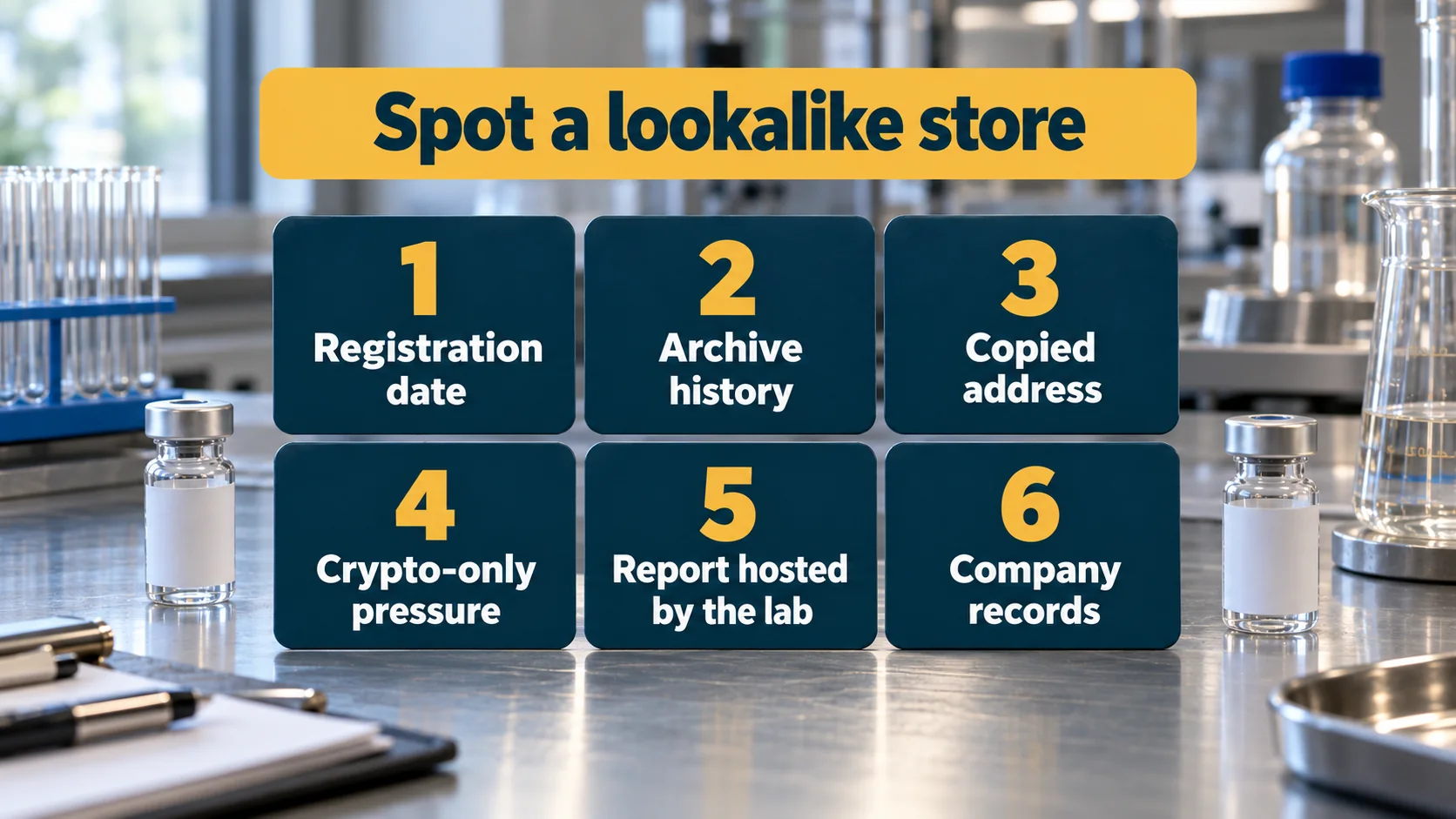
Six checks help with any storefront that claims a famous name:
- Registration date. A domain registered after March 2026 is not the original. Use a public registry lookup (RDAP) or WHOIS.
- Archive history. Open the site in the Internet Archive’s Wayback Machine and see whether the pages existed before the closure.
- Copied address. Some imitation sites copy a real company’s street address, and others use a virtual office. Check that the address, company name and registry record match, and that the address belongs to a real business.
- Payment pressure. Be careful with crypto-only checkout and with discount codes pushed through social media or affiliate pages. Finnrick found stale coupon funnels that make a closed brand look active.
- Report hosting. A lab report that lives only on the seller’s own site proves nothing. Look for one hosted by the lab.
- Company records. A real business has a name, an address and a way to reach it that match across its pages.
If you ordered from Peptide Sciences
The closure notice does not address open orders, refunds, discount codes or reward balances, and we found no primary or reputable source that does. The notice does say how to report impostor sites. Read that guidance on the company’s own page, and distrust any contact address a third party quotes.
For an order paid by credit card that never arrived, the FTC says to dispute the charge with the card issuer, and under the Fair Credit Billing Act the written dispute generally has to reach the issuer within 60 days of the first bill showing the error. For orders placed in early March, that window has probably passed. Bank transfers, payment apps and cryptocurrency are often irreversible, which is why payment method belongs on any supplier check. Keep the order emails, lot numbers and lab reports for anything you still hold.
Why research-peptide sellers are under pressure in 2026
Apart from the passing sentence in the Lilly complaint noted above, no source we found ties any of the following to Peptide Sciences. Together they show why choosing a supplier takes more care in 2026 than it did a year ago.
- FDA warning letters. FDA sent five warning letters to online peptide sellers dated August 24, 2026, after a batch dated March 31. The letters say that despite “research use only” labeling, evidence from the seller’s website shows the products are intended as drugs for human use, which makes them unapproved new drugs. FDA weighs a label disclaimer against the rest of the seller’s marketing. See our guide to peptide law and FDA status.
- Eli Lilly lawsuits. On August 12, 2026, Lilly filed six federal lawsuits against US businesses selling unapproved retatrutide: four online peptide sellers that it says falsely label the drug “research use only,” a compounding pharmacy and a medical spa. These are Lilly’s allegations, and we found no court findings.
- A federal prison sentence. On July 30, 2026, the owner of Paradigm Peptides in Indiana was sentenced to 70 months in federal prison after pleading guilty to introducing unapproved new drugs into interstate commerce with intent to defraud.
- State rules. Rules on selling and buying these materials differ by state and are changing, as are rules for clinicians and compounding pharmacies. This page is not legal advice, so ask a lawyer about your state.
Peptide Sciences alternatives: compare suppliers, do not trust a ranking
Search results for “peptide sciences alternative” are mostly ranked lists written by sellers and affiliates who earn from the ranking. Peptryn is a seller too, so we name no competitors. A reputable peptide supplier gives you facts you can check yourself, so compare any supplier, ours included, on these:
- Price per labeled milligram. A 5 mg vial at $40 costs $8.00 per mg, and a 10 mg vial at $70 costs $7.00 per mg. Add shipping, and check whether a sale price needs a code. A quantity result tells you whether the label amount is right.
- A report for the lot you receive. Results from your old supplier say nothing about a new supplier’s lot, and a report older than the lot describes a different batch.
Our supplier comparison checklist (10 points) scores a supplier on ten criteria, and the ten-minute check below is a shorter version.
What a lab report can and cannot show
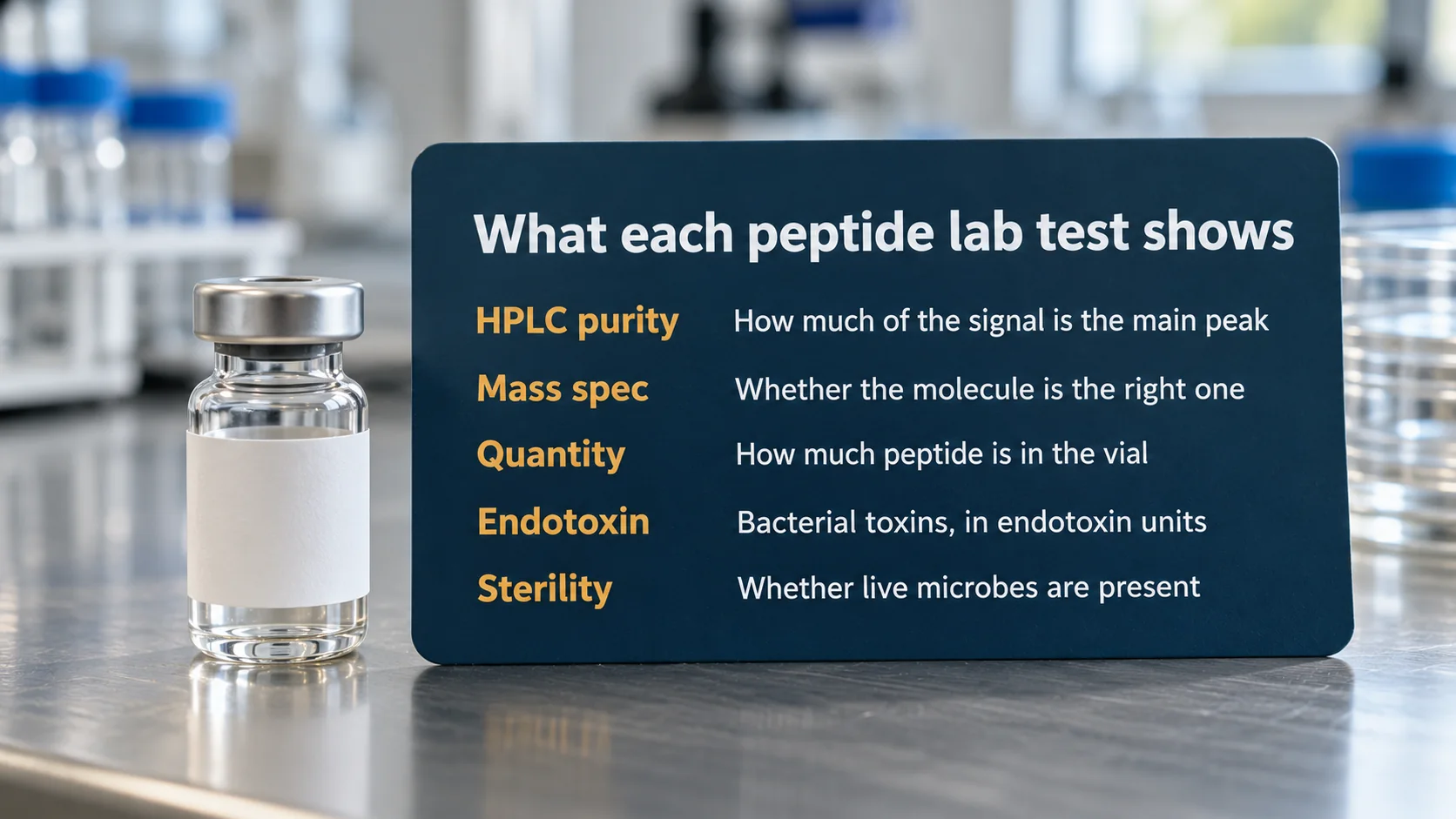
Each test answers a different question. HPLC measures purity, mass spectrometry confirms identity, a quantity assay measures how much peptide the vial holds, an endotoxin test checks for bacterial toxins, and a sterility test checks for live microbes. A report that shows one of these has answered one question. Our guides to peptide testing and how to read a certificate of analysis cover the methods.
Purity is not quantity
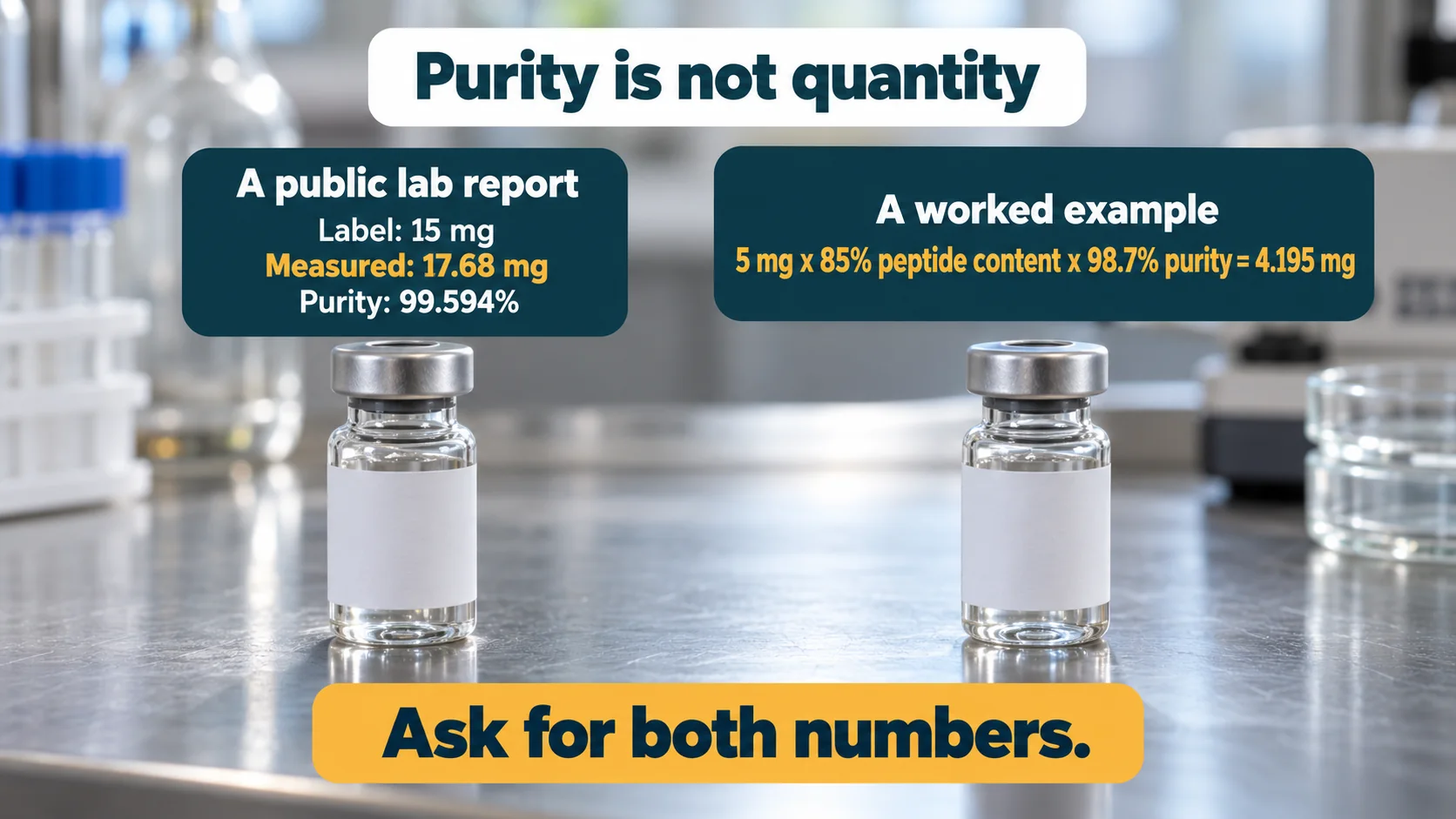
Bachem, a peptide manufacturer, gives a worked example: a 5 mg sample by gross weight with 98.7% purity and 85% net peptide content holds 4.195 mg of the target peptide. A public Janoshik report shows the reverse: a vial labeled 15 mg measured 17.68 mg at 99.594% purity, and its batch field holds only a slash. Read purity and quantity together, and tie both to a lot. See peptide purity for the counterion and net-content explanation.
Independent testing data exists, with caveats
Finnrick sells testing and rates vendors. After testing sermorelin, ipamorelin and tesamorelin samples, it concluded that quantity variance is often a bigger problem than purity. Among the 200 most recent BPC-157 tests on its product page, 92 failed Finnrick’s “purity focus” standard (at least 99.5% purity and a measured quantity within 35% of the label claim), 106 passed and 2 were incomplete. Samples come from users, from vendors and from Finnrick’s own purchases, and Finnrick says the sample tested is whatever was submitted, so these results are not a random draw. A fail is not the same as unsafe, and the figures describe the samples tested, not the market. They do support asking for quantity results as well as purity.
How to verify a lab report
A report that carries a verification feature lets you confirm it with the lab itself.
| Lab | How verification works |
|---|---|
| Janoshik | Enter a task number and a unique key at its verification page. The key is printed on the report, which also carries a QR code |
| Finnrick | Sign in or sign up, then enter a 7-character certificate ID. Its reports leave out the vendor name and batch by design, and Finnrick says to share results by URL |
| Freedom Diagnostics | Search by company name or by a code made of the first four characters of the company name plus the accession number |
| Chromate | Has a “Verify” portal on its site |
| MZ Biolabs | Reports sit on the lab’s own domain and open by certificate ID. We did not find a separate key-based verification tool |
We did not find a documented public verification feature for every lab. Check what your supplier’s lab offers.
What verification proves
It shows that the lab issued the report and lets you open the lab’s own copy to compare with the one you were given. It does not show that the vial in your hands is the one the lab tested. Finnrick states that a certificate covers only the submitted sample and carries no chain of custody, so a vendor could show a report for batch A while selling batch B. Insist on a lot or batch identifier on the vial that matches the report.
Does the lab need ISO 17025 accreditation?
It helps only when the lab’s accredited scope lists the test you need. On October 7, 2026, we searched the public A2LA and ANAB directories, and the Czech accreditation body for Janoshik.
| Lab | What the directories show |
|---|---|
| Harrens Lab | ISO/IEC 17025 accreditation, listed in the A2LA directory. The published scopes list no peptide or endotoxin tests |
| PharmLabs | Posts a PJLA ISO/IEC 17025 certificate on its own site. The scope lists HPLC testing of ten named peptides and no endotoxin test. We could not search PJLA’s directory to cross-check it |
| Krause Analytical, BTLabs, Chromate, Freedom Diagnostics, MZ Biolabs, TrustPointe, Ichor Life Sciences, Janoshik | No listing found in the A2LA or ANAB directories (or the Czech body, for Janoshik). None of the sites we could reach claims ISO 17025 for peptide testing, and TrustPointe’s site would not load |
“No listing found” does not prove a lab has no accreditation, and we could not search PJLA’s directory directly. If accreditation matters to you, ask the lab for its scope.
Fake and falsified reports: what has been reported
- A convenience-store vial. In a July 2, 2026 investigation, CBS News bought a vial sold as retatrutide for $95 at a Brooklyn convenience store. CBS reported that the certificate showed a graph that appeared to identify a different drug, and that an operations manager at the lab named on it said by email that the lab had not issued the certificate and had no client by that name.
- Paradigm Peptides. The Justice Department says the company falsely said its products were tested for quality and that its owner did not test them before sale. Several secondary reports describe forged certificates, but the Justice Department release we read describes false testing claims.
- Counterfeit labels and QR codes. Medical Dialogues, an Indian health-news site citing Nagpur Today, reported on September 9, 2026 that Maharashtra’s drug regulator allegedly found fabricated certificates of analysis and counterfeit “Peptide Sciences, USA” label designs at an export firm in Nagpur, and that the firm’s wholesale licences were cancelled. The labels carried QR codes that reportedly pointed to the genuine company’s website, and Peptide Sciences allegedly told investigators the artwork was not its own. These are allegations as reported, and we have not seen the regulator’s order.
If you still hold Peptide Sciences vials, do not treat the label or QR code as proof of origin. A lot number that matches a report hosted by a lab is the stronger signal.
A ten-minute check for a reputable peptide supplier
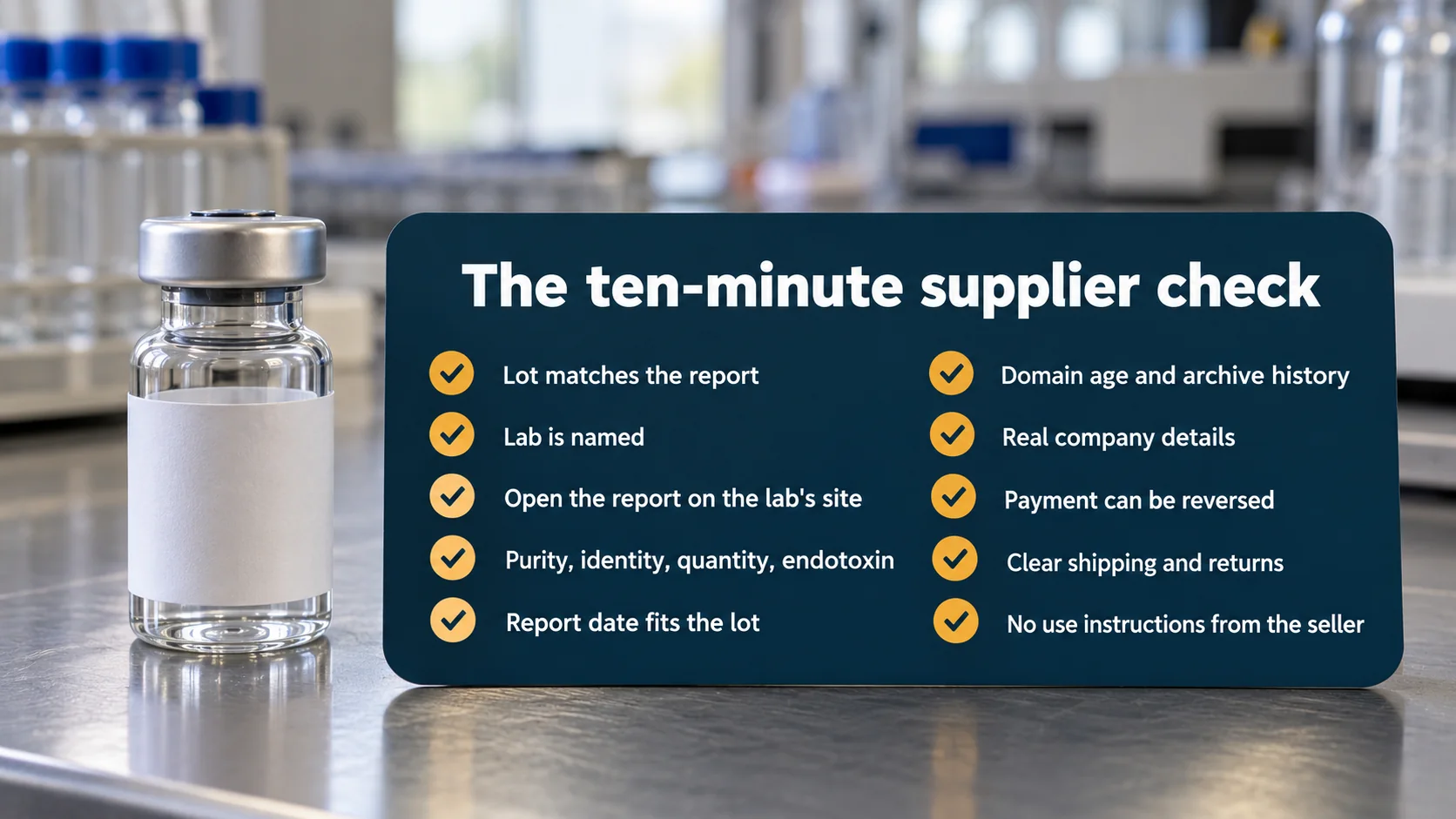
- Find the lot or batch number on the product page or vial and on the report. They should match.
- Find the lab’s name on the report, then confirm the lab exists and offers a way to verify a report.
- Open the report on the lab’s own site, not only a PDF on the seller’s.
- Read the purity, identity, quantity and endotoxin lines. If one is missing, ask why.
- Check the analysis date against the lot date. A report older than the lot describes a different batch.
- Look up the domain’s registration date and its Wayback history.
- Check for a company name, a physical address and a working support channel.
- List the payment methods and whether you can reverse a payment.
- Read the shipping and return terms for where the order ships from, what it costs and what happens if it arrives damaged.
- Be wary of any seller whose pages give use instructions, amounts or schedules, or claim that a compound has effects in people. Research materials are sold without use instructions, and this page gives none.
How Peptryn answers the same checks
We published this section so you can test our claims against the pages they come from, and we list gaps where we found them. We checked the pages on October 8, 2026.
| Check | Peptryn |
|---|---|
| Lot-specific reports | The COA Library lists 19 reports, with lot dates from June 12 to September 17, 2026. For 18 of them the certificate page links to a report for that lot on the lab’s own domain. One 30 mg listing links to a sample report from a different lot. The certificate IDs include the compound name and one or more dates, and for most listings the size. The library lists five catalog products as pending a published report and says it will send the current report on file to buyers who email an order number |
| Named third-party lab | MZ Biolabs of Tucson, Arizona, hired by Peptryn. Peptryn is the client named on the certificates. We have not independently confirmed that the lab has no ownership link to Peptryn |
| What the certificates show | HPLC-UV-MS purity and identity on every report, plus an endotoxin result on 15 of the 19 listings. Four newer listings show no endotoxin result. The endotoxin reports are MZ Biolabs PDFs hosted on peptryn.com, not on the laboratory’s own site. The laboratory certificates print a measured quantity, which Peptryn’s own certificate pages do not display |
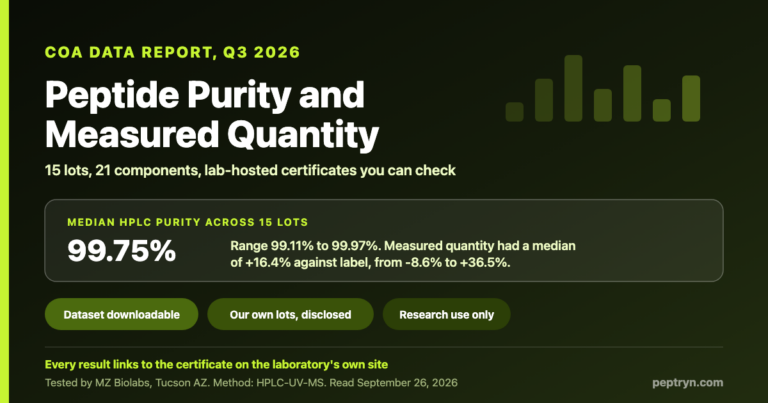
| Quantity | Peptryn’s data report of September 26 compares measured quantity with the label for 21 components in 15 lots and does not cover the four listings added or lacking a lab-hosted certificate since. The median was 16.4% above the label, 16 of the 21 were more than 10% above it, and the range ran from 8.6% below to 36.5% above. It lists open questions, including whether the quantity is net peptide or gross vial contents, and offers the full dataset as a CSV |
| Accreditation | We found no ISO 17025 listing for MZ Biolabs in the directories we searched |
| Payment | Zelle, CashApp and USDT (TRC-20). Peptryn lists no card payments, and these methods are often irreversible, so check the lot report before you pay |
| Shipping | From a US facility to US addresses only. Free over $150. Same-day dispatch before the daily cutoff |
| Damaged or incorrect orders | Contact Peptryn within 48 hours with the order number and photos. See the refund and returns policy for return eligibility |
| Company details | The contact page lists an email address and a mailing address in Chula Vista, California. It does not name a legal entity or give a phone number |
| Buyers | 21 or older. Research use only, not for human or veterinary use |
Check the lot before you decide
Read how Peptryn publishes lab reports, open a report on the laboratory’s own site where the page links one, and compare it with the product page. If something does not match, ask us.
Peptide Sciences shut down: common questions
Why did Peptide Sciences shut down?
The company has not said. Its notice calls the closure a voluntary decision to shut down and discontinue sales. We found no FDA warning letter naming it and no reputable source that gives a reason. One Lilly complaint against another seller says in passing that it shut down due to FDA enforcement pressures, citing that seller’s own marketing page.
When did Peptide Sciences close?
Peptide Sciences closed on March 6, 2026, according to archive captures and Finnrick. The first archived copy of the closure notice is dated March 8, 2026.
Is Peptide Sciences coming back?
No relaunch has been announced. peptidesciences.com shows only the closure notice, and the notice says any site claiming to be Peptide Sciences or a successor is fraudulent.
Is peptidesciences.com still online?
Yes, but only as the company’s closure notice. The domain has been registered since 2009, and on October 7, 2026 it showed the same notice archived since April.
Was Peptide Sciences shut down by the FDA?
We found no FDA warning letter naming the company in FDA’s published database, and no case in which it is a party in the records we searched. One Lilly complaint against another seller says in passing that Peptide Sciences shut down due to FDA enforcement pressures, citing that seller’s own marketing page. The company called the closure voluntary. We cannot rule out non-public contact.
Is Peptide Sciences legit?
Peptide Sciences sold research peptides online until March 2026, and this page does not assess the quality of its products. The company’s own notice says sites claiming to be Peptide Sciences, a successor or a seller of its products are unauthorized and fraudulent. The closure notice at its original domain is the only company statement we found.
Are Peptide Sciences discount codes still valid?
We found no source saying any code or credit balance is honored. Finnrick reports stale coupon and affiliate pages that make the closed brand look active, so treat any such offer with suspicion.
What are the best Peptide Sciences alternatives?
We do not rank suppliers, because a ranking from a supplier carries a conflict of interest. Compare candidates on lot-specific reports, a named lab, verification on the lab’s own site, quantity and endotoxin results, price per milligram, payment terms and company details.
How do I verify a Janoshik report?
Enter the task number and the unique key printed on the report at Janoshik’s verification page, or scan the QR code on the report. That confirms the lab issued the report and opens its own copy for comparison. It does not confirm that your vial is the one that was tested.
Is 99% purity enough?
No. HPLC purity measures the share of the main peak. It does not measure how much peptide the vial holds, whether the molecule is correct or whether endotoxin is present. Ask for identity, quantity and endotoxin results as well.
Are peptide lab reports ever fake?
Yes. CBS News reported a certificate whose named lab said it never issued it, and in a Justice Department prosecution a federal court sentenced a seller who claimed testing it did not do. Verify a report with the lab, and match its lot to your vial.
Do peptide labs need ISO 17025 accreditation?
Accreditation is granted for a defined scope. Of the ten labs we checked on October 7, 2026, two had an ISO 17025 certificate we could find: Harrens Lab, listed in the A2LA directory, and PharmLabs, which posts a PJLA certificate on its own site. Neither scope lists endotoxin testing, and Harrens’ scope lists no peptide tests. Ask a lab what its scope includes.
Is it legal to buy research peptides in the US?
Whether a sale or purchase is lawful depends on how the material is marketed and used. FDA says a “research use only” label does not control: it looks at what the seller’s website and marketing show about intended use, and it treats unapproved drugs sold for human use as illegal. State rules vary and are changing. This is not legal advice. See our guide to peptide law.
Does Peptryn sell Peptide Sciences products?
No. Peptryn is not affiliated with Peptide Sciences. Peptryn sells research materials for laboratory use only, under its own name. Its COA Library lists reports by lot for most catalog products, lists five products as pending a published report, and includes one listing that links only to a sample report.
Related: Supplier comparison checklist (10 points) · What is a COA? · Peptide testing · Peptide COA data report · Are peptides legal? · Lab results
Sources
Internet Archive. Captures of peptidesciences.com, March 6 to September 8, 2026 (closure notice versions of March 8, March 21 and April 15, 2026). web.archive.org
Finnrick Analytics. Peptide Sciences vendor page and report (July 3, 2026). finnrick.com
Verisign RDAP registry records for peptidesciences.com, peptidescienceslabs.com and peptidesciencesinc.com, retrieved October 7, 2026. rdap.verisign.com
Trustpilot. Reviews of peptidescienceslabs.com. trustpilot.com
U.S. Food and Drug Administration. Warning letters to online peptide sellers, for example Gram Peptides (March 31, 2026) and Peak Performance Peptides (August 24, 2026), and the warning-letter database. fda.gov
Eli Lilly and Company v. Lone Star Peptide Co. LLC, No. 4:26-cv-06562 (S.D. Tex., filed August 12, 2026), complaint, and Lilly’s press release on six lawsuits against retatrutide sellers, August 12, 2026. courtlistener.com and prnewswire.com
U.S. Department of Justice, Northern District of Indiana. Press release on the sentencing of Matthew Kawa, owner of Paradigm Peptides, July 30, 2026, and the case page. justice.gov and case page
CBS News. Investigation of unapproved retatrutide sold in a convenience store, July 2, 2026. cbsnews.com
Medical Dialogues. Maharashtra FDA cancels Skyline Impex licences after alleged spurious peptide export, September 2026. medicaldialogues.in
Federal Trade Commission. Using credit cards and disputing charges. consumer.ftc.gov
Bachem. Care and handling of peptides; FAQ, “What does net peptide content mean?”; and Quality control of amino acids and peptides: a guide. bachem.com and FAQ
Finnrick Analytics. How to read a certificate of analysis; Why endotoxin testing matters for peptides; Sermorelin vs ipamorelin vs tesamorelin; Verify a certificate; Testing methodology; BPC-157 product page. finnrick.com, methodology and BPC-157 tests
Janoshik Analytical. Verification page and public report, task 167355. janoshik.com
A2LA, ANAB and Czech Accreditation Institute public directories, searched October 7, 2026, and the Harrens Lab scope. a2la.org
PharmLabs. PJLA certificate and scope of accreditation L25-933-R1. pharmlabs.com
Peptryn. COA Library, lab-results page and Peptide COA data report, checked October 8, 2026. peptryn.com
For laboratory research use only. Not for human or veterinary use, and not a drug, food, dietary supplement or cosmetic. You must be 21 or older to buy.
Related: Janoshik peptide testing: how to verify a report and what “third-party tested” proves
Related: Finnrick peptide testing: how it works, what it costs and how reliable it is