BPC-157: what it is, what the research shows and how to check a vial
Research use only. Peptides supplied by Peptryn are sold strictly for in vitro and preclinical laboratory research. They are not approved by the FDA for human or veterinary use, and nothing here is medical advice, a dosing recommendation, or an instruction for self-administration. This guide summarizes the published record and what regulators have said about it.
BPC-157 is a synthetic peptide of 15 amino acids, named for “body protection compound.” It is not an FDA-approved drug. Nearly all of the published work is in cell cultures and animals, and the few human reports are small pilot studies. This guide covers what BPC-157 is, what the studies actually contain, how quickly it clears in animals, where it stands with the FDA and anti-doping agencies, and how to judge a vial’s certificate of analysis.
- What is BPC-157?
- What the published research covers
- What human data exist
- BPC-157 half-life and how it is cleared
- Regulatory status
- How to check a BPC-157 vial
- Is BPC-157 the same as TB-500?
- Common questions
- Final take
What is BPC-157?
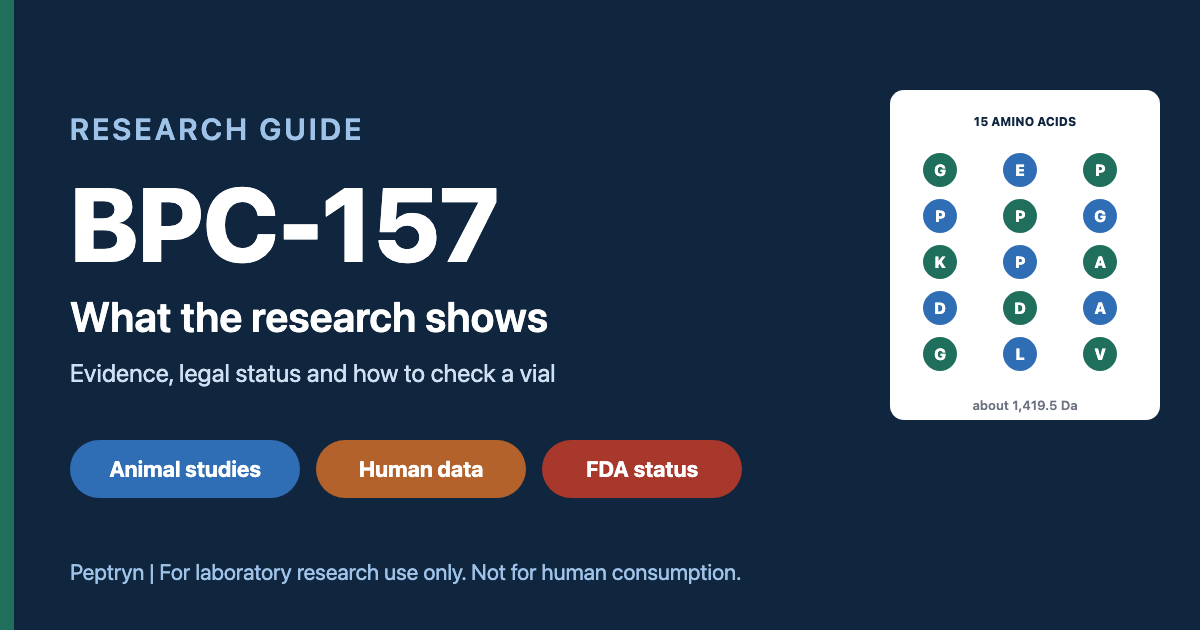
BPC-157 is a pentadecapeptide, a chain of 15 amino acids, with the sequence Gly-Glu-Pro-Pro-Pro-Gly-Lys-Pro-Ala-Asp-Asp-Ala-Gly-Leu-Val. Its molecular formula is C62H98N16O22 and its molecular weight is about 1,419.5 Da. The name comes from “body protection compound,” a protein found in human gastric juice. BPC-157 is a partial sequence of that protein, made by chemical synthesis (Gwyer 2019).
The compound was developed by a research group at the University of Zagreb led by Predrag Sikiric, and most of the early animal literature comes from that group and its collaborators. Other groups have since published on it, including work on tendon cells by a team in Taiwan and a separate pharmacokinetic study.
| Fact | Detail |
|---|---|
| Type | Synthetic pentadecapeptide (15 amino acids) |
| Formula and mass | C62H98N16O22, about 1,419.5 Da |
| CAS number | 137525-51-0 |
| FDA approval | None |
| Human evidence | Three small pilot studies, no large trials |
| Anti-doping status | Prohibited by WADA |
What the published research covers
The literature is broad but thin on independent replication. Studies report results in many tissues, but almost all of them are rodent experiments, and most were run by related research groups.
- Tendon and connective tissue. Chang and colleagues reported that BPC-157 increased outgrowth, survival and migration of tendon fibroblasts in culture (2011), and higher growth hormone receptor expression in those cells (2014).
- Muscle. Rat studies examined transected quadriceps muscle (Staresinic 2006), crush injury (Novinscak 2008) and muscle healing impaired by corticosteroids (Pevec 2010).
- Gastrointestinal tract. An early study reported effects in rats against lesions caused by non-steroidal anti-inflammatory drugs (Sikiric 1997).
- Wound models. Seiwerth and colleagues reviewed BPC-157 in wound healing models (2021).
Reviews of this body of work describe proposed pathways that include VEGFR2 signaling, nitric oxide synthesis through the Akt-eNOS axis, and ERK1/2 signaling (McGuire 2025). These are proposals drawn from animal and cell work. No one has shown that they operate the same way in people.
What human data exist
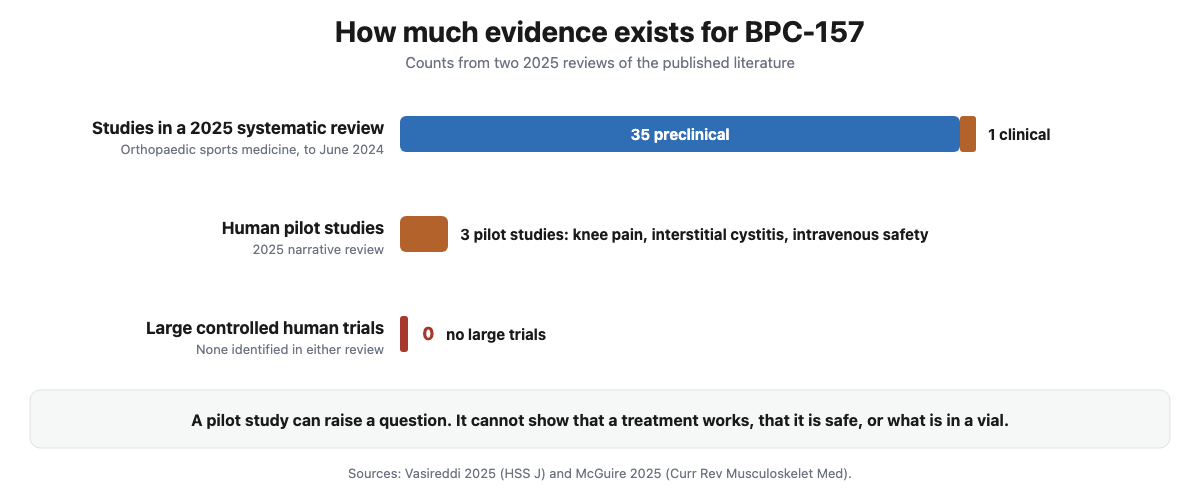
Very little. A 2025 narrative review counted three pilot studies of BPC-157 in humans, covering intra-articular knee pain, interstitial cystitis and intravenous safety with pharmacokinetics. The review noted that no adverse effects were reported and that large trials are lacking, and it concluded that BPC-157 should be considered investigational (McGuire 2025).
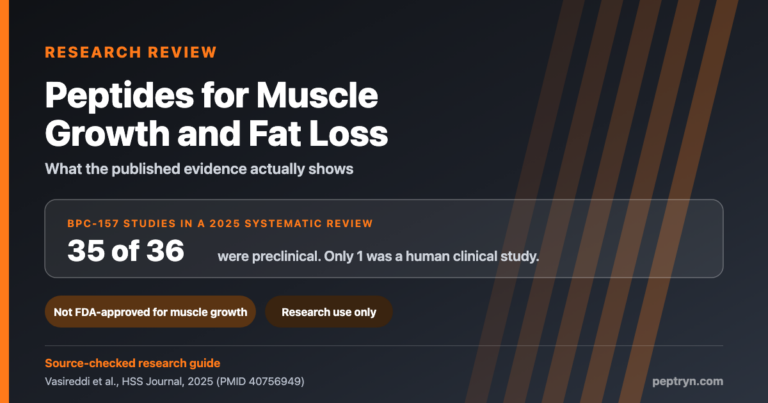
A 2025 systematic review searched PubMed, Cochrane and Embase for musculoskeletal studies. It found 544 articles, and 36 met its criteria: 35 preclinical studies and one clinical study (Vasireddi 2025).
A pilot study can raise a question. It cannot show that a treatment works or that it is safe, and it cannot show what a vial bought online contains.
BPC-157 half-life and how it is cleared
Half-life is one of the most searched questions about BPC-157, and the answer comes from one animal study. He and colleagues gave BPC-157 to rats and beagle dogs. The elimination half-life of the intact peptide was under 30 minutes, and the pharmacokinetics were linear across the doses tested. Bioavailability after intramuscular injection was about 14% to 19% in rats and 45% to 51% in dogs. Radiolabeled peptide was broken down quickly into small fragments and single amino acids, which followed normal amino acid metabolism, and excretion was through urine and bile (He 2022).
Those numbers describe rats and dogs under study conditions. The human pilot on intravenous safety and pharmacokinetics is the only human source, and a single small pilot does not settle the question for people.
Regulatory status
- FDA. BPC-157 is not an approved drug. The FDA lists it among bulk drug substances that may present significant safety risks for compounding, and says it has identified no or only limited safety information, and that the agency lacks enough information to know whether the drug would cause harm in humans. It also notes a possible immunogenicity risk for certain routes of administration. That page was last updated April 22, 2026.
- FDA advisory committee. On July 23, 2026, the Pharmacy Compounding Advisory Committee voted 8 to 6, with one abstention, to recommend adding BPC-157, KPV and TB-500 to the list of substances pharmacies may compound. An advisory vote is a recommendation. It is not an approval.
- Research use only labels. FDA warning letters issued August 24, 2026, including one to Peptide Partners LLC, rejected research-use-only disclaimers when the way a product was marketed pointed to human use. See Are peptides legal? for our review.
- Anti-doping. BPC-157 is prohibited by the World Anti-Doping Agency, and the U.S. Anti-Doping Agency has warned athletes about it. Check the current WADA Prohibited List before relying on any summary, ours included.
How to check a BPC-157 vial
A vial label tells you what the seller wants you to believe. A lot-matched certificate of analysis shows what a laboratory measured. Before you trust either, look for five things.
- The lot number matches the vial. A COA for “BPC-157” with no lot, or a lot that does not match yours, describes some other batch.
- Identity by mass spectrometry. The measured mass should match the expected molecular weight of about 1,419.5 Da.
- HPLC purity, read correctly. A figure such as 99.5% is area percent: the share of the main peak among all detected peaks. It does not say how much peptide is in the vial. Our guides to peptide purity and peptide testing explain the difference.
- Endotoxin. Bacterial endotoxin is a separate test. A purity number says nothing about it.
- A report you can verify. The strongest reports link to the laboratory’s own copy, so you are not relying on the seller’s PDF. Our guide to reading a COA covers each field.
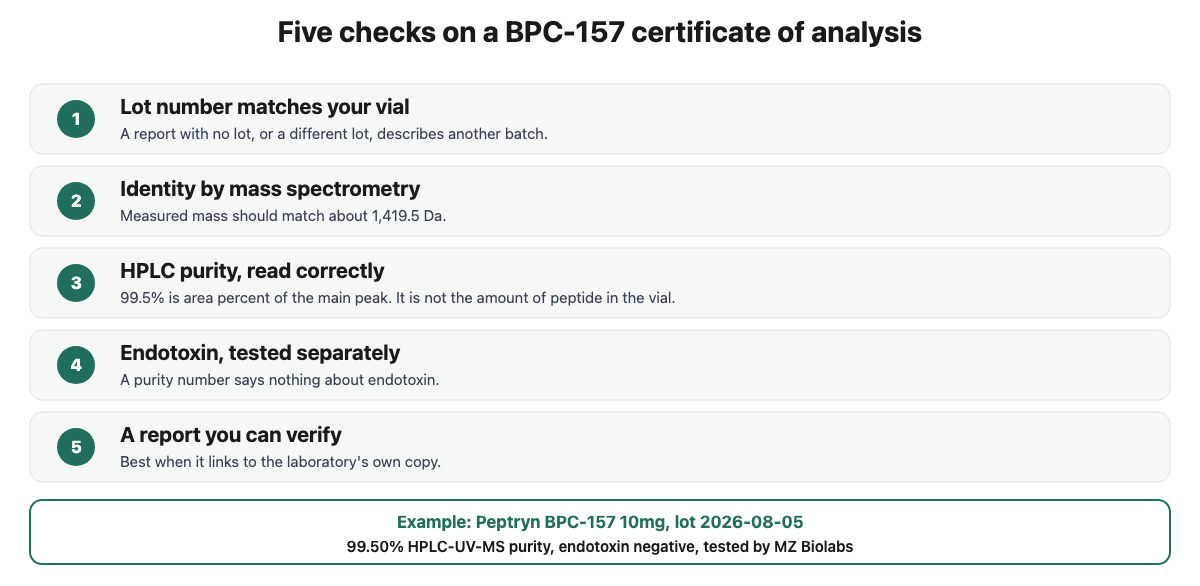
For reference, the published Peptryn report for BPC-157 10mg, lot 2026-08-05, reads 99.50% purity by HPLC-UV-MS with a negative endotoxin result, tested by MZ Biolabs. It is in the COA library, and the BPC-157 product page lists the full specifications.
Is BPC-157 the same as TB-500?
No. They are different peptides. BPC-157 has 15 amino acids and a mass near 1,419.5 Da, while thymosin beta-4, sold as TB-500, has 43 amino acids and a mass near 4,963 Da. They are often blended and discussed together. Our Wolverine peptide guide covers the blend and the evidence for each component.
Common questions
What is BPC-157?
A synthetic 15-amino-acid peptide based on part of a protein found in human gastric juice. It is not an approved drug, and it has been studied mainly in cells and animals.
Has BPC-157 been tested in humans?
Only in three small pilot studies, according to a 2025 review. There are no large trials.
What is the half-life of BPC-157?
In rats and beagle dogs the elimination half-life was under 30 minutes (He 2022). No comparable human data exist beyond a small pilot.
Is BPC-157 FDA approved?
No. The FDA lists it among bulk drug substances that may present significant safety risks for compounding, and a July 2026 advisory vote to recommend adding it to a compounding list is not an approval.
Is BPC-157 banned in sports?
Yes. It is on the World Anti-Doping Agency’s prohibited list, and USADA warns athletes against it.
Is BPC-157 legal to buy?
Sellers can offer it for laboratory research. Selling it for human use is a different matter, and FDA has acted against sellers who did so. Read our legal guide.
What does “body protection compound” mean?
It is the name given to a protein found in human gastric juice. BPC-157 is a synthetic 15-amino-acid fragment of it.
Final take
BPC-157 has a large animal literature, three small human pilots and no approval. The honest summary is that the questions are open. When you evaluate a vial, judge the paperwork: lot number, mass identity, purity read correctly, endotoxin and a report you can verify.
Sources
- McGuire FP, Martinez R, Lenz A, Skinner L, Cushman D. Regeneration or risk? A narrative review of BPC-157 for musculoskeletal healing. Curr Rev Musculoskelet Med, 2025. doi.org
- Vasireddi N, Hahamyan H, Salata MJ, et al. Emerging use of BPC-157 in orthopaedic sports medicine: a systematic review. HSS J, 2025. doi.org
- He L, Feng D, Guo H, et al. Pharmacokinetics, distribution, metabolism, and excretion of body-protective compound 157, a potential drug for treating various wounds, in rats and dogs. Front Pharmacol, 2022. doi.org
- Chang CH, Tsai WC, Lin MS, Hsu YH, Pang JH. The promoting effect of pentadecapeptide BPC 157 on tendon healing involves tendon outgrowth, cell survival, and cell migration. J Appl Physiol, 2011. doi.org
- Chang CH, Tsai WC, Hsu YH, Pang JH. Pentadecapeptide BPC 157 enhances the growth hormone receptor expression in tendon fibroblasts. Molecules, 2014. doi.org
- Gwyer D, Wragg NM, Wilson SL. Gastric pentadecapeptide body protection compound BPC 157 and its role in accelerating musculoskeletal soft tissue healing. Cell Tissue Res, 2019. doi.org
- Seiwerth S, Milavic M, Vukojevic J, et al. Stable gastric pentadecapeptide BPC 157 and wound healing. Front Pharmacol, 2021. doi.org
- Staresinic M, Petrovic I, Novinscak T, et al. Effective therapy of transected quadriceps muscle in rat: gastric pentadecapeptide BPC 157. J Orthop Res, 2006. doi.org
- Novinscak T, Brcic L, Staresinic M, et al. Gastric pentadecapeptide BPC 157 as an effective therapy for muscle crush injury in the rat. Surg Today, 2008. doi.org
- Pevec D, Novinscak T, Brcic L, et al. Impact of pentadecapeptide BPC 157 on muscle healing impaired by systemic corticosteroid application. Med Sci Monit, 2010. pubmed.ncbi.nlm.nih.gov
- Sikiric P, Seiwerth S, Grabarevic Z, et al. Pentadecapeptide BPC 157 positively affects both non-steroidal anti-inflammatory agent-induced gastrointestinal lesions and adjuvant arthritis in rats. J Physiol Paris, 1997. doi.org89474-0)
- U.S. Food and Drug Administration. Certain bulk drug substances for use in compounding that may present significant safety risks. fda.gov
- U.S. Food and Drug Administration. July 23-24, 2026: Meeting of the Pharmacy Compounding Advisory Committee. fda.gov
- U.S. Food and Drug Administration. Warning letter to Peptide Partners LLC (735063), August 24, 2026. fda.gov
- National Center for Biotechnology Information. PubChem: BPC-157. pubchem.ncbi.nlm.nih.gov
- World Anti-Doping Agency. Prohibited List (check the current edition). wada-ama.org
- Peptryn COA library, BPC-157 10mg, lot 2026-08-05. peptryn.com
All products on peptryn.com are intended for laboratory research purposes only. Not for human consumption, self-administration, or veterinary use. The information on this page has not been evaluated by the U.S. Food and Drug Administration and is not intended to diagnose, treat, cure, or prevent any disease.